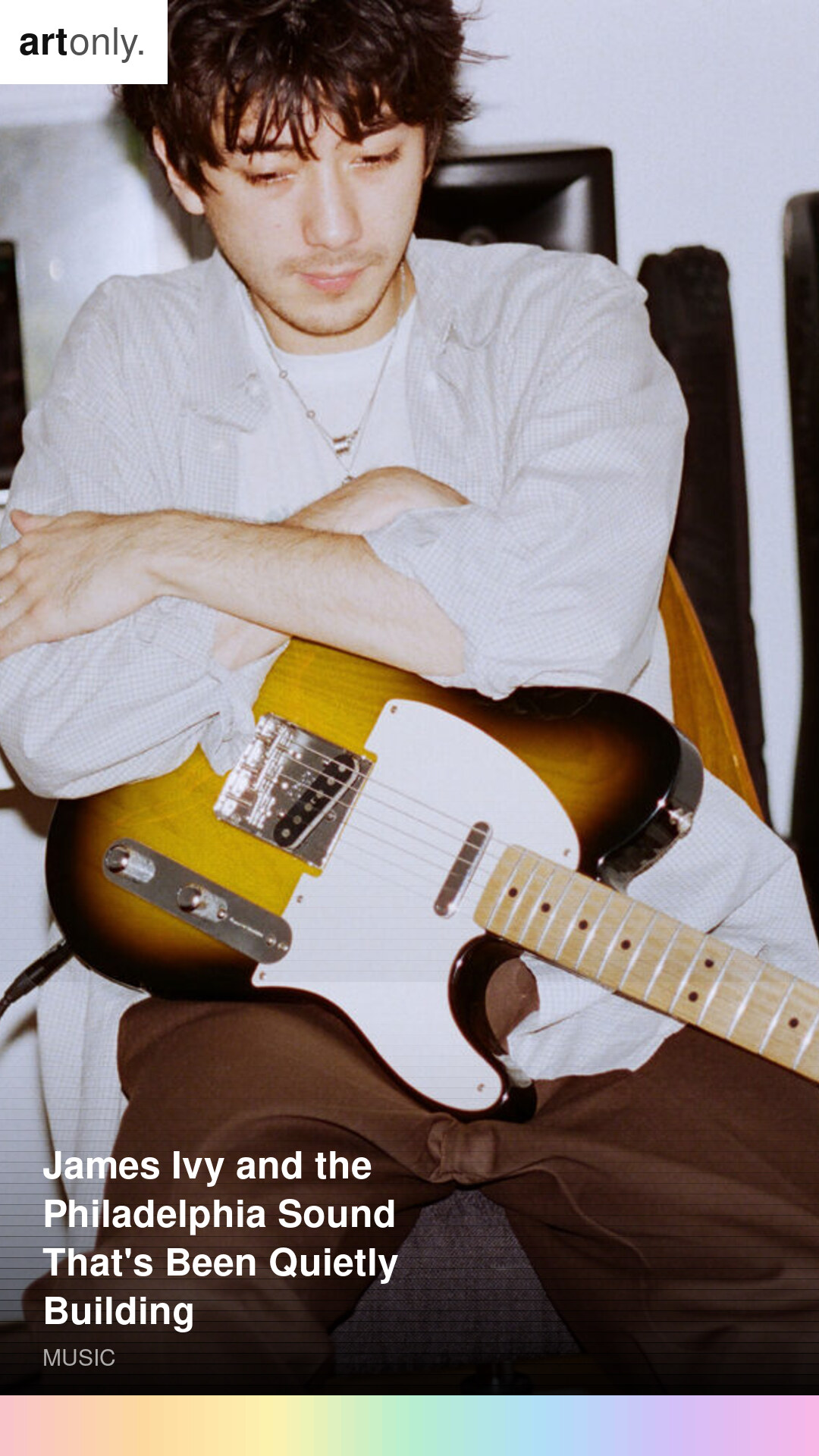
Philadelphia has a music history that tends to get reduced to its most famous exports, the Philly soul sound of the 1970s, the wave of producers who emerged from there and shaped hip-hop in the 1980s and beyond. The contemporary scene, which is vibrant and strange and producing interesting work across multiple genres, gets less attention because attention is distributed unequally between cities and Philadelphia has never had the mythology-making apparatus of New York or Los Angeles working in its favour. James Ivy is one of the reasons I've been paying closer attention.
There's something in his music that feels like it comes from a specific place without being parochial about it, rooted but open, local but with sight lines that extend outward. The production sensibility is sophisticated in a way that doesn't announce its sophistication, doesn't seem to be trying to signal its own taste. Things just sound right. Textures sit where they should. The rhythmic choices feel considered without feeling laboured.
What draws me back repeatedly is the quality of the writing. Ivy is a genuine songwriter in the old sense, someone for whom the song is the primary unit, the thing that justifies everything else. The arrangements serve the song. The production serves the song. This sounds obvious but it's rarer than you'd think. A lot of contemporary music inverts this, building elaborate sonic environments and treating the song as content to fill them.
The City in the Music
I find myself thinking about what it means for music to be of a place. Not about a place, the tourist's view, the external perspective, but of a place, soaked in it, formed by it, carrying its specific textures and rhythms and emotional registers without necessarily naming them. James Ivy's music has that quality of being formed by Philadelphia without being a postcard of it. The city is in the music the way water is in a plant, invisible in the sense of not being named, essential in the sense of being everywhere.
The Philadelphia soul tradition is audible in his work, and that connection is not superficial. The Gamble and Huff productions of the 1970s were themselves sophisticated, layered, emotionally intelligent records that combined classical string arranging with deep rhythm-section grooves and produced something entirely new. Kenny Gamble and Leon Huff at Philadelphia International Records built a template for emotional directness in pop music that still operates. Ivy knows this lineage. You can hear the respect for it in his arrangements, in his understanding of how multiple musical layers can coexist without crowding each other.
But Ivy is not an archivist. The Philadelphia reference in his music is not a costume. It's a foundation on which he builds things the 1970s did not build, that could not have been built then, that are particular to his own moment and his own sensibility. The lineage is present and so is the departure from it.
What the Songs Actually Do
The emotional register Ivy works in most consistently is one of precise ambivalence. Not the vague ambivalence that passes for depth in a lot of contemporary R&B, but something sharper: songs that hold two feelings at once without pretending they resolve into one. The arrangements mirror this. A chord that suggests resolution moves somewhere unexpected. A lyric that seems to close opens back up. The music and the words are doing the same thing.
This creates a listening experience that is genuinely re-playable. What you notice the first time is not what you notice the second time. The production is dense enough to reward return without being so busy that it exhausts attention on first contact. That balance is hard to achieve and Ivy achieves it.
On Quiet Building
The title of this post uses the word "quietly" and I want to justify it. Ivy is not unknown within the community of people who pay close attention to contemporary soul and R&B. He has followers. He has respect. What he doesn't have, yet, is the broader attention that his work merits, and the "yet" is the important word. Some artists build toward visibility through gradual accumulation, through the slow spread of genuine appreciation rather than the sudden spike of algorithmic promotion. That kind of visibility, when it arrives, tends to stick.
I've been playing his music to people with no existing context for him and watching them ask the question I asked when I first found him: how is this not already enormous? The answer is that it takes time. The better the question is, the more confidently I can say the time is coming.
In the meantime, there's the music itself, which is more than sufficient reason to be paying attention.
What I find myself thinking about is the relationship between a scene and the artists it produces. Ivy didn't emerge from nowhere. He emerged from a specific musical community, from relationships with other musicians and producers and listeners who helped form his aesthetic sensibility and gave him the context in which his particular voice could develop. The solo work is his, but the conditions for the solo work are collective. That's how it always is, even when we attribute everything to the individual. Philadelphia's music community made it possible for James Ivy to be James Ivy. That seems worth saying. The music deserves to be understood as the product of a place and a community, not just a talent.
The Gap Between Recognition and Readiness
There is a version of this situation where the absence of broad recognition is a failure of the system, and only that. The system does fail. Geography, race, the absence of a publicist with the right relationships, the luck of when a particular algorithm decided to surface a particular song: all of these things shape who gets heard and who doesn't in ways that have nothing to do with quality.
But there is also something to be said for the particular quality of music made by an artist who has not yet had to negotiate with widespread attention. The choices are purer. The compromises that come with mainstream visibility have not yet been made. Ivy's music has the specific quality of work made entirely on its own terms, because those terms have not yet been challenged by the market.
When the broader recognition comes, and the work merits it, the question will be whether he can hold onto the qualities that exist precisely because the attention hasn't arrived yet. That is the real challenge for artists in his position. The music is already there. The pressure that comes with visibility is what needs to be navigated next.