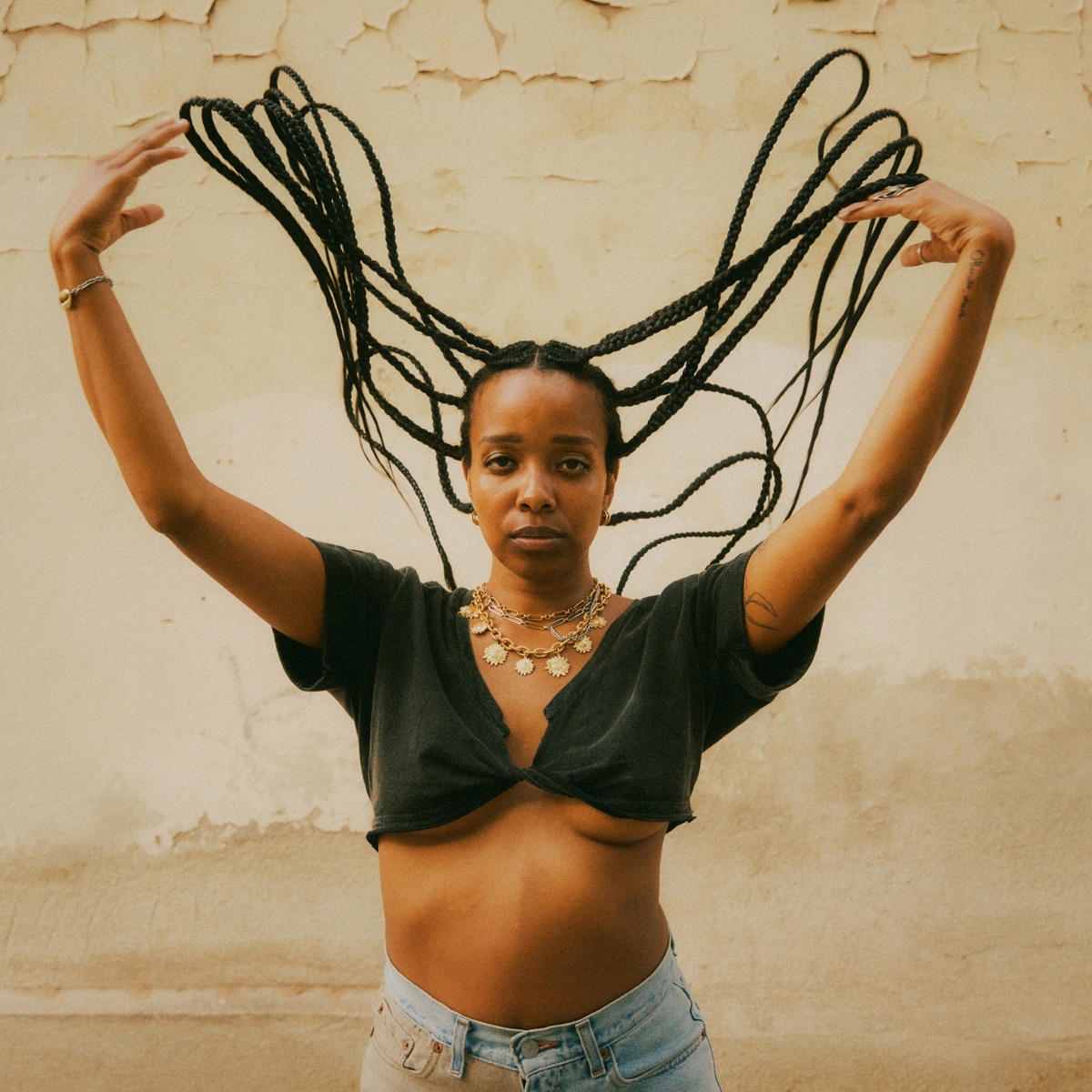
Jamila Woods doesn't write songs the way most people do. She writes poems first, then figures out the music later. The result is something that sits between lyric and melody in a way that feels entirely her own.
Her 2023 album Water Made Us is probably the best entry point. It's built around the metaphor of water, how it changes shape depending on the container, how it carries things, how it holds memory. But it never feels heavy. Woods has this way of making dense ideas feel airy. "Practice" features Saba and the two of them build something thoughtful and unhurried.
What makes Woods interesting isn't just her lyrics, though they're sharp. She's also been writing and performing poetry since before the music took over. She was the Associate Artistic Director of Young Chicago Authors for years, teaching and championing young writers in the city. That institutional commitment to other people's voices says something about how she thinks about art: not as private expression but as a social practice, something that exists between people rather than in isolation.
The Legacy Series
LEGACY! LEGACY! (2019) remains her signature work. Each track on that album is named for a specific person from Black history and culture, "ZORA" for Zora Neale Hurston, "GIOVANNI" for Nikki Giovanni, "FRIDA" for Frida Kahlo. The research is there but the music never feels like homework. It's a way of claiming heritage that feels genuinely alive.
The structural decision behind that album is worth examining. Woods chose figures who were artists and thinkers, people whose work had been either forgotten or narrowed in the cultural memory. By naming songs for them rather than about them, she creates a different kind of relation: the song doesn't explain the person, it inhabits them, takes on something of their energy, carries their presence into a new context. Zora Neale Hurston did not make soul music. But "ZORA" sounds like what Hurston made might have felt if it had been music. That's a harder thing to do than research.
The Nikki Giovanni track, "GIOVANNI," is direct where the poet it invokes is direct. It doesn't soften the reference or translate it into something more comfortable. It stays in the register of the woman it names, which is the register of someone who says exactly what she means and trusts you to handle it.
Why Restraint Is a Decision
Compared to a lot of artists making lush soul music right now, Woods operates at a smaller scale on purpose. Nothing on her records is trying to be a radio hit. That restraint is what gives the work its weight. Her debut HEAVN (2016) established that, homemade, circulated quietly, only later properly released. It's the record that built her following person by person.
"Holy" from that record is still one of her strongest moments: a slow, layered devotional that doesn't commit to any single faith but takes all of them seriously. The chord structure underneath it supports that ambiguity. Nothing resolves too cleanly. The song stays open in ways that a more conventional devotional wouldn't allow itself to stay open.
The Chicago thing matters too. The city shows up in her work not as a backdrop but as a living part of the music, a place with its own literary tradition, its own political history, its own way of carrying loss. Chicago has a Black literary culture that runs from Gwendolyn Brooks forward, and Woods is in that line as much as she is in any musical lineage. The poetry-first process is not incidental to the music. It is the architecture the music lives inside.
The Live Dimension
Woods' live performances add a dimension that the recordings gesture toward but can't fully contain. She works with bands that understand the gospel and soul lineage in her music at a structural level, not as decoration. The rhythm sections play with the deliberateness her writing requires. The backup arrangements create space for the voice to do what studio versions can only approach.
The performance context also allows her poetry practice to be visible in a different way. Between songs, in interviews, in the way she talks about her work, Woods makes explicit the connection between the written word and the musical form that the records leave implicit. The songs are poems that found their music. Understanding that changes how you hear them. The formal ambition in the lyrics is not just wordplay but a poet's understanding of line, breath, pause, and the way a sentence can turn and mean something different at its end than it seemed to mean at its beginning.
Chicago audiences who have followed her from HEAVN onward have watched a specific kind of artistic development: an artist who knew exactly what she was doing from the beginning and has been deepening it since. That continuity is rare. Most careers involve at least one significant pivot. Woods' career has been a long elaboration of an original vision.
What Consistency Costs
She's one of the more consistent artists working in this space right now. Every record has a clear reason to exist. That's harder than it sounds. Consistency of this kind requires saying no to many things: to genre trends, to feature requests that don't fit, to the version of expansion that means losing specificity. Woods has made those refusals and the records are sharper for it.
Water Made Us marked a movement from the named-subject structure of LEGACY! LEGACY! toward something more internally personal, still formally ambitious but organized around a felt experience rather than a research project. The shift is not a retreat. It's a deepening. The same intelligence that went into the historical reclamation of the previous album turns here toward the interior, and the interior proves equally rich.
The water metaphor earns its place across the entire album rather than functioning as an opening conceit that the record then abandons. Each song finds a different property of water to inhabit: its capacity to hold temperature, its tendency to move around obstacles rather than through them, the way it takes the shape of what contains it without losing its own nature. This is the kind of structural thinking that comes from writing poetry first. A songwriter building a concept album might find a metaphor and deploy it for color. A poet finds a metaphor that has enough interior complexity to sustain extended examination, and then examines it.