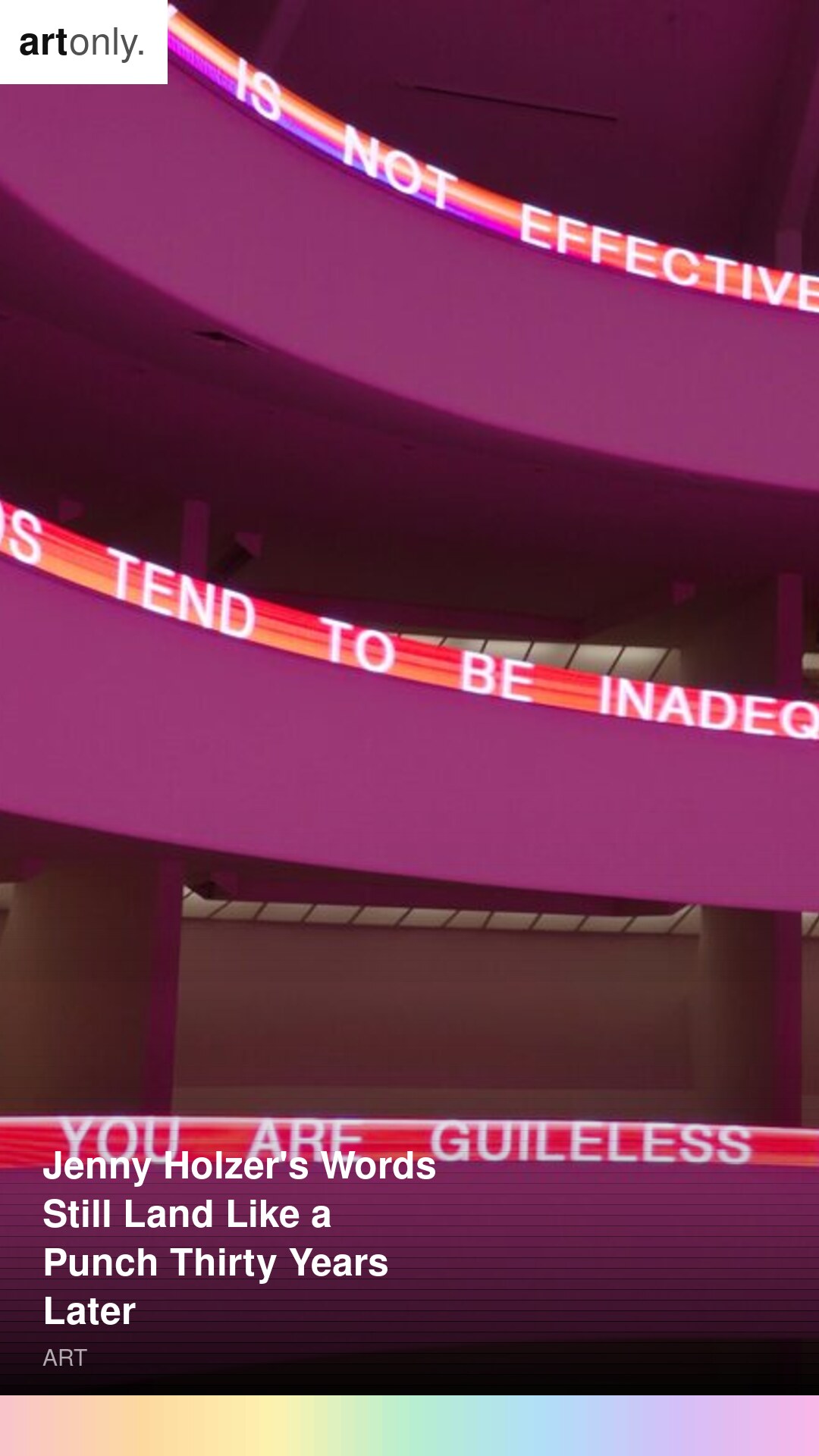
The Truisms started in 1978, a series of one-line statements that Jenny Holzer printed on posters and flyered around Lower Manhattan, anonymous statements that looked like advertising and were something else: 'Abuse of power comes as no surprise.' 'It is in your self-interest to find a way to be very tender.' 'Protect me from what I want.' These sentences, encountered on the street without context, author, or clear intent, operated on passersby in ways that advertising can't quite manage, because they weren't selling anything.
Four and a half decades later, the Truisms appear on LED signage in major institutions, on monumental buildings, in books and prints and countless online reproductions. They have been so thoroughly absorbed into visual culture that it's easy to forget they were once anonymous, were once discovered rather than installed. The discovery quality, the sense of a message arriving from outside the authorized channels of communication, was partly what gave them their force.
I've been thinking about whether they still have that force, whether the institutionalization of work that was originally insurgent necessarily domesticates it. This is a question for all art that moves from margins to centers, but it applies particularly acutely to work like Holzer's, which depends on the context of encounter for part of its meaning.
What Survives Canonization
Here is my answer, arrived at after standing in front of Holzer's work recently at a major retrospective: yes, some of it still lands. The force has changed, it arrives through different channels now, but the sentences themselves retain something.
'Abuse of power comes as no surprise' is not a statement that ages badly. It does not become less resonant in a moment when abuses of power are visible everywhere. The fact that it's on an LED board in a gallery rather than a flyered lamppost doesn't fully dissolve the puncture it creates, even if the puncture is smaller.
What survives canonization, I think, is the quality of the sentences themselves, the way they're written, the precision, the willingness to use the language of advertising and the voice of authority to say things that authority doesn't usually say. That formal quality is independent of context, though context shapes how it's received.
The later works, the Inflammatory Essays, the Living series about mortality, the war and violence works, have a different register and different relationship to their context. The 'Laments' were written during the AIDS crisis and speak of death with a directness that is still difficult. The war-related projections onto government buildings in various countries during the early 2000s were genuinely risky acts of political speech.
The Sentences Themselves
Holzer has described her process as beginning with an observation about how authoritative language behaves, how it achieves certainty, how it closes off questioning. The Truisms mimic that certainty at the level of form, the declarative sentence, the absolute statement, while filling it with content that either undermines authority or exposes its contradictions. 'Money creates taste' sounds like something a business school professor might say approvingly. Read in a different register, it is an indictment of the relationship between capital and culture so compact it barely takes up space.
That double valence is not accidental to the work. It is structural. The sentences are written to function simultaneously as sincere statement and critique of sincere statement. The reader decides which reading to take, and then finds both readings available simultaneously, and that simultaneity is where the discomfort lives.
Some of the Truisms have not aged well, and that's worth saying too. A handful feel more like provocations than observations, sharper in 1978 than they are now. But the core ones, the ones that have entered common usage, the ones that appear on protest signs and Twitter bios, remain formally perfect. They are sentences that have earned their permanence.
The Inflammatory Essays as Escalation
The Truisms were followed by the Inflammatory Essays, and the step between them is instructive. Where the Truisms operated through individual declarative sentences, the Essays deployed paragraph-length rhetoric in the visual style of political pamphlets: twelve by twelve inch posters, printed in one of twenty colored inks, pasted in sequences along walls and surfaces. The language was drawn from extremist rhetoric across the political spectrum, structured to be formally identical regardless of ideological origin.
The argument the Essays made was specific: the most violent political language operates through the same formal mechanisms whether it comes from the revolutionary left or the authoritarian right. The cadences of incitement are universal. By placing these texts in physical proximity to each other, printed in the same typeface at the same scale, Holzer collapsed the apparent distance between them and forced the question of whether formal structure rather than content was doing the political work.
This is a harder, riskier move than the Truisms. The Truisms could be read as wise. The Essays demanded that readers sit with language that was designed to produce action, to generate the specific kind of persuasion that has historically preceded atrocity. Holzer's decision to reproduce that language was not neutral and was not received as neutral. It remains the most confrontational work in a practice built on confrontation.
The Problem With Great Art
There's a problem with work that becomes great in the institutional sense: the greatness becomes its frame, and the frame can contain what was once uncontainable. You come to Holzer with the information that she's important, that her work is significant, and you see it through that frame rather than against it.
I keep trying to encounter the sentences the way someone might have encountered them on a lamppost in 1979, without the frame, without the authorization. The attempt is only partially successful. But even partially successful is enough to feel what the sentences do when they land without protection.
Thirty years later. Still landing. Still some of them true in ways that make you wish they weren't.
The history of public text art in the decades since Holzer established her practice has been shaped by what she demonstrated was possible. The idea that language could be deployed in public space not as advertising or wayfinding but as art, as a thing that acts on passersby in ways that other art cannot, that arrives without the frame of gallery or museum, has been developed by artists working in her wake.
The Truisms are the originals. Knowing that doesn't diminish what they do. Some of them still arrive like a hand on the shoulder, like someone has said the thing that needed saying. 'Protect me from what I want,' thirty years old and still, somehow, exactly right.