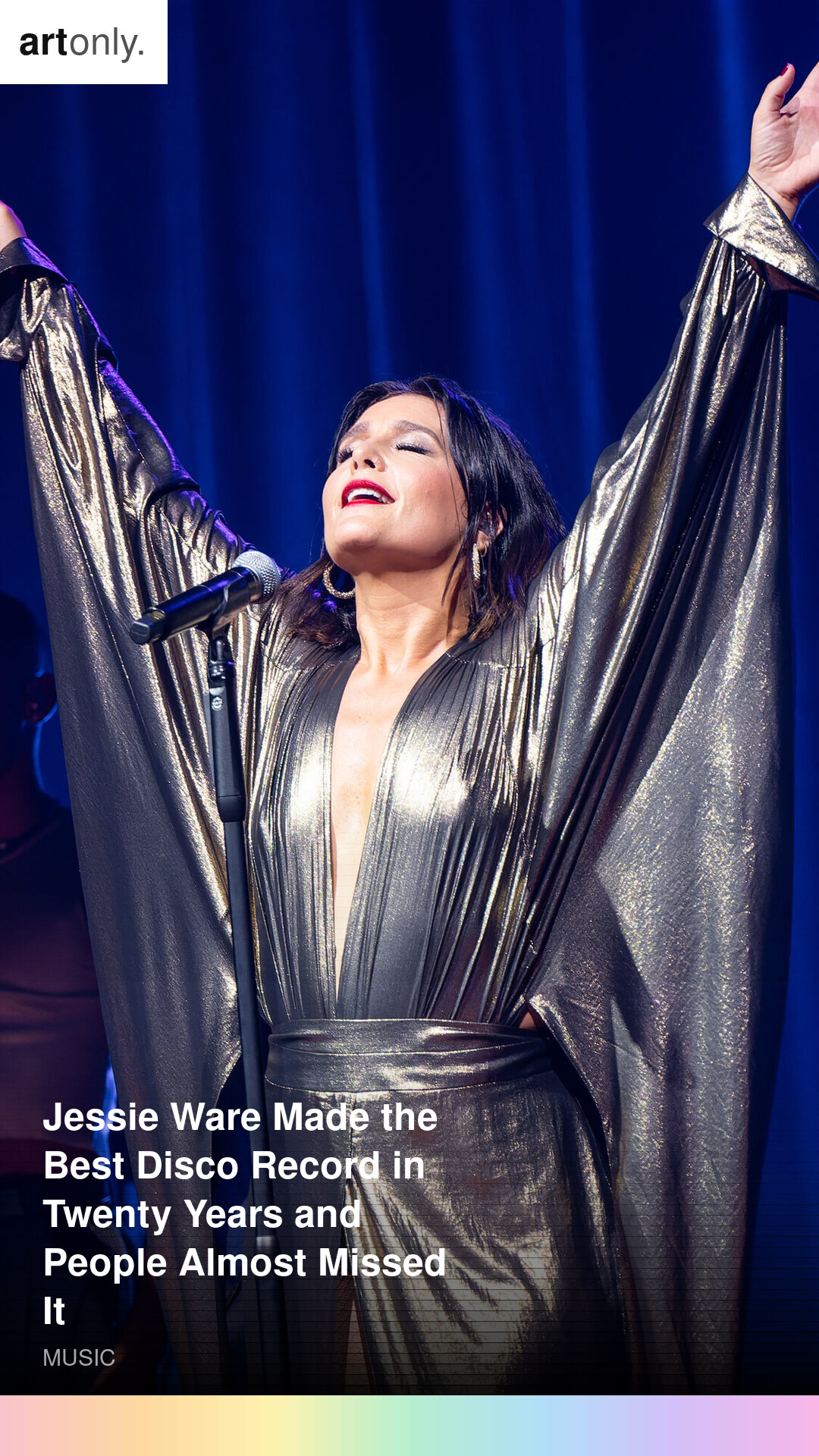
I have a theory about records that arrive slightly ahead of their cultural moment. They either get ignored or they become cult objects before they get canonised, the delay itself becoming part of the mythology. What's Your Pleasure? came out in 2020 at possibly the worst moment for a disco record about physical joy and collective abandonment. The pandemic had made clubs illegal, made dancing with strangers an act of genuine risk. I know people who kept it on repeat through lockdown with the discipline of someone maintaining a practice, keeping a flame alive against the possibility that the world might eventually allow them to use this music for what it was designed for.
Jessie Ware had already made three albums, one of them (Tough Love) very good, but none of them prepared me for the scale of ambition on What's Your Pleasure?. This is a record that knows exactly what it is. It's not pretending to be something more important than a great disco album. But a great disco album, properly considered, is actually quite important. It is a piece of social architecture, a set of instructions for how bodies in a room can stop being individual and start being something else, something looser and more animal and more free.
The Craft Is in the Pleasure
What James Ford brought to the production, and Ware's own involvement in the songwriting, which is sharper here than anywhere before, is a kind of production intelligence that sounds effortless precisely because it is so thoroughly worked out. The hi-hats sit exactly where they need to sit. The bass guitar has the particular low-mid weight that makes hips move before the conscious mind has registered what's happening. The strings never over-emote; they accent and retreat with the cool elegance of session players who've played in rooms where Chic records were being made.
And Ware's voice, which I'd always admired but never quite loved, does something on this album that I didn't know she had in her. She sounds liberated. Not in the clichéd sense of a press release. In the literal sense of someone who has found the room they were meant to be singing in and is now finally singing in it. There's a quality on "Ooh La La" and "Step Into My Life" that sounds like complete inhabitation. She's not performing these songs. She's living them.
James Ford's production work on this album deserves specific credit beyond the general acknowledgment it received. Ford came up through Simian Mobile Disco and has production credits across a wide range of artists, but What's Your Pleasure? represents his most sustained engagement with the disco idiom. The key decision, audible from the first bars of the album, is to build the arrangements around live rhythm sections rather than programmed beats. The groove is human-placed, slightly imperfect at the micro level, and that imperfection is what makes it irresistible. Programmed disco sounds like an argument about what disco should have been. This sounds like the thing itself.
The Almost-Miss
The "almost miss" of the headline is real and worth dwelling on. The timing was cruel. The critical response was positive but not ecstatic. There's a particular form of critical hedging that happens with women making pop music, where the word "fun" gets used as a slight compliment that's also a diminishment, where pleasure gets coded as less serious than difficulty. Fun is not easy. Making music that makes people feel good is one of the hardest things you can do in music, and the historical record of who gets credit for it and who doesn't tracks uncomfortably well with gender.
The live show that followed, when the world opened back up, became one of those events that people who attended speak about with a particular quality of insistence, the way you talk about something you want to have been there for. I was not there. I've watched enough footage to be genuinely envious. The conversion of What's Your Pleasure? from a headphones-in-lockdown experience to a room-full-of-bodies-moving experience must have been something close to cathartic.
Ware also released a companion album, Glasshouse (2017), before this one, that showed a different kind of ambition: orchestral, more overtly emotional, less interested in function than in feeling. The gap between that record and What's Your Pleasure? is the gap between an artist exploring and an artist who has found the precise territory that fits her. The exploration was necessary. But the arrival is something else.
Two years on from its release I find myself returning to this record in a way I don't return to most things. It has aged, if anything, into greater certainty, confident in what it is, unbothered by what it isn't, still making me want to move.
The case for What's Your Pleasure? as one of the great pop records of its decade doesn't require hedging or qualification. It's a record that knows what it wants to do and does it with the kind of complete execution that is almost never available the first time you attempt something in a new register. Ware found her register and filled it completely. The world eventually caught up. It was right to.
What the Sequel Confirmed
Ware released That! Feels Good! in 2023 as the companion and continuation of What's Your Pleasure?, and the decision to extend rather than pivot confirmed that the 2020 record was not an accident or an experiment but a discovery. That! Feels Good! leans further into the Italo disco and Hi-NRG influences that were present but submerged on its predecessor. It is louder, more overtly joyful, less interested in the tension that gives What's Your Pleasure? its particular quality.
The second album is good. It is not better. But its existence clarifies what was at stake on the first one: Ware found something on What's Your Pleasure? that no amount of continuation could replicate, because part of what made it extraordinary was the discovery itself. The restraint, the productive tension between the genre's conventions and her own more emotionally complex instincts as a singer, the particular quality of a record made during a period of forced stillness, these are not conditions that repeat.
What That! Feels Good! confirms is that the register she found is genuinely hers, that she is not leaving it. The quality of the first record in that register remains the standard. That standard is high.