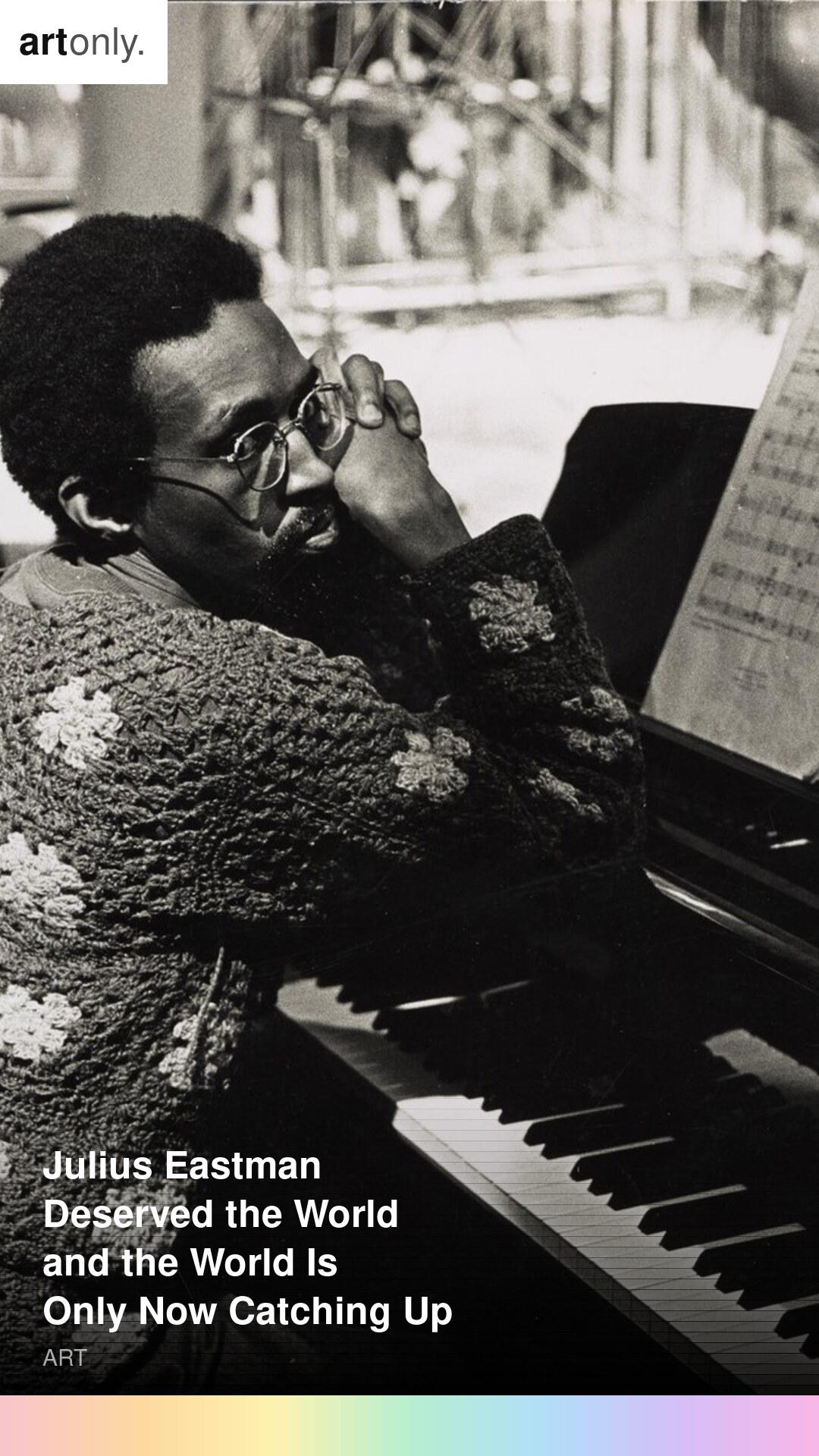
Julius Eastman died homeless in 1990, his music largely lost, his reputation dissipated, his existence so thoroughly erased from the record of American music that the exact date of his death was unknown for years. He was a Black, gay, avant-garde composer and performer who was building one of the more extraordinary bodies of work in American minimalism and was destroyed, by addiction, by homelessness, by the indifference of institutions that might have helped, by the specific brutality the world reserves for people who are poor and Black and queer and don't play by any of the rules.
The recovery of his work, the finding of scores in dumpsters outside Carnegie Hall, the reconstruction from recordings and memories of people who knew and performed with him, the gradual reintroduction of his music into the concert repertoire, is one of the more remarkable stories in contemporary classical music. It has been gathering pace over the past decade and accelerated significantly around 2022, when several major performances and recordings of his work reached wide audiences.
The pieces that have been recovered and reconstructed are extraordinary. The titles Eastman gave his major works, deliberately provocative and reclamatory, are quoted here as part of understanding the work and the politics. The major pieces comprise long, hypnotic, intensely physical works for multiple pianos and other instruments that operate in a zone somewhere between minimalism and gospel, between academic composition and something rawer.
What the Music Actually Does
I've been sitting with performances and recordings of Eastman's work for a few years now and each encounter adds something. These pieces are long, the major works run forty minutes to an hour, and they require a different kind of attention than most contemporary concert music. They build slowly, obsessively, with a kind of grinding intensity that's physical rather than cerebral.
The minimalist tradition Eastman was working within, the tradition of Glass and Reich and Young, produced work that is often described as meditative, as inducing a kind of trance state. Eastman's minimalism is angrier. There's a rage in it that the transcendental minimalists don't have, a quality of insistence that feels different from the cool repetition of his contemporaries.
This might be what the lost decades did, the specific experience of being Black and gay in 1970s New York, of navigating the avant-garde and its own hierarchies and exclusions, of being brilliant and visible and then suddenly not. The music carries something about what that costs. Not as autobiography but as structure.
The physical quality of the works is underappreciated in most critical writing about Eastman, which tends to focus on the conceptual and biographical dimensions. But what these pieces do to a room, to the bodies in a room, is their most fundamental achievement. Multiple pianos playing in overlapping but non-identical patterns generate a kind of acoustic pressure that is more like standing in weather than sitting in a concert hall. The experience is environmental before it is intellectual.
The Titles as Argument
Eastman's decision to title his major works with language that the concert music world was not prepared to accommodate was not incidental. It was the argument made visible. The titles forced institutions and presenters to either commit to the work in full, including its insistence on the reality of the Black, gay, poor, marginalized experience, or to look away. Many looked away during his lifetime. The titles remain as a record of that choice and its cost.
Some institutions programming Eastman's work now have attempted to navigate around the titles by describing them rather than printing them. This is a failure of nerve that Eastman's work explicitly refuses. The titles are the work as much as the notes are the work. They are his insistence on full legibility, on not being performed in polite half-measures.
The Catching Up
The institutions that are now performing Eastman's work and writing about his significance are the same kinds of institutions that failed him during his lifetime. There's a complicated relationship to sitting in a concert hall hearing his music performed well, knowing the story of how it was lost.
But the catching up is still better than not catching up. The music deserves to be heard. The people who hear it deserve to encounter it. The record of American music is more accurate when Eastman is in it.
The specific timing of his rediscovery, during a moment of broader reckoning with whose work gets preserved and whose legacy gets maintained, makes sense. He's being recovered because the questions his life and work raise are the questions the culture is asking.
He deserved better than the world gave him. The world is only now understanding what it lost.
The musicians who have been playing Eastman's work in recent years, the performers who have committed to learning and reconstructing it, who have made performances that allow new audiences to encounter it, are doing something important that goes beyond the individual performances. They're building the knowledge infrastructure that allows the music to persist. They're answering, in practical terms, the question of what we do after the catching-up.
We play the music. We make it available. We insist that it stays in the conversation. That insistence is the ongoing act. Eastman deserved better from the world that was his contemporary. We owe the world that comes after the chance to know what he made.
The Performers Who Made Recovery Possible
The recovery of Eastman's work did not happen automatically. It happened because specific musicians committed their time and skill to learning and reconstructing pieces that existed only in fragmentary form. Julius Eastman Gay Guerrilla, the ensemble named for one of his works and dedicated to performing his music, has been central to this. Individual pianists who trained in the minimalist tradition recognized in Eastman's work something they needed to learn and made performances that allowed new audiences to encounter it for the first time.
Mary Jane Leach's archival work in the 1990s, gathering scores that had been discarded and making them available, was the foundation on which the subsequent performance revival was built. Leach had known Eastman personally and understood that what was being lost was not just music but a specific artistic consciousness, a set of choices made by a specific person at a specific moment that could not be reconstructed from general principles.
The Frozen Reeds label's recording of Evil Nigger, Gay Guerrilla, and Crazy Nigger by the ensemble of pianists assembled for the purpose stands as the definitive document currently available. Listening to it is the closest most people outside major cities will get to the experience the work is designed to produce. It is not the same as being in the room. It is still extraordinary.