There are music videos and then there are events. FATHER, the Kanye West and Travis Scott collaboration from Ye's twelfth studio album Bully, is an event.
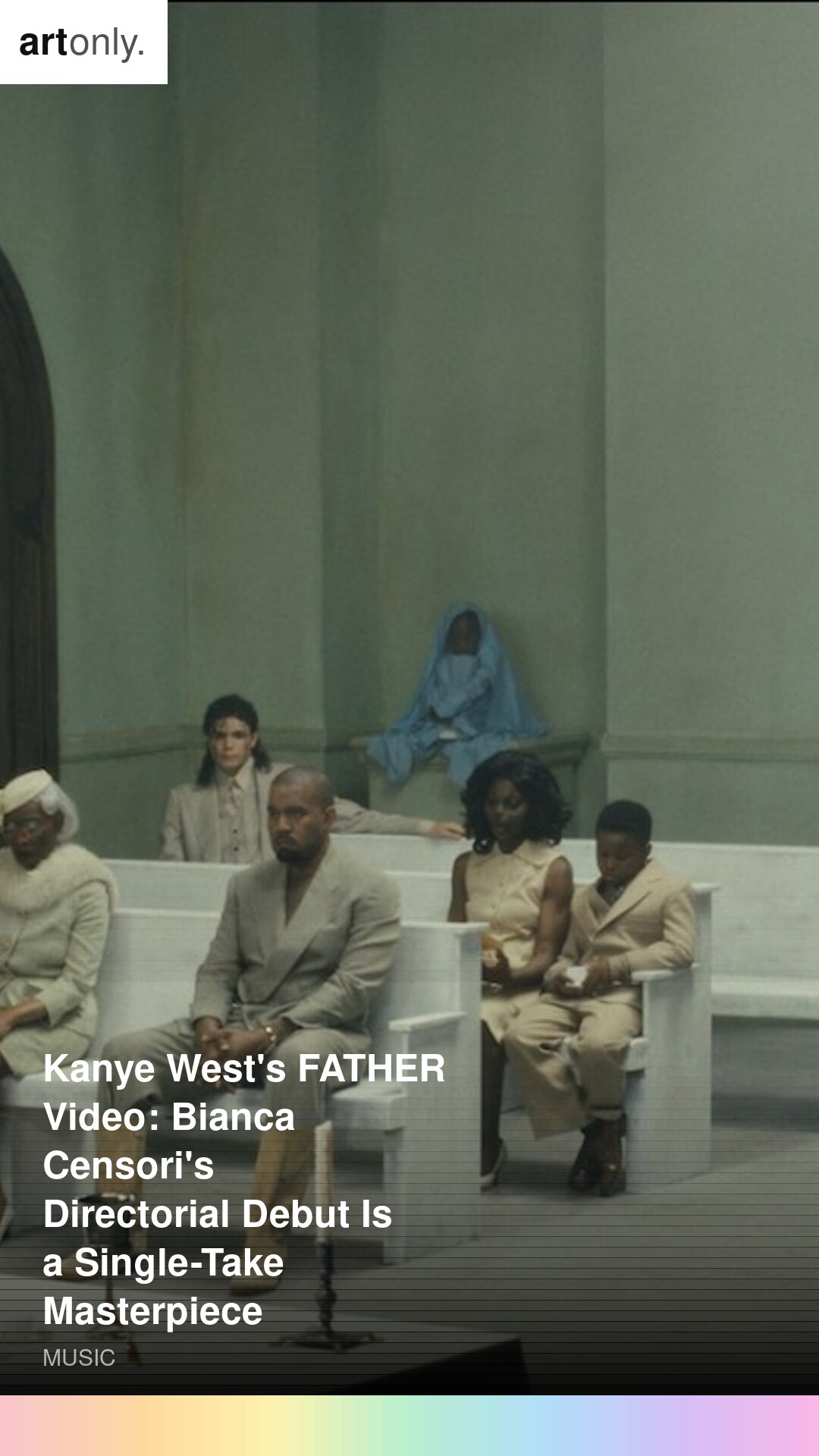
Directed by Bianca Censori in her filmmaking debut, the video is shot in a single continuous take with zero cuts. Set inside a minimalist, earth-toned church, it unfolds like a dream sequence that refuses to let you look away. Ye sits in a gray suit and stone-colored cowboy boots, stoic and still, while increasingly surreal scenes erupt around him.
The Vision
Censori's background is in architecture, not film, and it shows in the best possible way. The video is constructed as a spatial experience rather than a narrative one. The church is not a backdrop. It is the work. Every element, the lighting, the depth of the single continuous shot, the deliberate pacing, treats the frame as a room you inhabit rather than a screen you watch.
The events that unfold are deliberately dreamlike: an attendant's card tricks burst into flames. A police squad accompanied by a plate-armored knight on horseback arrests a nun and carries her out. A pageant queen is carried down the aisle. Two astronauts arrive and unmask Ye, revealing him as something extraterrestrial. Travis Scott appears in a wedding scene. Every image is loaded, symbolic, and open to interpretation.
The single-take technique is not a gimmick here. It is a statement of commitment. There is nowhere to hide in a continuous shot. Every transition, every entrance, every moment of choreographed chaos has to land in real time. The fact that it works, that the video maintains its tension and visual coherence for its entire runtime without a single edit, is a technical achievement that most seasoned directors would struggle to execute.
Censori as Director
Bianca Censori has described the project as a natural extension of her work in spatial design and performance art. The architectural thinking is evident: the video's composition treats the church interior as a series of spatial relationships, with Ye as the fixed point around which everything orbits.
This is not a vanity credit. The directorial voice is distinct, confident, and fully realized. Whatever else one thinks about the surrounding discourse, the visual work speaks for itself. Censori has announced herself as a filmmaker with a perspective that is genuinely different from the music video mainstream.
The Details
The production quality is meticulous. The costume design ranges from austere to fantastical. The knight in plate armor. The astronauts. The contrast between Ye's stillness and the motion around him. These are choices made by someone who understands that the power of a single frame comes from the tension between what moves and what does not.
FATHER is from Bully, Ye's twelfth studio album released March 28, 2026, featuring production from Ye, Travis Scott, Andre Troutman, Sheffmade, Che Pope, and Jahaan Sweet.
The Verdict
FATHER is one of the most visually ambitious music videos released in 2026. The single-take format, the architectural direction, the density of symbolic imagery, it demands repeated viewing. Whatever your position on Kanye West as a public figure, the creative output here is undeniable.
Bianca Censori made a music video that functions as installation art, performance piece, and cinematic short simultaneously. For a debut, that is extraordinary.
The Architecture of Music Video as Art Form
The single-take music video has a lineage worth acknowledging. Michael Jackson's Thriller established the template of the music video as short film. Michel Gondry expanded it into surrealist territory. Chris Cunningham pushed it toward body horror and industrial dread. The tradition of treating the music video as a vehicle for serious visual ideas rather than commercial product promotion is long and distinguished.
FATHER's single-take construction recalls the long-take tradition in cinema, the work of directors like Aleksandr Sokurov, whose Russian Ark was shot in a single ninety-minute take through the Hermitage, or the tracking shots in Alfonso Cuarón's films that use continuous movement to create spatial immediacy. Applying that technique to a four-minute music video compresses the stakes. Every second of a ninety-minute film has room to recover from a near-miss. Every second of a four-minute video does not.
Censori understood this constraint and designed the video around it. The church interior functions as a stage set whose geography is revealed gradually through the movement of figures rather than through camera movement. Ye's stillness is the fixed point around which this geography organizes itself, and the escalating strangeness of each new arrival is calibrated so that the viewer's attention never drifts even though the camera never cuts away to help.
Bully in Context
Ye's twelfth album arrived under conditions that guaranteed saturation-level discourse irrespective of its quality. The music, whatever its reception, operates now in an environment where the figure making it generates so much ambient noise that the work itself risks being inaudible. FATHER is the clearest demonstration on Bully that the work can still cut through, and the reason it cuts through is precisely because the visual component demands a different kind of attention than a streaming play.
You cannot passively consume FATHER. The single-take format forces sustained engagement. Censori's architectural compositions do not yield their meaning in a glance. You have to stay with it, track the spatial logic, and follow the symbolic thread. That demand is itself a statement. It argues that whatever else is happening around this artist, the work still requires and rewards the kind of attention that art is supposed to generate.
The comparison point is not other music videos. It is film scoring work like Daniel Lopatin's for Marty Supreme, where the visual and sonic components achieve a symbiosis that makes either element lesser on its own. FATHER works because Censori and Ye are working toward the same image rather than separately producing components that are later assembled. That coherence of vision is detectable, and it is the video's most lasting quality.