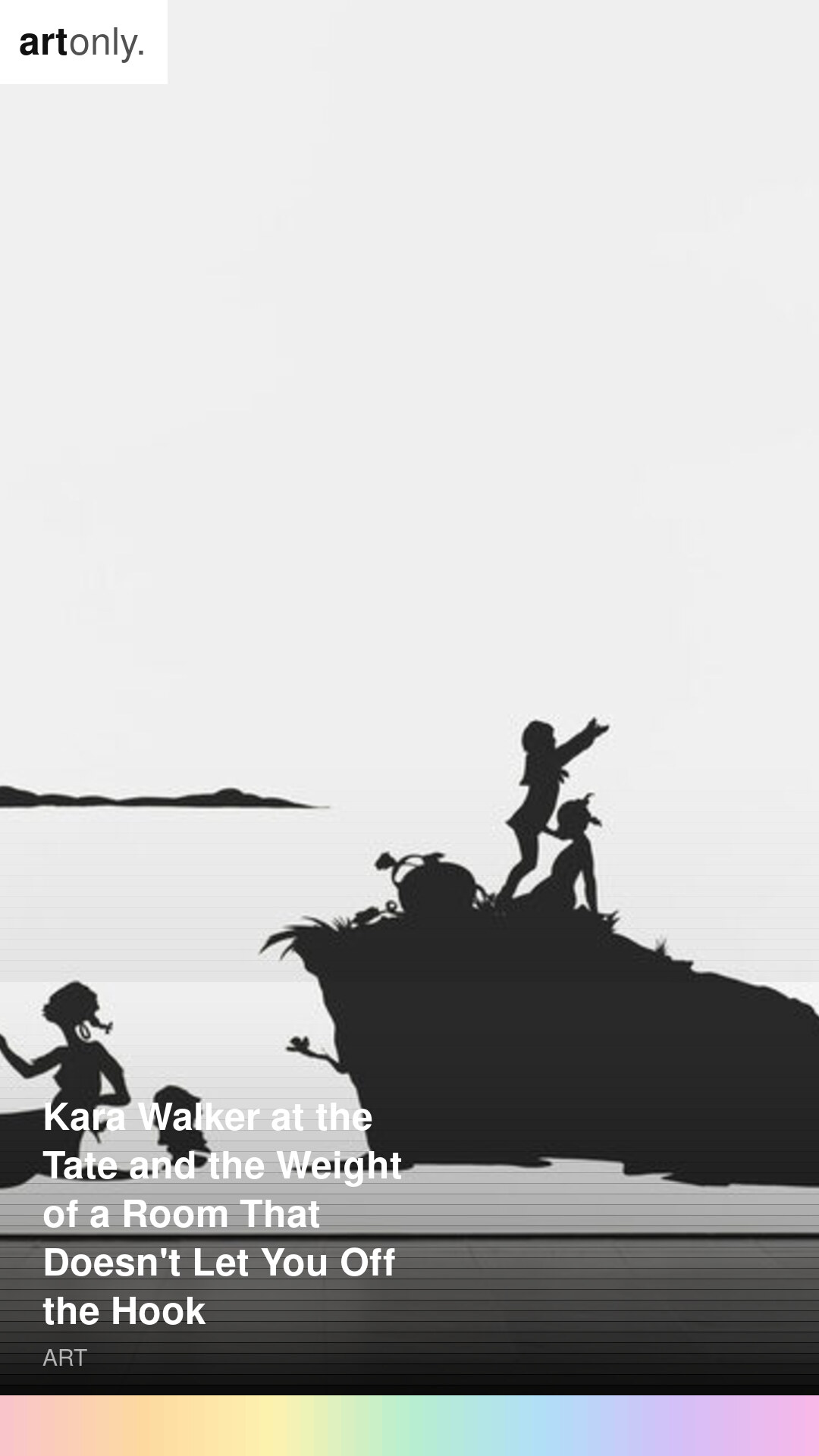
The first thing that happens when you enter a room containing Kara Walker's work is a readjustment of your own body in relation to the images. There is a physical response before there's an intellectual one, a slight catch, a repositioning, the kind of instinctive response you have to something that your nervous system registers as requiring attention before your mind has processed why.
Her Tate show in 2023, a major survey that gave her work the institutional scale it demanded, was one of those exhibitions where the curatorial decisions were secondary to the experience of the art itself. You could think about the hang, the sequence, the choices about adjacency, but mostly you were just in the presence of things that refused to let you maintain the aesthetic distance that gallery visits often allow.
Walker works primarily in silhouette, cut-paper black figures against white backgrounds, and the formal choice is itself a statement. The silhouette has a history in American portraiture that is bound up with questions of race and representation, with the reduction of subjects to outline, with the violence of flattening a person to their shadow. She takes this form and uses it to represent the history of racial violence and subjugation in American slavery, and the combination of beautiful formal clarity and deeply troubling content is what produces the discomfort that her work is known for.
The Beauty Problem
There is a legitimate tension in Walker's work between formal beauty and the horror of its content, and it's a tension she courts rather than resolves. The silhouettes are gorgeous, precise, elegant, compositionally sophisticated, rewarding of close formal attention. And they depict atrocities. The beauty and the horror coexist without mediation.
This makes some viewers uncomfortable in a way that goes beyond the obvious discomfort of the subject matter. The beauty feels like complicity, as if enjoying the formal qualities of the work is participating in the aestheticization of something that shouldn't be aestheticized. Walker has addressed this in interviews with characteristic directness: the discomfort is the point, the complicity is the point, the question of what you're doing when you find this beautiful is exactly the question she wants you to be asking.
The Tate show presented works across her career in a sequence that demonstrated how consistently she has held to this formal and ethical strategy. Early works and recent works share the same essential approach, the silhouette, the complex and sometimes explicit sexual violence, the tableau drawn from the history of American slavery, and the consistency is itself a statement. This is not a young artist's provocation that will be tempered by time. It is a sustained project.
The installation work has become increasingly monumental over her career, the Turbine Hall installation at Tate Modern in 2014 being the most famous, and the survey included documentation and related works that allowed you to understand the trajectory toward that scale. Monumentality is not usually associated with cut paper. Walker found a way.
The Nineteenth Century as Present Tense
Walker's consistent use of nineteenth century imagery, plantation settings, antebellum dress, the visual grammar of a period she was not alive for, is a formal position as much as a historical one. She is arguing that the past is not past in any useful sense, that the imagery of slavery and its violences is not safely historical but structurally present in how America understands itself and is understood by others.
The silhouette as a form reinforces this. Silhouette portraiture had its popular peak in the late eighteenth and early nineteenth centuries, before photography made cheap portraiture available. It is a period form. By using it to depict scenes of violence and subjugation from that same period, Walker collapses the distance between historical representation and contemporary encounter. You are not looking at documents. You are looking at images that operate on you now, that ask something of you now, using a visual form that belongs to then.
This is why the Tate show was not merely a career retrospective. It was an argument about time, about what history does and does not make distant, about the specific failure of aesthetic distance when the subject is still producing effects in the present.
What the Hook Is
The hook in my headline is the moral one, the sense of implication, of being caught in something, of the work not allowing you the clean separation of viewing. You leave Walker's work still thinking about what you just experienced, still sitting with the questions she raises, still not sure what the right relationship is to having found it beautiful.
I don't think there's a resolution to that. I think the irresolution is where the work lives and where it demands that you live too, at least while you're in the room.
The weight of that room stays with you. It's supposed to.
The work travels. It reaches people who weren't in the room at Tate, who see it in other contexts, who encounter it in reproduction and then seek out the experience of the actual object. The scale of Walker's reach, the places her work has gone, the conversations it has generated, is evidence that the discomfort it produces is not the kind that drives people away but the kind that keeps them engaged, that requires processing.
You don't get off the hook. That's the work. That's the agreement she makes with whoever walks through the door.
The Graphic Novel as Extension
Walker has extended her practice into other two-dimensional forms, including illustrated texts and works on paper that place her figures in different relationships with language and narrative. These works are less discussed than the silhouettes but illuminate the range of her formal thinking. She is not constrained by the cut-paper form; she uses it because it is the most powerful vehicle for this particular argument.
The works on paper tend toward a more fragmented, less compositionally unified visual field, closer to the sketch or the working note than to the finished tableau. They show an artist for whom the image is always a thought in progress, always testing itself against the difficulty of the subject matter. The silhouettes, by contrast, have the quality of conclusions, of arguments that have been arrived at through a process the viewer is not shown. The two modes together describe a practice that is at once systematic and intuitive.
Her video work, which includes pieces like 8 Possible Beginnings or: The Creation of African-America (2005), brings the silhouette form into motion and time, allowing sequences that the static frieze cannot produce. A figure that moves is a different argument than a figure that is fixed. Walker uses both modes with precision, and the Tate survey gave audiences the chance to see the range of formats within which the central formal and ethical commitment remains constant.
The consistency across forms is what the retrospective format makes legible. Individual works seen in isolation can be received as singular provocations. Seen together across a career, they constitute an argument, a sustained position about what American history is and what it continues to do to American bodies.