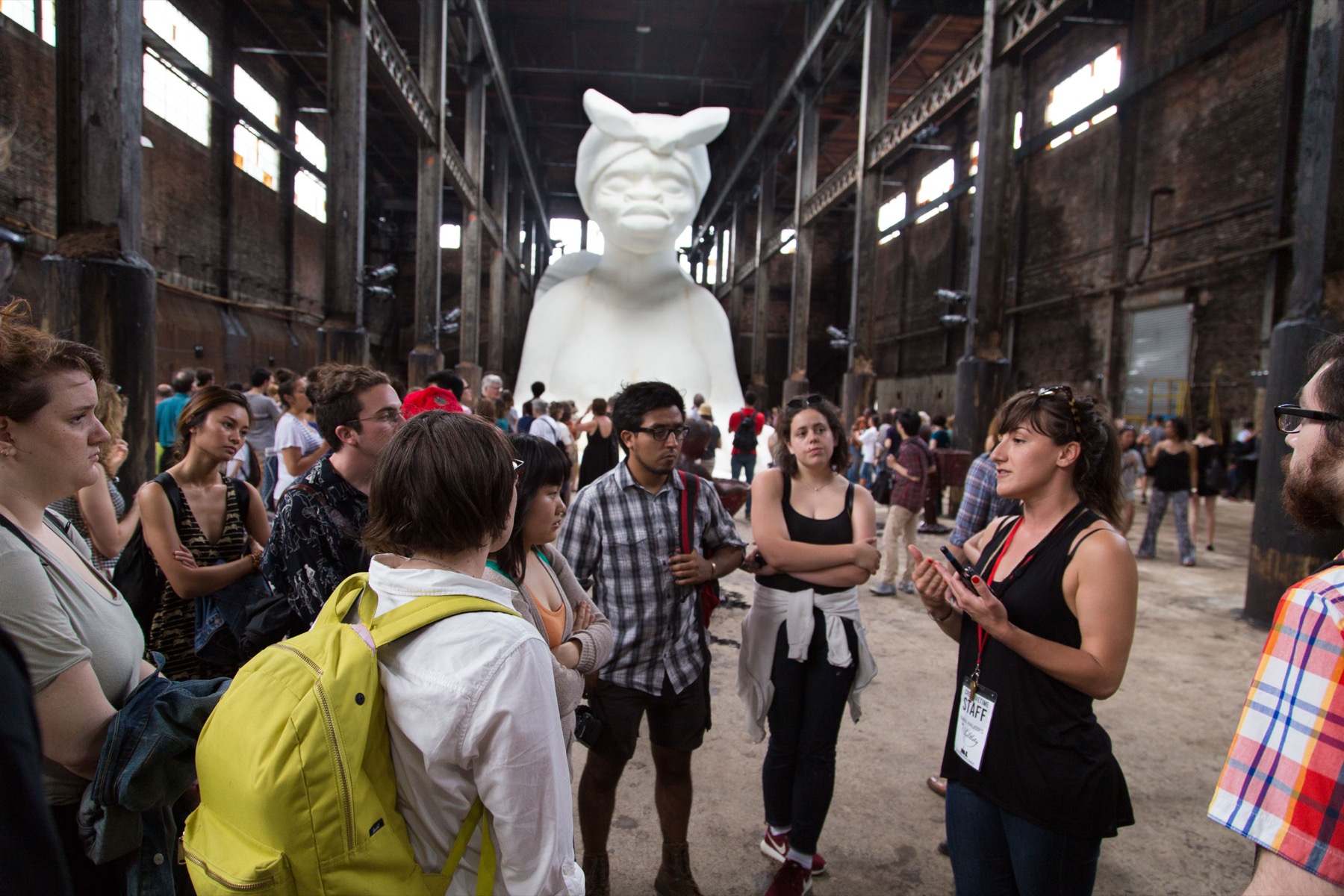
In the summer of 2014, visitors to the abandoned Domino Sugar Factory in Williamsburg, Brooklyn stood inside a vast, crumbling industrial shell and looked up at something that defied easy description. At the far end of the building, nearly 75 feet long and 35 feet high, was a sphinx. She was made of refined white sugar, coated with resin. Her features referenced the mammy figure of American racial iconography, broad and exaggerated. She was monumental. She was nude. She was looking directly at you.
Around her, on the factory floor, were a series of smaller figures, dark brown and melting, their forms made of hardened molasses and sugar and resin. They were boys, some of them carrying baskets, some of them in postures of service. In the summer heat, some of these figures were actively dissolving, their shapes changing slowly across the weeks of the installation's run.
This was A Subtlety, or the Marvelous Sugar Baby, an Homage to the unpaid and overworked Artisans who have refined our Sweet tastes from the cane fields to the Kitchens of the New World on the Occasion of the demolition of the Domino Sugar Refining Plant, by Kara Walker. The full title is as deliberately excessive as the work itself, a rolling indictment dressed up as a historical plaque.
Sugar as Evidence
The choice of material was not decorative. The Domino Sugar Factory was built in 1882 and for most of the twentieth century was the largest sugar refinery in the world. The sugar industry in the Americas was built almost entirely on enslaved African labor. Walker selected the site and the medium with full awareness of this history, using the very substance that was the product of that labor to construct a monument to the people who produced it.
Refined white sugar is itself a transformation. The raw cane is dark, fibrous, complex. The refining process strips away everything but the sweetness, producing something pure-looking and uniform. Walker's sphinx is blinding white. The irony is built into the material: the whiteness of the sugar, the whiteness associated with purity and refinement, produced by the labor of Black people whose own humanity was systematically erased by the same economic system that craved sweetness.
The mammy figure that Walker draws on is a specific piece of American racial mythology, the devoted, self-sacrificing Black domestic servant, a figure designed to make white Americans comfortable with their dependence on Black labor. Walker blows this figure up to the scale of ancient Egyptian monuments, which is its own commentary. The sphinx as a form references one of the oldest civilizations on earth, one located in Africa. The mammy as sphinx is not simply a critique. It is a reclamation of scale and power.
The Silhouette Practice
Walker's work before and after A Subtlety is built primarily around a different medium: black paper cut into silhouettes and mounted on white gallery walls. She began making these works in the mid-1990s, and they caused immediate controversy when she first showed them. Some critics, including prominent Black artists and intellectuals, argued that her imagery was irresponsible, that her use of racial caricature and depictions of violence gave ammunition to racist viewers.
Walker pushed back, and the debate she provoked was itself a kind of demonstration of what her work does. The silhouette is a form with a specific history. Popular in the eighteenth and nineteenth centuries, silhouettes were considered a democratic art form because they required no expensive pigments, only skill with scissors and paper. They were also frequently used to represent Black figures in caricature, reducing human beings to outlines.
Walker reclaims the form and fills it with scenes that the official historical record preferred to omit. Her panoramic works show plantation life with an unflinching specificity: the violence, the sexual exploitation, the mundane horror of a system that required the total subjugation of one group of people for the comfort of another. The scenes are rendered in a visual language that can initially read as whimsical, the silhouette's inherent abstraction working against easy identification of what is being depicted. That dissonance is deliberate.
The Particular Genius of the Format
What makes Walker's silhouette practice formally extraordinary is the relationship between flatness and content. Silhouettes are, by definition, without depth. They are shadows. They have outline but no interior. This flatness mirrors the historical flattening of Black life in American cultural and legal history, the reduction of complex human beings to categories, to property, to labor units, to stereotypes.
Walker's figures are recognizable because they draw on recognizable types, but they are always doing something that the type was never supposed to do. They are agents in their own stories, sometimes as victims, sometimes as perpetrators, often as both simultaneously. The moral complexity of her imagery refuses the comfort of clear victim and villain designations, which is one reason the work remains controversial and one reason it remains so important.
Her large-scale works often stretch across entire gallery walls, demanding that the viewer move through them rather than take them in from a fixed position. The experience is more like reading than viewing, though the literacy required is not textual but historical and visual. You need to know the references to read the layers, but even without that knowledge, something of the work's weight arrives.
Documentation and the Question of Who Was Looking
One of the unexpected dimensions of the A Subtlety installation was the documentation it generated. Because the work was free and open to the public, and because the Domino Factory site was photogenic and the sphinx was genuinely spectacular, thousands of visitors came and photographed themselves with it. Many of these photographs ended up on social media. Some of them showed visitors making sexual gestures toward the sphinx or the smaller figures, or mugging for the camera in ways that were, to put it plainly, racist.
This secondary archive became part of the conversation around the work. Walker has said she anticipated this outcome and was not surprised by it. The way viewers interacted with the figures, the way they posed with them, the way some chose to document their encounter with an artwork about enslaved labor, revealed something about the present tense that all the historical framing in the world could not have demonstrated as efficiently.
Art about difficult history always risks the audience deflecting from the difficulty. A Subtlety made that deflection visible and made it part of the record.
Three Decades of Necessary Discomfort
Kara Walker is now in her mid-fifties and has been making work for over thirty years. She has received a MacArthur Fellowship, shown at virtually every major museum in the world, and become one of the most discussed figures in contemporary American art. None of this has made her work easier or more comfortable, which is perhaps the best thing that can be said about an artist working in this territory.
Her project, at its core, is the project of making American history visible in its full dimension. Not the sanitized version, not the nostalgic version, but the actual history, with its actual content and its actual consequences that are still being lived with today. She does this with extraordinary visual sophistication, with formal rigor, with humor that is never quite comfortable, and with a willingness to sit with complexity that is rare in any art form.
A Subtlety was demolished along with the factory at the end of its run. The sugar sphinx was not meant to be permanent. Monuments to the people it honored were never built. Walker made one, briefly, out of the substance of their labor, and then it was gone.