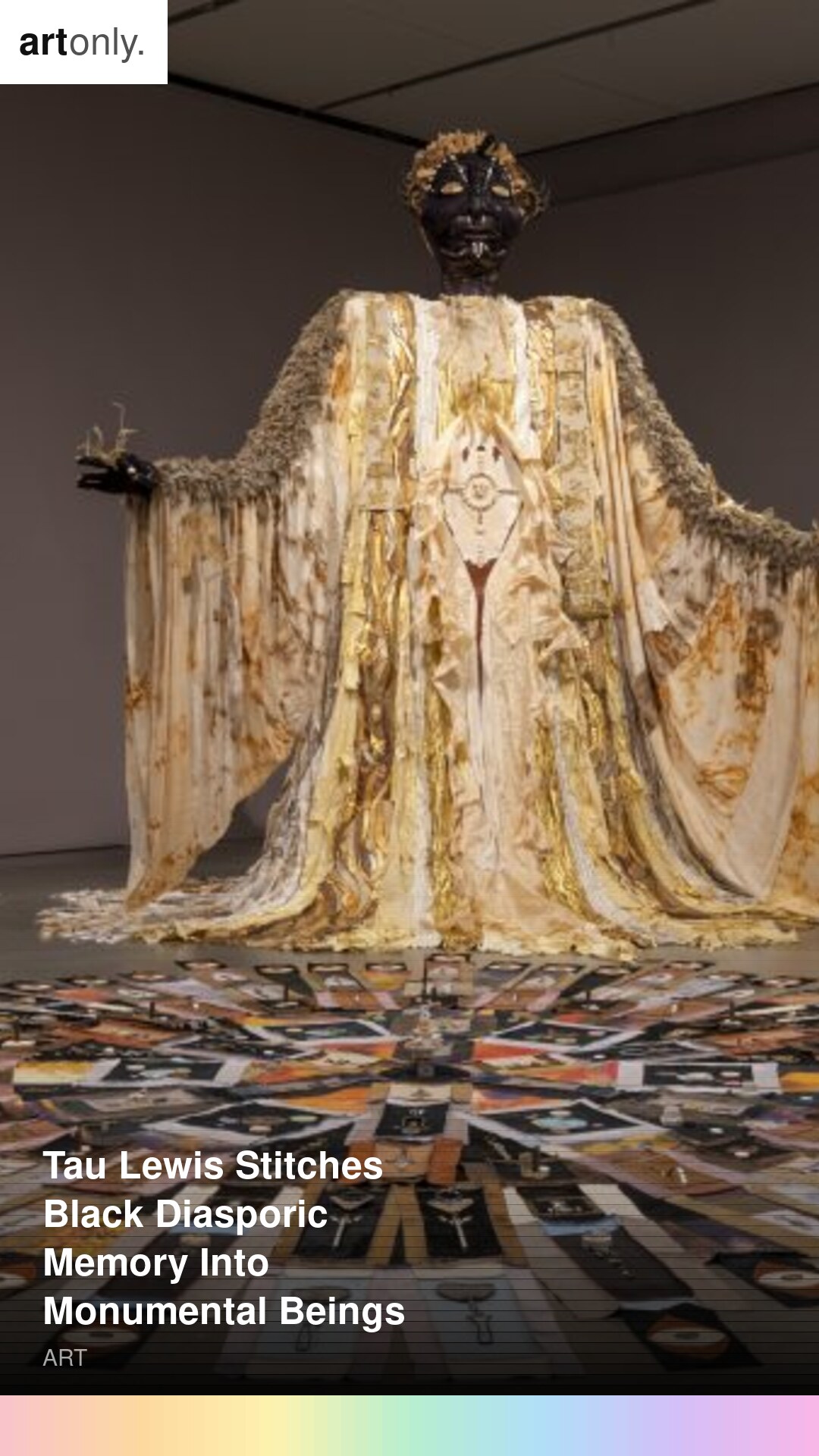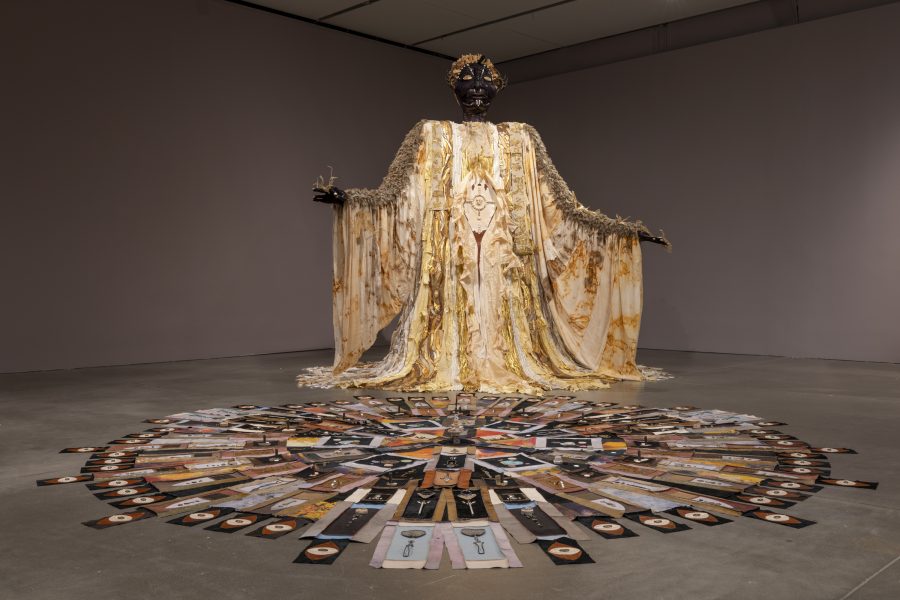
Tau Lewis was born in Toronto in 1993 and now lives and works in Brooklyn. Her medium is textile sculpture, which is a phrase that does her practice almost no justice. The objects she makes are figurative, often eight or ten feet tall, hand sewn from foraged fabrics, leather scraps, beadwork, and found objects gathered over years. They have faces. They have hands. They look back at the viewer in ways that most contemporary sculpture does not bother to. Standing in a room with one of Lewis's pieces is closer to standing in a room with a person than with an artwork. That is the point of the work, and it is one of the reasons she has become one of the most discussed sculptors of her generation.
The Work She Has Been Making
Her practice as it stands now took shape in the late 2010s. She started by gathering materials, much of it discarded clothing and worn textiles with a history of bodies attached to them, and using those materials to construct figures that pull from West African mask traditions, Caribbean spiritual practice, and the visual vocabulary of Black diaspora storytelling more broadly. She calls the figures she builds spirits, and she has talked about her process in interviews as a kind of conversation with the materials. The textiles tell her what they want to become, and she stitches accordingly.
Her 2022 Venice Biennale piece, Divine Giants Tribunal, was the work that pushed her into the international conversation. The piece, an immense wall covering of stitched faces and figures, occupied a long room in the central pavilion and stopped most people walking through. Critics called it one of the strongest works in the Biennale that year. From there her exhibition schedule accelerated quickly. Spirit Level at the ICA Boston in 2024 gave American audiences their first comprehensive solo show. The Canadian National Gallery presented Symphony, her largest Canadian institutional outing to date.
Why The Work Lands The Way It Does
A lot of contemporary sculpture is conceptual. It depends on a wall text or a press release to deliver the meaning. Lewis's pieces do something rarer. They function as objects first. You can walk into a room with one of her sculptures and feel something specific without reading anything, and the feeling is not abstract. It is closer to the way you might feel walking into a room with a stranger who is much taller than you. The work asks for an emotional response in real time.
Part of why this works is craft. Lewis hand sews everything. Her materials are not industrial fabricated. They were touched by other hands before they were touched by hers, and her stitching makes that history visible. Up close, the figures are made of recognizable cloth: an old jacket, a length of stitched suede, what appears to be a section of leather chair. Step back and the figure resolves into a single being with weight and presence. That tension between the visible smallness of the materials and the resolved monumentality of the finished sculpture is part of what makes the work hit.
The 2026 To 2027 Slate
This is a particularly active stretch for her. She has a solo exhibition planned for the Haus der Kunst in Munich, one of the most consequential contemporary art spaces in Germany. She is part of Prospect 5, the New Orleans Biennial, which is titled Yesterday we said tomorrow. She has co produced exhibitions opening at the Brandts Museum in Odense, Denmark and Tramway in Glasgow in 2026 and 2027, both curated by Kathy Noble and based on her work for the 2025 Performa Biennial, which reimagined the Sumerian poem The Descent of Inanna.
The Performa piece is worth pausing on. Lewis has been moving in recent years toward work that combines sculpture with performance, narrative, and installation. The Performa commission gave her a long form structure to work in, and the result was a multi part work that staged the Inanna myth using her sculptural figures as performers within a built environment. That work is now the source material for the European tour. It marks a turn in her practice, away from the standalone monumental figure and toward an interest in storytelling at scale.
What Her Career Says About The Wider Field
There is a generational shift happening in figurative sculpture, and Lewis is one of its central figures. The previous generation of African diasporic figurative sculpture, the one that included artists like Lubaina Himid's contemporaries, leaned painterly and tableau based. Lewis represents a different inheritance. She is closer in spirit to artists like Simone Leigh, who used to be considered a contemporary peer and is now an established institutional figure, and Kara Walker, whose silhouette work pioneered the use of historical material as visual vocabulary. Lewis has cited both. Her work also belongs in conversation with Theaster Gates, whose use of salvaged materials operates on a similar moral logic.
What Lewis adds to that lineage is a specifically textile based language. She is one of the few sculptors of her generation who is committed to fabric as a primary material at monumental scale. That choice has implications. Textile is gendered in art history, often dismissed as craft. Lewis insists, by the scale and ambition of her work, that the medium can carry the weight she gives it.
The Galleries And The Institutions
She is represented by Sadie Coles HQ in London. The relationship was reportedly courted by several major galleries before Sadie Coles closed it, and the choice was a smart one. The gallery has a track record of placing work from artists who deal in figuration and historical material in the most consequential public collections, and they have moved Lewis's work into institutional hands quickly. Pieces of hers are now in the Tate, the Smithsonian's National Museum of African American History and Culture, and several private collections that have been actively building out programs around contemporary African diasporic artists.
Where To See It
If you are based in Europe in 2026, the Munich show is the one to plan a trip around. North American readers should look at Prospect 5 in New Orleans. The ICA Boston catalog from Spirit Level is still available, and it is a useful way to live with the work between exhibitions. Tau Lewis is the kind of artist whose practice rewards patience and rewards repeat looking. Spend time in front of one of her figures and the sculpture will open up to you. Refuse to rush, and the work will return the favor.