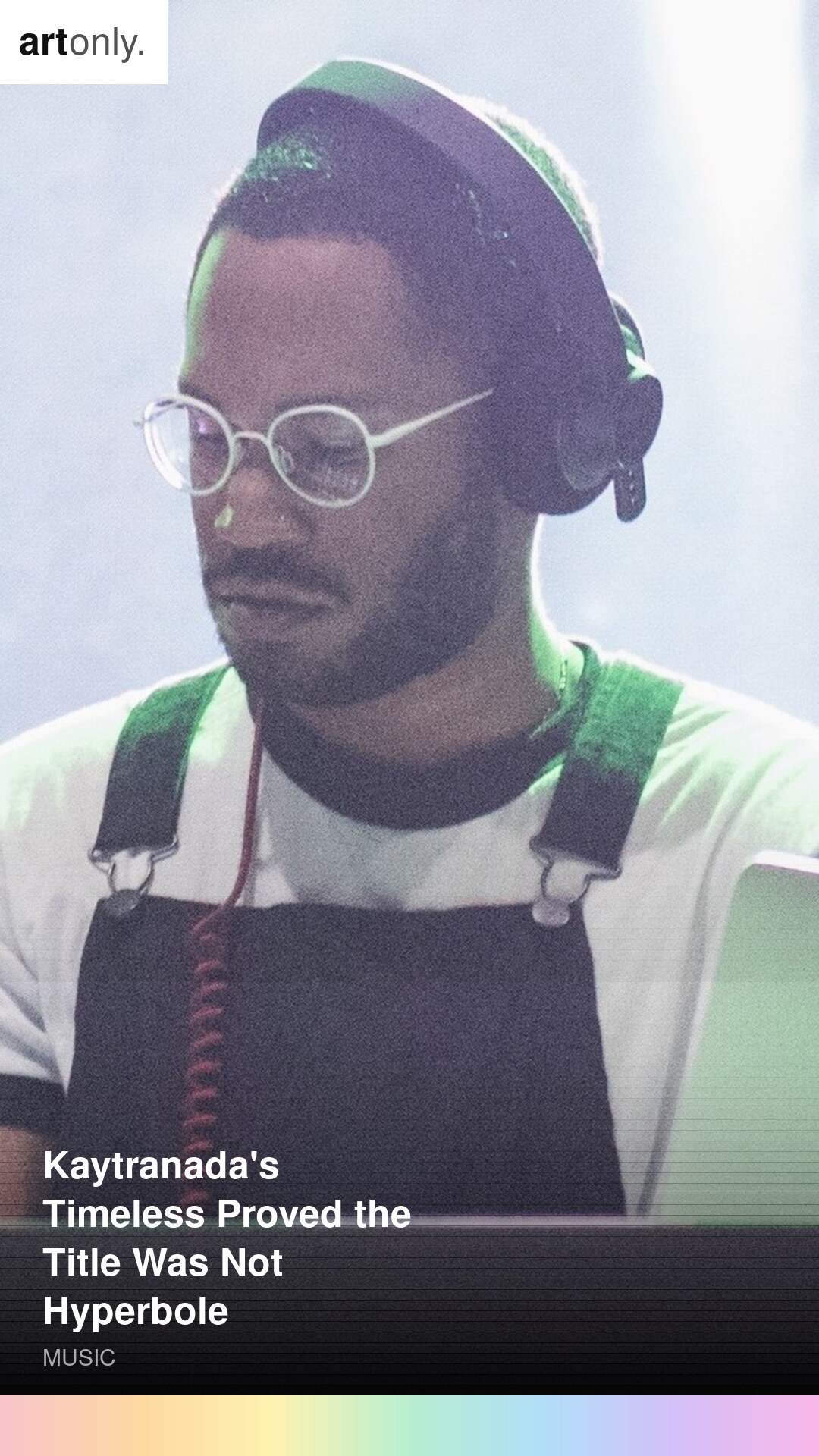
The Producer's Producer
Kaytranada has spent the better part of a decade building a reputation as the producer who makes other producers jealous. His beats are immediately recognizable, built on a foundation of rubbery basslines, off-kilter rhythms, and a groove sensibility that draws equally from house music, hip-hop, and R&B. With Timeless, his third studio album, he delivered the most confident and complete statement of his career.
The Sound
What makes Kaytranada's production distinctive is its refusal to sit still. Tracks shift and evolve constantly, with elements entering and departing the mix in ways that reward repeated listening. The drums are never straight. The basslines are never predictable. And yet everything grooves with an ease that disguises the complexity underneath. This is maximalist music that sounds minimalist, dense arrangements that breathe.
The Collaborations
Timeless assembled a roster of vocalists that read like a wishlist from the most discerning A&R in the industry. Each collaboration felt purposeful rather than transactional. Kaytranada has always had a gift for bringing out unexpected dimensions in his collaborators, placing familiar voices in unfamiliar sonic contexts and discovering new textures in the process.
Beyond Genre
The album resisted easy categorization, which has become Kaytranada's signature move. It was too funky for the electronic music press, too electronic for the hip-hop press, and too rhythmically complex for mainstream pop coverage. This genre-evasion is not a marketing problem. It is the entire point. Kaytranada makes music for the spaces between categories, and Timeless argued persuasively that those spaces are where the most interesting things happen.
The Verdict
In a musical landscape dominated by algorithmic playlisting and genre-specific optimization, Kaytranada continues to make records that defy every impulse toward sonic conformity. Timeless was not timeless in the sense of being safe or universal. It was timeless in the sense of existing outside the trend cycle entirely, operating on its own rhythmic logic and daring the listener to keep up. Most of us were happy to try.
From Montreal to Global Influence
Louis Kevin Celestin, who records as Kaytranada, grew up in Montreal as the son of Haitian immigrants. His production sensibility is rooted in the intersection of Haitian kompa, American funk and soul, and the particular Montreal dance music scene of the 2000s and 2010s that produced a generation of producers with unusually broad reference palettes. This cultural triangulation is audible in everything he makes, and it is what separates his work from producers who attempt similar genre-spanning exercises from a narrower foundation.
His 2016 debut 99.9% won the Polaris Music Prize, Canada's most prestigious music award, and signalled that Kaytranada was not simply a producer who made excellent club music but a composer of full-length statements. The move from 99.9% to Bubba in 2019 to Timeless in 2024 tracks a producer growing more confident in his own idiosyncrasies rather than smoothing them out for wider palatability. Each album is more distinctly itself than the last.
The Groove Question
There is a philosophical argument embedded in Kaytranada's production that is worth making explicit. The groove in popular music has been subject to increasing quantisation, the digital process of aligning rhythmic elements precisely to a grid. Modern pop and hip-hop production frequently operates at a level of rhythmic precision that earlier recordings, made with human musicians playing together in real time, never achieved. The result is music that is technically perfect and rhythmically inert.
Kaytranada's drums feel human in a way that most contemporary electronic production does not. The swing, the placement of elements slightly off the grid, the sense that the rhythm is breathing rather than ticking, these are choices that take technical skill to implement convincingly. They are also choices that most producers do not make because the groove they produce does not score well on the metrics that streaming algorithms reward. Kaytranada makes them anyway, which is why his music rewards dancing in a way that algorithmic optimization simply cannot replicate.
This commitment to the physical experience of music connects his work to the longer house and funk traditions from which he draws, and it explains why artists like Peggy Gou, who shares his commitment to groove-centered production, have been able to build careers that transcend the usual genre boundaries. The dancefloor is not a niche. It is a universal.
Timeless and the Grammy
Timeless won Best Dance/Electronic Album at the 2025 Grammys, a recognition that was both deserved and somewhat beside the point. The Grammy acknowledged the album's quality while the category that houses it continues to be broadly defined to the point of meaninglessness. What the award confirmed is that Kaytranada has moved from critical favourite to broadly acknowledged excellence, a transition that most producers in his position never quite manage. The recognition does not change the music. The music was already this good. But it does mean that the conversation about where contemporary dance music is happening now includes his name at the front rather than in a footnote.
The Live Dimension
Kaytranada's live performances represent a necessary addendum to any discussion of Timeless as a studio achievement. The album's rhythmic complexity, which rewards headphone listening, translates into something more physical in a club or festival environment. The way his productions shift and evolve is even more apparent at volume, with the bass frequencies doing spatial work that speakers at home cannot fully replicate.
This live dimension connects Timeless to the broader tradition of dance music that exists to be experienced in shared physical spaces as much as through personal listening devices. The album works in both contexts, which is rarer than it sounds: most club-oriented music loses dimensionality away from the dancefloor, and most production-forward music loses its warmth on a PA system. Kaytranada's achievement with Timeless is that neither compromise applies. See also Peggy Gou's approach to bridging studio precision and live impact.