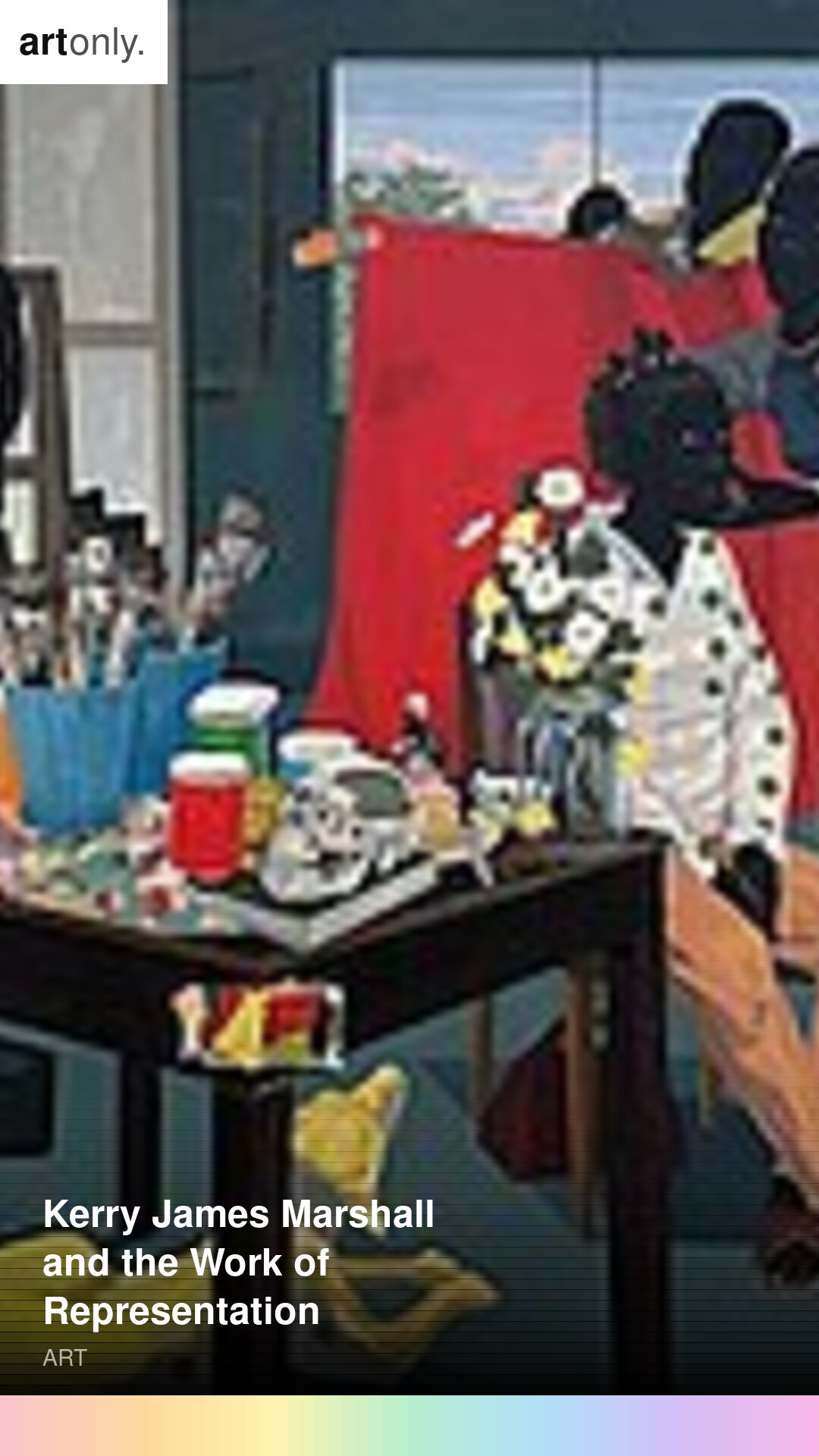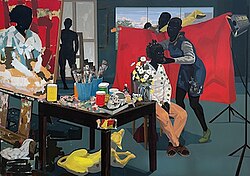
Kerry James Marshall has been making paintings about Black life in America for more than forty years. The body of work that culminated in the 2016 retrospective Mastry at the Museum of Contemporary Art Chicago, the Metropolitan Museum of Art, and the Museum of Contemporary Art Los Angeles, represented one of the most sustained engagements with a single set of questions in contemporary art: who is represented in the Western painting tradition, how, and by whom.
Marshall's answer to the absence of Black subjects in the historical canon was not to lament the exclusion. It was to paint. And to paint with such technical mastery, such direct engagement with the formal traditions of Western painting, that the work could not be dismissed as outside or below the tradition it was addressing.
He grew up in Birmingham, Alabama, and moved to South Central Los Angeles as a child. His formative years were spent in the Nickerson Gardens and Watts housing projects, and those environments became a recurring subject. The critical move Marshall made early was to refuse the distinction between subject matter and formal ambition. There was no reason, in his view, that a painting set in a public housing project could not be as formally rigorous as a painting set in a European garden. His career has been the sustained demonstration that this is true.
Technical Mastery as Argument
The title of the retrospective, Mastry, is a constructed word that collapses mastery, the name Marshall, and the historical weight of the master-slave dynamic that shadows any Black artist's engagement with Western cultural institutions. The wordplay is characteristic: Marshall's work consistently operates at multiple levels simultaneously, with formal and conceptual arguments running in parallel.
The technical achievement of the paintings is central to their argument. Marshall studied at the Otis College of Art and Design in Los Angeles, and his work shows a deep understanding of pictorial construction: how to organize a composition, how light behaves, how spatial depth is created in two dimensions. This is not academic formalism for its own sake. It is the foundation of his ability to make the work legible within the tradition he is addressing while using that tradition's own tools to transform it.
Marshall has spoken extensively about the importance of being undeniable, of making work that could not be dismissed on technical grounds. That the work would also carry its political and historical argument was necessary, but it could only carry that argument if the craft was beyond reproach. He was right about this, and the career proves it.
The Darkness of the Figures
One of the most discussed formal decisions in Marshall's work is the depth of darkness in his figures' skin tones. The Black figures in his paintings are rendered in very dark, almost absolute blackness, often with bright whites and strong colors deployed as contrast. This is not a naturalistic representation. It is a decision with conceptual weight.
By painting his figures at the extreme dark end of the value scale, Marshall does several things simultaneously. He resists the normative tendency in Western painting to lighten skin tones. He creates figures with a formal presence and solidity that anchors them in the picture plane. And he makes a historical argument: these are people who were rendered invisible, and their darkness is their full visibility.
The figures glow. The darkness is luminous. What might seem like an absence is, on sustained viewing, an overwhelming presence.
The contrast with the environments the figures inhabit is deliberate. Marshall often places these intensely dark figures in bright, colorful settings, lush gardens, cheerfully decorated interiors, vivid public spaces. The effect is neither ironic nor melancholic. It is a claim about belonging: these bodies belong in these spaces, and the spaces are richer for containing them.
Genres and Traditions
Across the retrospective, Marshall engaged directly with the genres that constitute Western painting's canonical history: portrait painting, genre painting, history painting, landscape, still life. For each genre, he asked what changes when the subjects are Black Americans rather than the European and Euro-American subjects who populated the tradition.
The Garden Project series imagines idealized domestic scenes set in the public housing projects where Marshall grew up. The formal language of idyllic garden painting is applied to subjects the tradition had excluded. The result is both formally beautiful and historically disruptive.
The Portraits series engages with the conventions of formal portrait painting, placing Black subjects in the formal poses and settings that the tradition reserved for people of standing and social consequence. The point is not ironic. It is restorative. These are portraits of dignity, painted with the full vocabulary of a tradition that spent centuries making such dignity invisible.
The history paintings take on scenes from Black American life with the same scale and compositional ambition that European academic painters brought to battles and mythological events. De Style (1993) places two Black men in a barbershop interior rendered with the formal precision of a Dutch interior. The barbershop is the history painting's subject. Marshall treats it that way without condescension.
The Market Correction
Marshall's critical reputation was established well before the financial market caught up. His prices in the secondary market rose dramatically in the mid-2010s, with Past Times (1997) selling at Sotheby's in 2018 for $21.1 million, a record for a living Black artist at that time. The market catching up to the critical consensus was a delayed recognition, not a revaluation.
That delay matters. The work was always this good. The institutional and commercial recognition of that was slow in ways that had to do with which collectors, which curators, and which dealers were paying attention to which artists. The Mastry retrospective was in part a correction of a long institutional failure to position Marshall where he belonged.
What the Retrospective Established
Mastry established Marshall as a central figure in the history of American art in a way that required no qualification or contextualization. The reviews were not about a significant Black artist or an important political painter. They were about one of the most technically accomplished and conceptually rigorous painters of his generation, working at the height of his powers, with a body of work behind him that could stand comparison to any painter in the tradition he was engaging with.
That is the argument the work makes, and the retrospective made it undeniable. Forty years of sustained attention to a single set of questions, answered with increasing depth and confidence, represents something rare in contemporary art: a lifetime of work that accumulates rather than disperses, that builds rather than restates.