Joseph Kamaru was born in Nairobi and is now based in Berlin, and that distance, geographical, emotional, temporal, is what his music is made of.
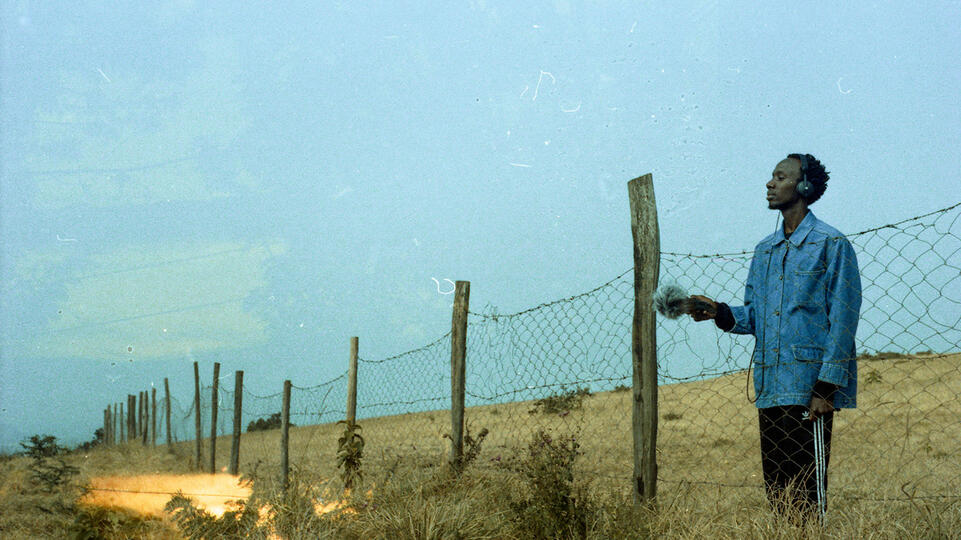
Working as KMRU, he makes ambient and experimental music rooted in field recording, machine learning, and a kind of patient listening that feels increasingly rare. He is not making background music. He is making music that teaches you to hear differently, if you stay with it long enough.
His 2020 debut Peel on Editions Mego established him immediately as someone operating at a serious level. The album was built from recordings made across Kenya, layered and processed into something that retained the texture of specific places without reducing them to postcard. The sound of rain at a particular time of day in a particular part of Nairobi is not decoration, it is the point.
Editions Mego and What It Means
Editions Mego has been the home of serious experimental electronic music for over two decades. The label, founded by Peter Rehberg, released work by Fennesz, Grouper, Actress, and dozens of other artists working at the edges of what sound can do. Being on Mego is not just a distribution arrangement. It is a statement about aesthetic lineage, about which conversations you are entering and which you are refusing.
KMRU's arrival on the label with Peel meant his work was immediately contextualized within that lineage. The comparison to Fennesz's chromatic, guitar-derived electronics was made quickly and was not wrong, but it was incomplete. Where Fennesz typically works with processed guitar creating dense harmonic environments, KMRU works with recorded environment creating something more forensic. The source materials are different, and so is the relationship to place.
Peel was followed by Jar (2021) and a series of collaborative and solo releases that pushed the field recording methodology in different directions. Jar was rawer, more immediate, closer to the source recordings without the heavy layering that characterized Peel. The stripped-back quality was not a step back. It was a choice about how much processing to allow between the place and the listener.
The Machine Learning Turn
Kamaru has been explicit about using machine learning tools in his compositional process. This is worth addressing directly, because the discourse around AI and music has generated more heat than light. What Kamaru is doing with these tools is specific and disciplined.
The machine learning in his work functions as a compositional collaborator rather than a generator. He feeds it material, field recordings, processed sounds, structural fragments, and uses its outputs as one layer among many. The human decisions are still the ones that determine what the music becomes. The tools extend his vocabulary without replacing his judgment.
The result in practice is music that contains sounds that are difficult to source, that sit at the edge of recognition without resolving into the familiar. You hear something that might be a voice, or wind through a specific kind of structure, or a mechanical process translated into frequency. The ambiguity is productive. It keeps your attention active rather than passive.
Kin and the Weight of Dedication
Kin, released on Editions Mego in early 2026, is his most personal record yet. It grew from conversations with the late Peter Rehberg, the label's founder and one of the most important figures in experimental electronic music, who died in 2021. The album is a dedication to Rehberg's memory, though it wears that weight quietly rather than as announcement. Guest contributions from Fennesz bring an additional emotional register, chromatic, slightly fractured guitar-into-electronics that adds colour to KMRU's more austere palette.
What Kin does that earlier releases didn't is let you feel the structural grief of the thing. There is an awareness running through it of the time between conversations, the conversations that cannot now happen. The field recordings are still there, still anchored in specific places, but they press against that absence with a new kind of weight.
Fennesz's presence on the record creates a specific dialogue. Fennesz was one of Mego's defining artists, a figure Rehberg believed in and championed across decades of collaboration. Having Fennesz appear on a record that mourns Rehberg is not a coincidence of scheduling. It is a choice about who belongs in the room when grief is the subject. The two sounds, KMRU's processed Nairobi environments and Fennesz's fractured guitar harmonics, occupy the same space without resolving into each other. They coexist with the friction of genuine difference, which is what the best collaborations do.
The Process of Active Listening
The Berlin Positioning
Living in Berlin places Kamaru in a specific context that is worth naming. Berlin has been a gravitational center for experimental electronic music since the early 1990s, the city's specific history, cheap spaces, a culture of extended night, a postwar relationship with darkness and transcendence, producing the conditions for a distinctive scene. That scene is not monolithic. It contains techno producers and ambient composers and noise artists and everything between. What it shares is a seriousness about sound as an end in itself, not as accompaniment or product.
Kamaru does not make Berlin music in the genre sense. His sources are too specific, too tied to Nairobi and Kenya, to be absorbed into a European scene aesthetic. But Berlin gives him access to infrastructure: recording technology, collaborative networks, the Editions Mego distribution and curatorial relationship that takes his work to listeners who would not have found it otherwise. He is in Berlin without being of it, which is the correct relationship for an artist whose work depends on maintaining the distance between where he is and where his sounds come from.
Kamaru has talked about his process as a form of active listening, he does not go into a space to extract material but to understand what the space is already doing. That orientation shows in the work. The sounds on Kin do not feel captured. They feel given.
This distinction matters. Field recording is often discussed in terms of capture: the microphone as a device that takes. Kamaru inverts this. His recordings feel like acts of attention rather than acquisition. The space is not diminished by the recording. Something of it is present in the result.
The practice he has developed, moving between Nairobi and Berlin, carrying recordings from one context into processing in another, using machine learning as one layer of translation while maintaining the integrity of the source, produces music that is genuinely about distance. Not as metaphor. As structural reality. The Nairobi that appears in his Berlin-made music is not the Nairobi you hear on location. It is Nairobi translated through distance, memory, technology, and the specific emotional conditions of someone living with the fact of having left.
Editions Mego continues to release records that age well. Kin will be one of them.