There is a frequency in certain kinds of music, in specific moments of club music, in certain passages of electronic sound, that is both grief and ecstasy simultaneously. Not alternating between them, not mixing them. Both at once, in a way that is one of the stranger and more genuine experiences available in contemporary life.
Korakrit Arunanondchai's video and installation work inhabits this frequency. The Thai-born, New York-based artist makes work that involves performance, video, painting, sound, and collaborators from across the arts and music worlds, and the work tends to operate in this zone where the mourning and the dancing are not opposites but aspects of the same response to being alive in a difficult world.
The works involve an ongoing collaboration with director Alex Gvojic and the recurring presence of a ghost figure, a presence that moves through the work's cosmology as a connecting figure between the living and the dead, between past and future, between Thailand and New York, between traditional and contemporary. This ghost is not horror-genre. It's ancestral, it belongs to the spirit traditions of Southeast Asia that maintain ongoing relationships with the dead.
Syncretism as Form
Arunanondchai's work is syncretic in a way that feels both intentional and organic, the Thai Buddhist and animist traditions mixing with Western contemporary art frameworks mixing with club culture mixing with personal biography in combinations that shouldn't hold together and do. The holding-together is itself part of what the work is about: the possibility of maintaining multiple cosmologies simultaneously, of being neither fully traditional nor fully contemporary but both.
This resonates with a certain contemporary experience, the experience of living between cultures, of holding multiple inheritances that don't simplify into a single identity. The work doesn't offer a synthesis of these positions. It maintains them in productive tension.
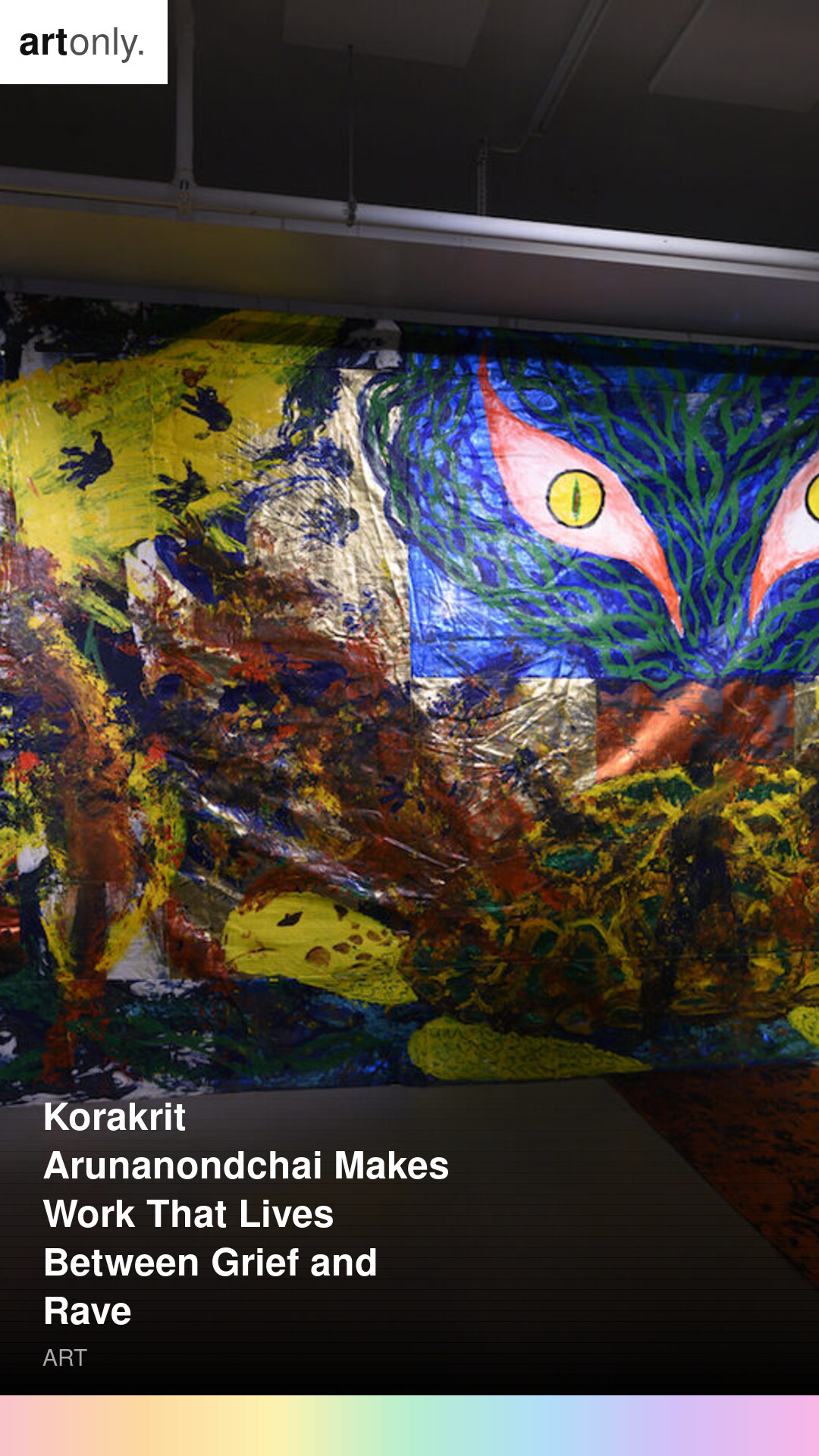
The painting element of his practice is something critics sometimes overlook. The canvases, often large, worked with denim fragments and other materials as well as paint, have a physical intensity that his video work sometimes doesn't. They're objects in space in a way that video can't be, and standing in front of them produces a different kind of engagement than the immersive video environments.
The Video Practice in Detail
The "Songs for Dying" and "Songs for Living" video series, developed over several years and screened in gallery and museum contexts worldwide, established the visual language that runs through all his subsequent work. The footage moves between Thailand and New York, between intimate domestic spaces and large public gatherings, between moments of extreme loss and moments of collective exuberance. The editing is not chronological. Time in these videos works differently from narrative time.
Govjic's contributions as director are integral rather than auxiliary. The collaboration is genuine: two sensibilities shaping the same material rather than one vision executing another's concept. The result has a quality of surplus, of more meaning in any given frame than a single author would have put there. You watch and sense decisions made in conversation rather than in isolation.
The music that runs through the videos is sometimes composed, sometimes sourced from electronic and club contexts, and sometimes hybrid. The relationship between sound and image in Arunanondchai's work is never illustrative. The sounds do not explain the images or accompany them. They create a separate register that the images inhabit, or that inhabits the images. The friction between the two is where the work lives.
The Political Frame
Arunanondchai's work has become increasingly engaged with specific political contexts, particularly the ongoing political struggles in Thailand and the global environmental crisis. The 2021 work "with history in a room filled with people with funny names 4," presented at the Gwangju Biennale, addressed the 2020 pro-democracy protests in Thailand with images of young protesters using the three-finger salute from The Hunger Games, a pop culture image repurposed for genuine political risk.
The move from a film franchise's protest gesture to actual political protest is itself the subject. How political languages circulate, how popular culture provides forms that get filled with real urgency, how a generation growing up inside global media simultaneously does and does not share a political vocabulary, these questions run through the work without being resolved.
The environmental dimension is present throughout the longer video works, in images of water, of degraded landscape, of the atmosphere. These are not documentary images. They carry emotional weight without rhetorical framing. The world as a patient in an unacknowledged crisis appears in the background of scenes whose foreground is occupied by personal grief, by dancing, by ancestors.
What the Rave Is For
The rave as cultural space has always been about something beyond recreation, about community, about the body's right to pleasure, about collective experience as a form of survival and resistance. Arunanondchai's work understands this and takes the rave seriously as a ritual space with genuine spiritual dimensions.
This is not unusual in the discourse around electronic music and club culture, which has long addressed the sacred dimensions of the dancefloor. What's unusual is an artist bringing this understanding into the gallery, making visual and sculptural work that carries the knowledge of the rave without simply depicting it.
The grief in the work is the grief for all the things being lost, in Thailand, in the environment, in the specific communities the work draws from. The dancing is the response to that grief that doesn't require resolution, that accepts that you can mourn and move at the same time.
I find that acceptance genuinely valuable. The work has given me a way to think about something I already felt. I find myself thinking about the specific communities that Arunanondchai's work addresses and includes, the Thai diaspora, the rave communities, the art world people who encounter this work in galleries, the collaborators who make it with him. These are not natural constituencies. Bringing them into the same space, making work that speaks to something in each of them, is itself an act of community-building.
The work will keep developing. It's one of the more alive practices in contemporary art, one of the ones that seems genuinely uncertain about what it will become next. That uncertainty is the sign of something still in motion. I want to keep watching.