The Monument and Its People
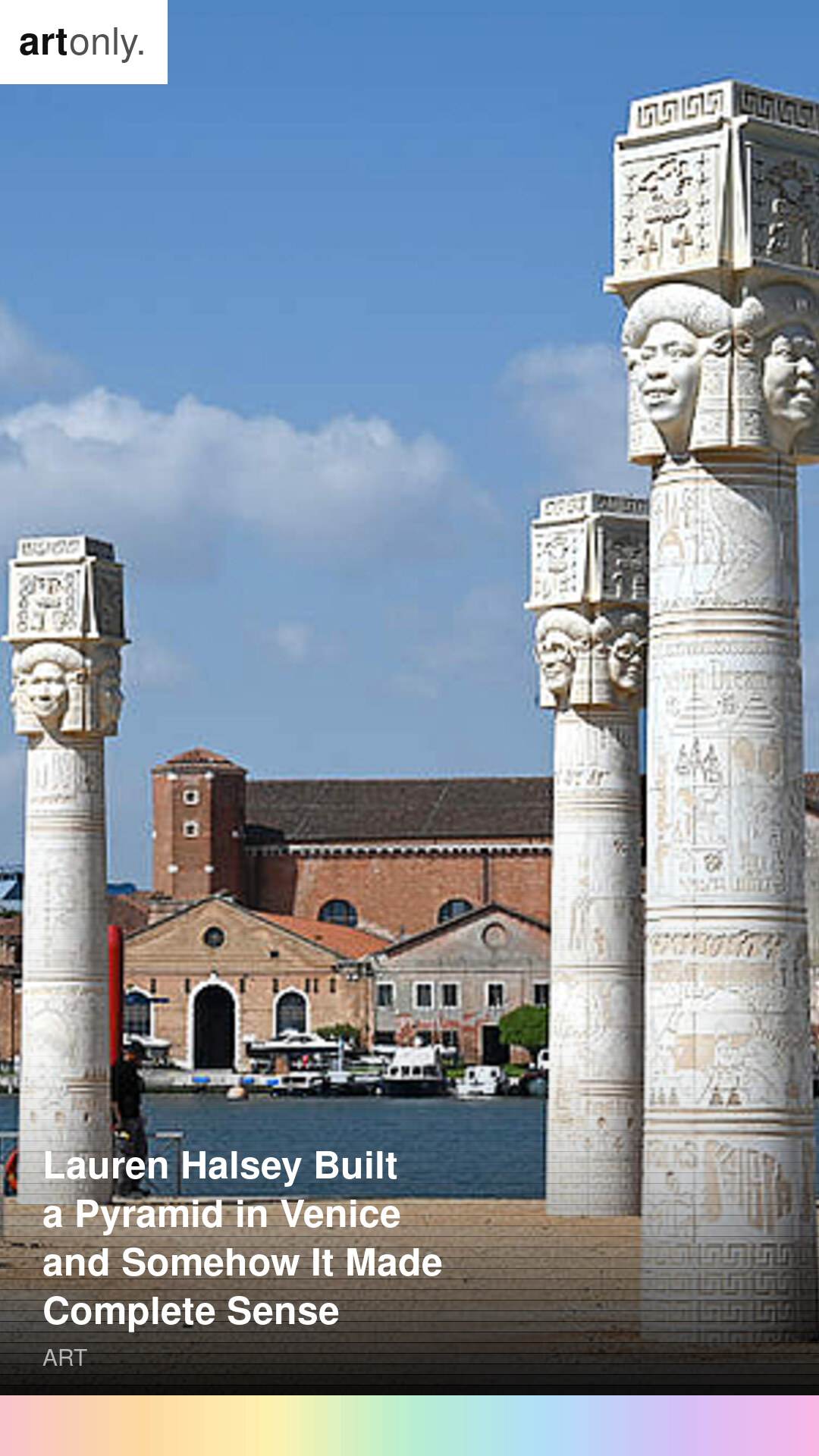
The history of monumental public art is a history of power: of who gets to be commemorated, whose vision of civic life gets to occupy public space at scale. The pyramid is perhaps the most loaded shape in that history: ancient, imperial, encoded with meanings that span continents and millennia. When Lauren Halsey installed her hieroglyph prototype architecture at the Arsenale for the Venice Biennale, she was doing something with all of that accumulated meaning, using the most monumental of forms to carry the most particular of contents.
Halsey's work was covered in hieroglyphic imagery drawn from South Central Los Angeles: from the neighbourhood she's from, from its murals and its community centres and its everyday visual culture. The figures carved into the marble and concrete weren't pharaohs or abstractions. They were the people of her community, rendered in a formal language associated with permanence and power, insisted upon as worthy of monument.
That insistence is the political and aesthetic core of her work. She has been working in South Central for years, running a community distribution centre from a former bodega, growing food in urban gardens, documenting the visual culture of a neighbourhood that is often described in terms of what it lacks rather than what it has. The Venice work was a statement at a different scale but continuous with all of that work. You cannot understand the one without the other.
Scale as Argument
When something is big enough, when it occupies space forcefully enough, it makes claims that smaller things can't make. The history of public sculpture and civic architecture is the history of this principle being applied by those with power: the building of monuments to empire, to victory, to the figures that power wished to commemorate. The Egyptian pyramid is the extreme expression of this logic. Mass and height as the materialization of authority. The pharaoh's permanence encoded in stone designed to outlast everything around it.
Halsey deploys scale on behalf of a different community and in service of a different argument. The scale of the work insisted that the subject matter was monumental. That the lives and visual culture of South Central Los Angeles deserved this treatment. That monuments need not be for kings, and that using the king's formal language to say so is not appropriation but reclamation.
This seems obvious stated plainly. It is not obvious in practice. The art world has particular ideas about what constitutes significant subject matter, and those ideas are encoded in which artists receive the resources needed for monumental work. Halsey having those resources, Halsey receiving the invitation, Halsey using both to do exactly this: all of it was significant. None of it should be taken for granted.
The Hieroglyph and the Contemporary
There's a formal precision in Halsey's use of the hieroglyphic register. Hieroglyphs are a writing system, a language, and using them for contemporary imagery creates a kind of temporal folding, places the present in conversation with a deep history in ways that neither romanticize the past nor dismiss the present. The Egyptian tradition had its own politics of monumentality: the hieroglyphic script was associated with sacred and official use, with the permanence of inscription rather than the impermanence of speech.
The figures on Halsey's work were not naively inserted into an ancient form. They transformed the form. The pyramid with these images is a different object than a pyramid with different images: it has different meaning, different affect, a different relationship to the viewer standing in front of it. The community members, the street vendors, the local institutions of South Central rendered in the grammar of ancient authority: the formal decision is the argument.
In Venice, surrounded by the other art world monuments, the work did something that the best site-specific work does: it commented on its context by being incompatible with it. By being something the context didn't expect and couldn't fully contain.
The Ongoing Project
The community work continues in South Central: the distribution centre, the community garden, the documentation of the neighbourhood's visual culture. Venice was one highly visible node in that ongoing project rather than a separate statement. Understanding it as continuous with the community work changes what the scale means: the monumentality is not about the artist. It's about the community. That reframing is the whole argument.
In 2023, Halsey's hieroglyph prototype architecture was also installed on the Roof Garden at the Metropolitan Museum of Art in New York, where it sat from April through October. Two different contexts for the same logic: in both cases a monument built for and by a specific community arriving in spaces associated with different, older ideas of what monuments are for. Each context reframes what you think you know about Egyptian pyramids, about who gets to be monumental, about what permanence means when it's given to people that institutional power has tried to make temporary.
I keep thinking about what it would look like for more public monuments to be organized around this logic: not the commemoration of power but the insistence on the value of specific communities, specific lives, specific visual traditions. The pyramid showed what that could look like. It looked like exactly this.
The materials matter too. Halsey uses marble, stone, concrete: the building materials of civilization's most permanent structures, the same substances empires chose when they wanted to say forever. Choosing those materials for these subjects is itself an argument about permanence, about who deserves to last, about which communities are worth writing into the architecture of history. The durability of the medium is the statement. These figures will outlast us. They are meant to.
The argument is not abstract. It is built into the physical choices of the work: the material, the scale, the imagery, the location. Every decision compounds the central claim. This is what community looks like when it takes its own importance seriously. Halsey's community work in South Central predates any gallery attention: the distribution centre, the urban farm, the documentation projects were already in place before the art world noticed. The Venice installation and the Met Roof Garden commission are extensions of that long project, not departures from it. The monuments are built from the same commitment.