The Fictive Portrait
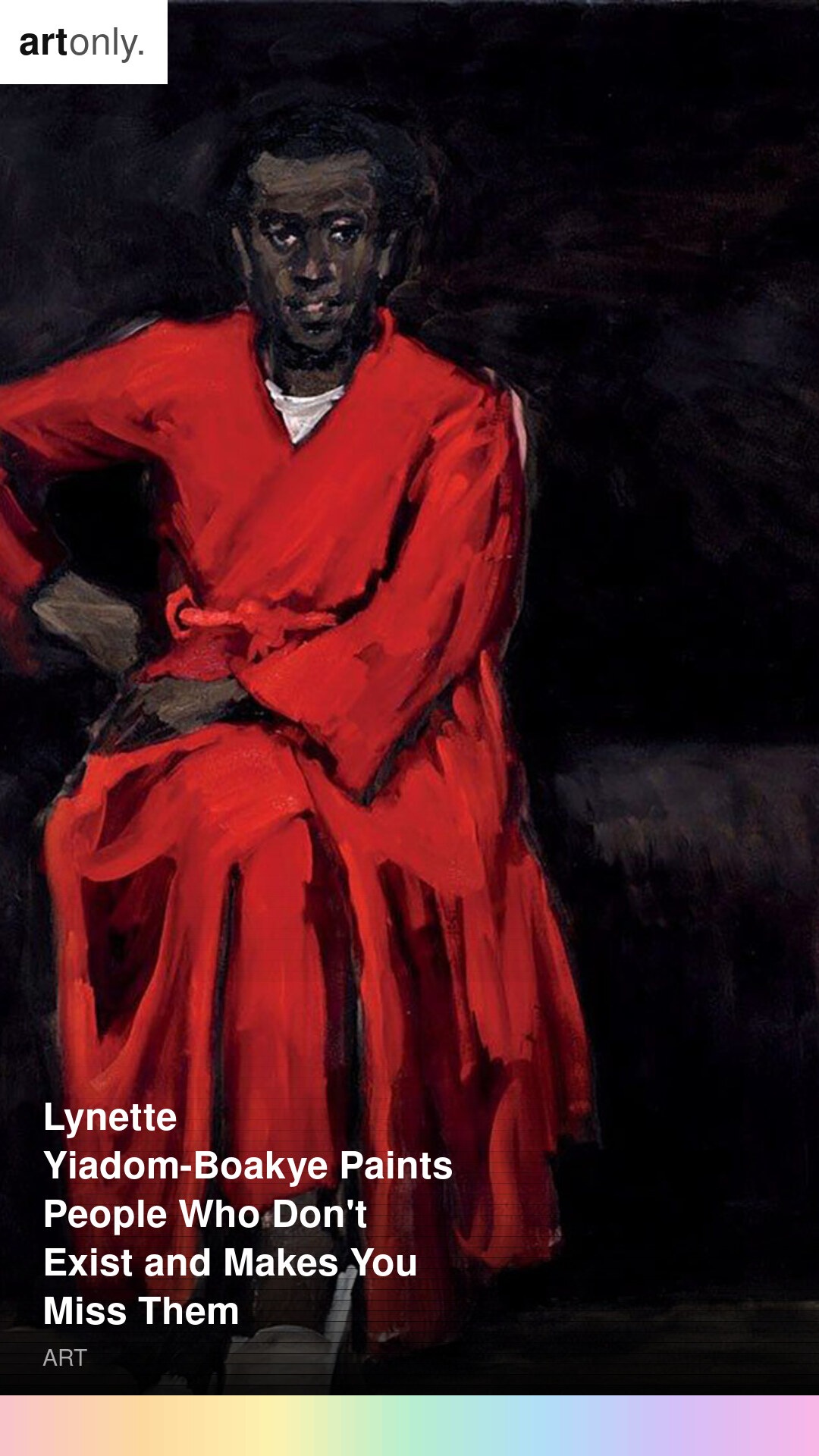
The people in Lynette Yiadom-Boakye's paintings don't exist. They are composite figures built from images and imaginations, from the history of portraiture, from a deep engagement with how paint can be made to describe a person without having a specific person to describe. The names she gives them, the titles of her works, are invented names, occasionally poetic phrases, never identifiers. You cannot recognize who you're looking at. And yet you feel, standing in front of these paintings, that you know them.
Yiadom-Boakye is British-Ghanaian, trained at Central Saint Martins and Falmouth, working now in London and Cornwall. Her paintings are all figurative, all depicting Black figures in interior settings or against neutral grounds, in poses that suggest a moment caught between one action and another, in states of rest or reflection or something unnamed. They are painted quickly: she reportedly completes most canvases in a single day, and the speed is visible in the handling, in the directness of the mark-making, in the surfaces that have a freshness that belies the historical intelligence behind them.
The relationship to the history of portraiture is explicit and complex. Yiadom-Boakye has absorbed the tradition from Velázquez through Manet through Sargent and applies its vocabulary to subjects that the tradition historically excluded. Black figures painted with the authority and technical facility reserved in the tradition for wealthy white patrons. The formal homage is inseparable from the political reclamation. She is not critiquing the tradition from outside. She is operating inside it and changing what it means by changing who it centers.
The Missing
The missing in my headline is a strange thing to say about people who never existed. But the experience of standing in front of Yiadom-Boakye's paintings has that quality: a recognition that produces something like loss, a feeling of knowing someone who is not there.
This is what portraiture has always done, in its most honest versions. The portrait freezes a moment, presents a person as they were at a specific instant, and the viewing of it is always also a confrontation with absence: with the fact that the person is elsewhere now, older, different, or dead. The portrait is a document of presence that produces awareness of absence.
For Yiadom-Boakye's fictive subjects this logic is collapsed and intensified. The absence is total: they never existed, so the presence the painting gives them is the only presence they have. The painting is not a document of someone but the creation of someone. This gives the figures a peculiar intensity. They exist only here. They are entirely dependent on the paint for their being. The titles, their strange compressed poetry, are the only other existence they have outside the canvas.
The Speed and What It Means
Painting quickly doesn't mean painting carelessly. The one-day practice requires extraordinary confidence and technical facility. There is no time for overworking, for second-guessing, for the kinds of revision that slower painting allows. Every decision has to be right or at least right enough, and the rightness has to be achieved through accumulated skill rather than iterative correction.
The surfaces of the paintings show this. They have a character, the specific quality of paint applied with speed and certainty, that distinguishes them from similar work made more slowly. The handling is direct without being crude, quick without being careless. The figures emerge from the ground with a kind of inevitability that feels like discovery rather than construction. The paint describes cloth and skin and shadow with a fluency that takes years to build but looks effortless in the result.
Yiadom-Boakye has described painting from imagination rather than life as a matter of emotional freedom: without a specific person in front of her, she is free to follow the painting's own logic rather than the obligation to accurately represent someone. The figure becomes whoever the painting needs it to be. The titles, almost never descriptive in any literal sense, function as a second layer of invention: not the name of a person but a phrase that creates a space for a person to exist within.
What Keeps Returning
I've been following her work for several years and each new encounter adds something to my understanding of what she's doing. The consistency of the project, the sustained attention to a set of formal and conceptual problems across hundreds of paintings, produces a body of work that is more than the sum of individual canvases. The figures accumulate into something that functions almost like a community: people who know each other in the way that figures in a long novel know each other, through proximity and shared space even without direct interaction.
The Tate Britain retrospective in 2021 to 2022 gave the full sweep of the project a room for the first time. Seeing a hundred paintings together changes what each one means: the formal decisions that read as individual choices in isolation reveal themselves as commitments, as an ongoing argument about what painting can do with a face, with a body, with an hour of the day.
She makes you miss people who were never there. I don't have better language for the experience. The missing is real. The people aren't. The gap between those two facts is where the painting lives.
The colour palette she works with is also significant: darker, more muted than the Old Masters she draws from, the grounds often brown or grey rather than the warm neutrals of the tradition. This gives the figures a different relationship to the light: they are not illuminated from without but seem to contain their own quieter light, as if the source is internal. That reversal of the traditional portrait's lighting logic produces figures who look self-sufficient, who do not need the painter's light to exist. They were here before the canvas. They will be here after it.
The Turner Prize in 2013 gave her a wider audience without changing the practice. She has continued painting quickly, inventively, and at scale since, as if the recognition confirmed what she was already doing rather than redirecting it. That stability of practice across changing levels of recognition is itself a form of integrity.