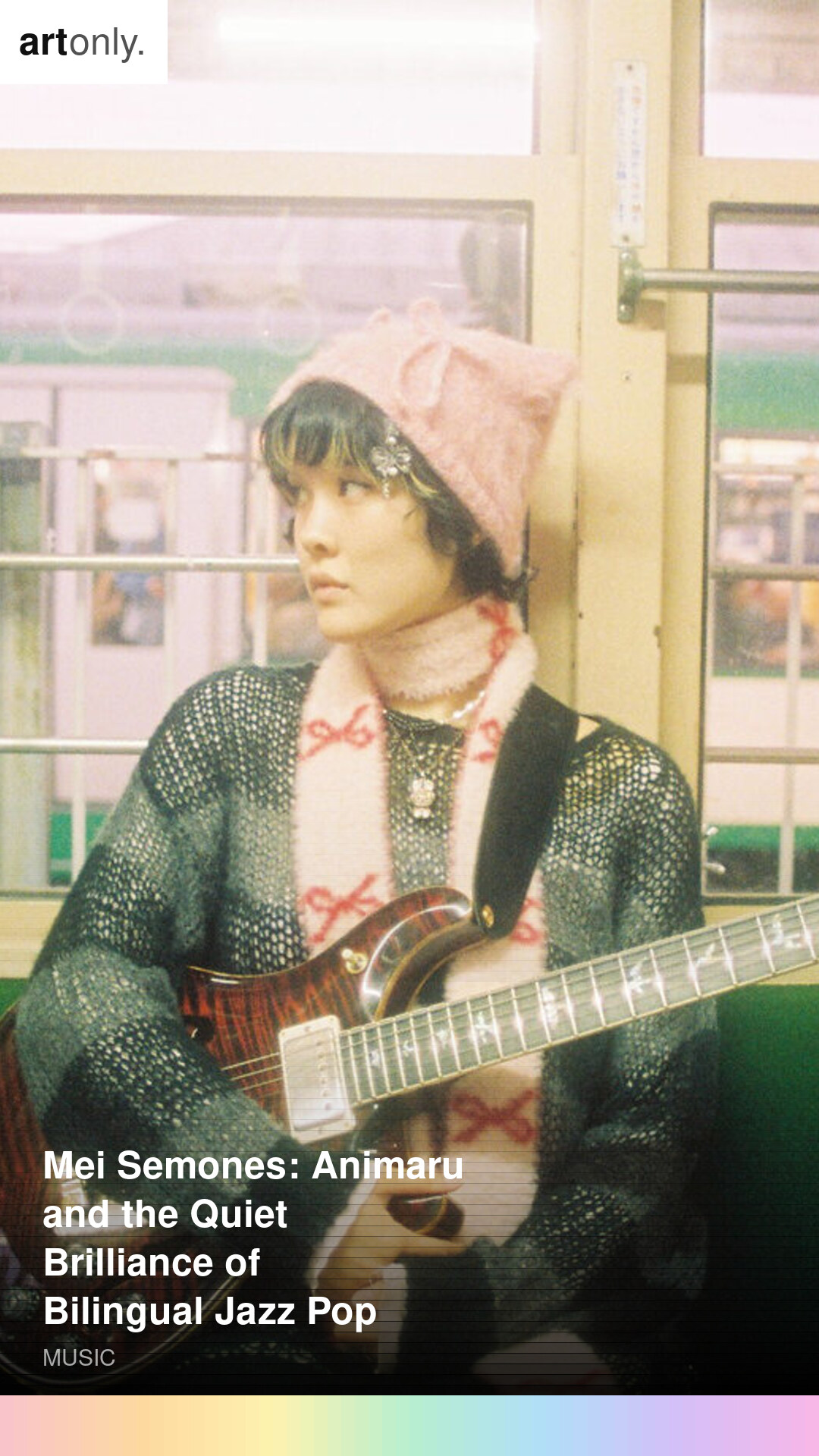
A New York songwriter writing in two languages at once
There are very few American songwriters who can write in Japanese and English without it feeling like a gimmick. Mei Semones is one of them, and she does it so naturally that the bilingualism stops being a feature and starts being a baseline. Her 2025 debut album Animaru, released on the New York label Bayonet Records, is the strongest case yet that she is doing something other songwriters in her generation are not.
Semones grew up in Michigan, studied jazz guitar at Berklee, and now lives in Brooklyn. That biography matters because it shapes the music. The jazz training shows up in her chord choices, the way she can drop a major-seventh into a verse and have it sound like an emotional decision rather than an academic one. The Berklee schooling shows up in the discipline of her arrangements. The Michigan-to-Brooklyn pipeline shows up in the kind of bedroom-pop-meets-jazz hybrid that has become the unofficial sound of a certain corner of indie music.
Animaru as a debut that already feels confident
Animaru opens with Tora Moyo, a song that establishes the rules of the album within its first thirty seconds. There is the warm acoustic guitar, the careful bass, the strings that drift in like a half-remembered Burt Bacharach session. And then there is Semones's voice, which slips between Japanese and English without announcing the switch, treating the languages as two registers of the same emotional vocabulary.
The album is full of these moments. Donguri, named after the Japanese word for acorn, is a small song about something small, and it works precisely because it does not try to be more than it is. Inaka, the word for countryside or rural home, is a song about distance and the difficulty of going back. Hfoas is the kind of song that could have been on a Stereolab record in 1996, all loose pulse and floating melody, except the lyrical perspective is unmistakably contemporary.
What ties the album together is restraint. Semones is a virtuosic guitar player who chooses, on almost every song, to play less than she could. The arrangements lean on string quartets and brushed drums. The dynamics stay mostly in the middle range. There is one or two moments where the band breaks open, but they feel earned because they are surrounded by quieter passages.
The Tsukino EP and the early signals
Before Animaru there was Tsukino, a 2023 EP that introduced most of the aesthetic vocabulary the album would later expand. Tsukino was the EP that got Bayonet Records interested. It also got tastemakers like Pitchfork and The Fader to start mentioning her in their year-end coverage. The songs were shorter, the arrangements thinner, but the core was already there: bilingual lyricism, jazz harmony deployed with pop instincts, an unhurried melodic patience that almost no one her age was attempting.
The difference between Tsukino and Animaru is the difference between a sketch and a painting. The sketch was already good. The painting fills in the corners with detail.
Why bilingual songwriting matters here
There is a long tradition of Japanese pop crossing over into English-speaking markets, from Yumi Matsutoya through Hikaru Utada through Hiromi Uehara. There is also a long tradition of American songwriters dipping into other languages for novelty effect. Semones is doing something different from both. She is writing songs that simply happen to live in two languages because her own interior life lives in two languages. The Japanese passages are not exoticism. The English passages are not capitulation. They are both home.
This is, among other things, a generational distinction. The bilingual or multilingual artist is a much more common figure now than even ten years ago. Rosalia moved between Spanish and English without it being remarkable. Bad Bunny built a global career mostly in Spanish. Yaeji has done similar work between Korean and English. Semones belongs to this lineage, but the jazz-pop framework she is working in is more intimate than any of them, and the bilingualism reads as more domestic.
A guitar player first
Something easy to miss in the warm wash of Animaru is that Mei Semones is, fundamentally, a guitar player. Listen to I Can Do What I Want or to the bridge of Tegami. The voicings are unusual. The rhythmic feel is jazz, even when the genre on top of it is closer to indie folk. She uses her guitar as a melodic instrument as much as a harmonic one, which gives the songs an internal counterpoint that most singer-songwriter records do not have.
This is partly why the record holds up to repeat listens. The lyrics reveal themselves slowly, but the playing reveals itself even more slowly. There are passages that sound, on the tenth listen, like they could be excerpts from a Pat Metheny album, except sung over.
What Animaru tells us about the next decade of indie
Indie music in the streaming era has tended toward two poles. There is the maximalist pop of Charli XCX and her circle, and there is the fragmentary bedroom output of TikTok-native artists. Semones is doing something neither of these tend to attempt. She is making complete albums, with arc, with patience, with virtuosity, in a style that does not chase any algorithmic moment. The fact that this is now read as quiet rebellion says more about the state of the industry than about her.
If Animaru is a sign of where Bayonet Records and the broader bilingual jazz-pop scene are heading, then the next few years are going to be interesting. There is room for an entire micro-genre here, and Semones is its most fully realized practitioner so far. Animaru is not just a debut. It is a quiet declaration that there are still ways to make pop music that prioritize craft over scale, and that those ways still find their listeners.