The Man Has a Type
There is a thread running through Romain Gavras's career that does not get discussed enough. The man keeps coming back to gingers. Not as a passing visual detail. Not buried in a color grade. Literally, structurally, as the subject of the thing he is making.
In 2010 he directed Born Free for M.I.A. The video follows a military-style sweep through Los Angeles, where a tactical unit rounds up red-haired men, loads them onto trucks, and drives them to the California desert to be executed. YouTube banned it within hours. The debate that followed came from all directions and it covered racial profiling, ethnic persecution, the absurdity of discrimination, and what a music video was permitted to say to an audience that had not asked for it. Critics disagreed on the meaning and agreed on everything else. The direction is cold, precise, and completely committed. Four minutes and sixteen seconds, not a single frame that does not know exactly what it is doing. It remains one of the most formally controlled pieces of cinema ever attached to a pop record.
Then in 2011 he made Notre Jour Viendra, his debut feature film. The title translates as Our Day Will Come. Vincent Cassel plays a redheaded man on the edge of a breakdown who picks up a troubled teenage ginger and drives with him toward the coast and somewhere in the direction of a very bad ending. The film is about being marked from birth. About the specific kind of social exclusion that builds over a childhood of being told that what you look like is a punchline. Gavras does not play it as a joke. He was developing the feature before he shot the music video. The redhead fixation is not a gimmick or a phase. It is a recurring inquiry into what it means to be visually other in a world that will not let you forget it.
Now, sixteen years after Born Free, he is back. And yes, the gingers are still involved.
STORM I and II
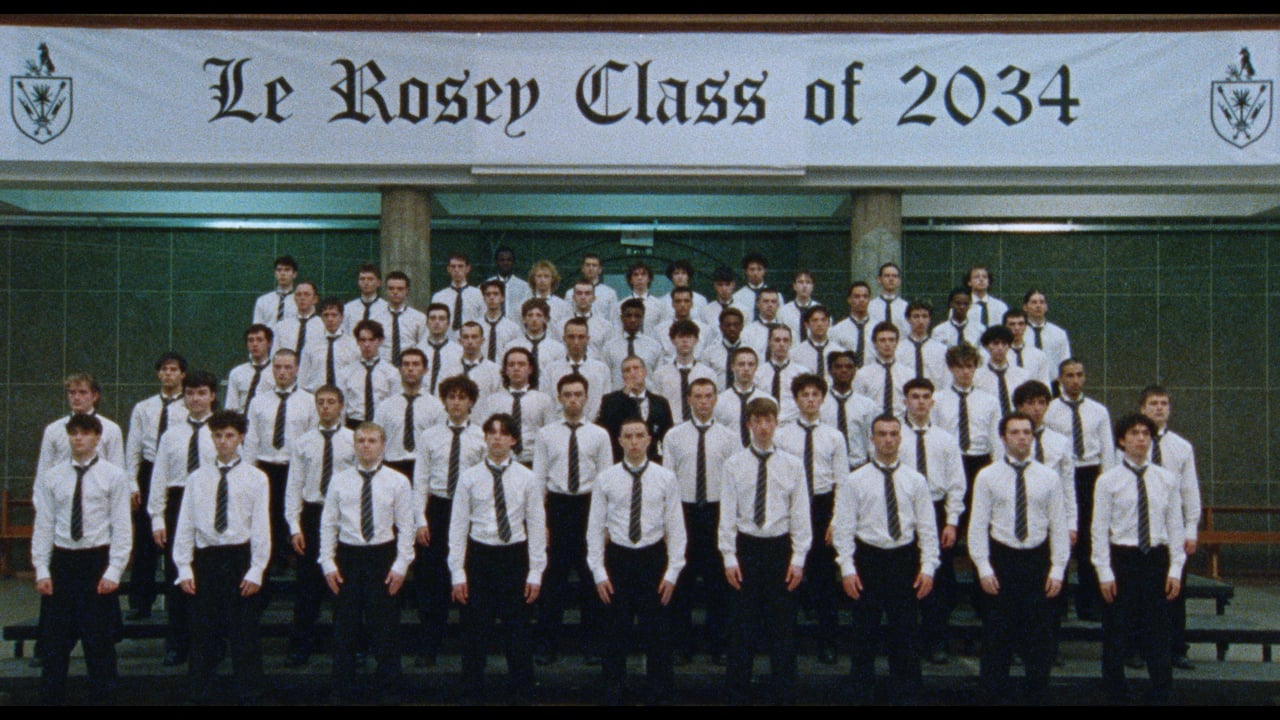
The video runs seven and a half minutes. It is set in 2034, inside what reads as a boarding school operating under some kind of unspecified authoritarian pressure. Yung Lean moves through it with the particular stillness that defines his best visual appearances. A presence that does not perform for the camera because it does not need to. GENER8ION provides the architecture. The track has weight and space in the right proportions, a production that understands what it is hosting and leaves room for the direction to do its work.
GENER8ION feat. Yung Lean · Directed by Romain Gavras · Choreography: Damien Jalet · (p) Iconoclast Music
What Gavras does in this video that most directors do not do anywhere is hold the frame. The camera does not drift out of anxiety. The editing does not accelerate to manufacture tension that the images cannot generate on their own. The result is seven minutes that you watch without the usual pull toward the skip button, because you are not certain what is coming and you do not want to be somewhere else when it arrives.
The ginger thread continues. Whether it lives in the cast, in the institutional palette of the setting, or simply in Gavras deciding to return to the formal territory he built across Born Free and Notre Jour Viendra, the sensibility is continuous. This is not a director making something new. This is a director going deeper into something he has been working on since before most of the people watching this video were paying attention.
Damien Jalet and Choreography That Actually Means Something
The detail that separates STORM I and II from the rest of the release calendar is the choreography credit. Damien Jalet is one of the most significant working choreographers in any medium, and his name in the credits means the movement in this video was not assembled by a second unit or left to the performers to develop on the day. It was built from a specific set of ideas about what bodies can say in space, and those ideas were taken seriously before a single camera was loaded.
Jalet's most visible film credit is Suspiria, Luca Guadagnino's 2018 remake, where the choreography is not incidental to the horror. It is the mechanism of the horror. The dances are the point. What bodies do under instruction, in service of something that is not entirely human, is what the film is about. Jalet understands that choreography is a form of directing. He makes decisions about where weight lands, where rhythm fractures, where stillness sits beside something violent, and those decisions change the meaning of every image they are inside.
In STORM I and II he brings that same rigour into a music video context. The choreography is integral in the full meaning of the word. Removing it would not produce a shorter video. It would produce something that no longer coheres. Every sequence is built around the movement rather than decorated with it. That distinction is the difference between choreography as furniture and choreography as argument.
Gavras has always understood that collaboration at this level produces something neither party could reach alone. The director provides the frame and the architecture. Jalet provides the grammar of the body inside that frame. The track provides the time. When all three are operating at full force the result does not feel like a music video. It feels like evidence of something.
Shot on Film
Gavras shoots on film and the choice is visible in every frame in a way that no digital grade replicates with the same conviction. There is a texture to the image that lives in the grain and the fall-off and the way highlights behave at their limit. It is not a look applied in post. It is physics. Light hitting silver, time being recorded rather than calculated.
For a video that will be compressed and streamed and watched on phone screens smaller than a paperback, shooting on film is an argument about intent. It is a statement that this was worth the discipline the format demands, worth the cost, worth the attention it requires from every person on set. You cannot hide behind the take count when you are working on film. Every frame is a decision and the decisions are visible.
The result looks like something made by someone who was not interested in the minimum viable version of anything. That is rarer than it should be.
Yung Lean and GENER8ION
Yung Lean arrived in music as a teenager from Stockholm with a sound and an aesthetic built around a specific kind of melancholy that read as genuinely strange in 2013 and reads as foundational now. He has moved through phases of internet celebrity and genuine cultural influence, periods of real difficulty, and a sustained body of work that holds up under serious examination. His best appearances on camera have always been defined by a particular quality of stillness. A refusal to oversell what the frame is already doing. STORM I and II is exactly the kind of context that quality deserves.
GENER8ION is the project of French producer Benoit Heitz, known in electronic music as Surkin, who has been working at the intersection of club music and conceptual ambition for close to twenty years. The GENER8ION name is where the more cinematic ideas live. The collaboration with Gavras is not new. Their earlier work together, The New International Sound Pt. II with M.I.A., established a shared language built around large-scale spectacle and a political edge that does not announce itself. STORM I and II continues that conversation at a different register. Quieter in some places, more interior, but no less committed to taking the thing seriously.
The track earns the direction it gets. A cramped or cluttered production would not give Jalet's choreography the space it needs. The music provides the right conditions and Gavras and Jalet fill them completely.
Stream it hereIt Does Not Disappoint
There is a category of director who makes the case, year over year, that a music video can hold serious cinema. Gavras is at the top of that list. Born Free made the argument in 2010. No Church in the Wild made it in 2012. STORM I and II makes it now, with the added weight of Jalet in the room and film in the camera and a seven-and-a-half-minute runtime that no streaming algorithm would have greenlighted and that Gavras shot anyway.
The gingers keep showing up. The film keeps running through the gate. The choreographer keeps building things that deserve the camera they get. We love that it does not disappoint. We love the grain and the Jalet credit and Yung Lean moving through a 2034 boarding school with the cool that his best work has always carried.
Sixteen years on from Born Free, Gavras is still the most interesting person in any room he walks into with a camera. The redheads remain a recurring motif. We remain completely fine with that.