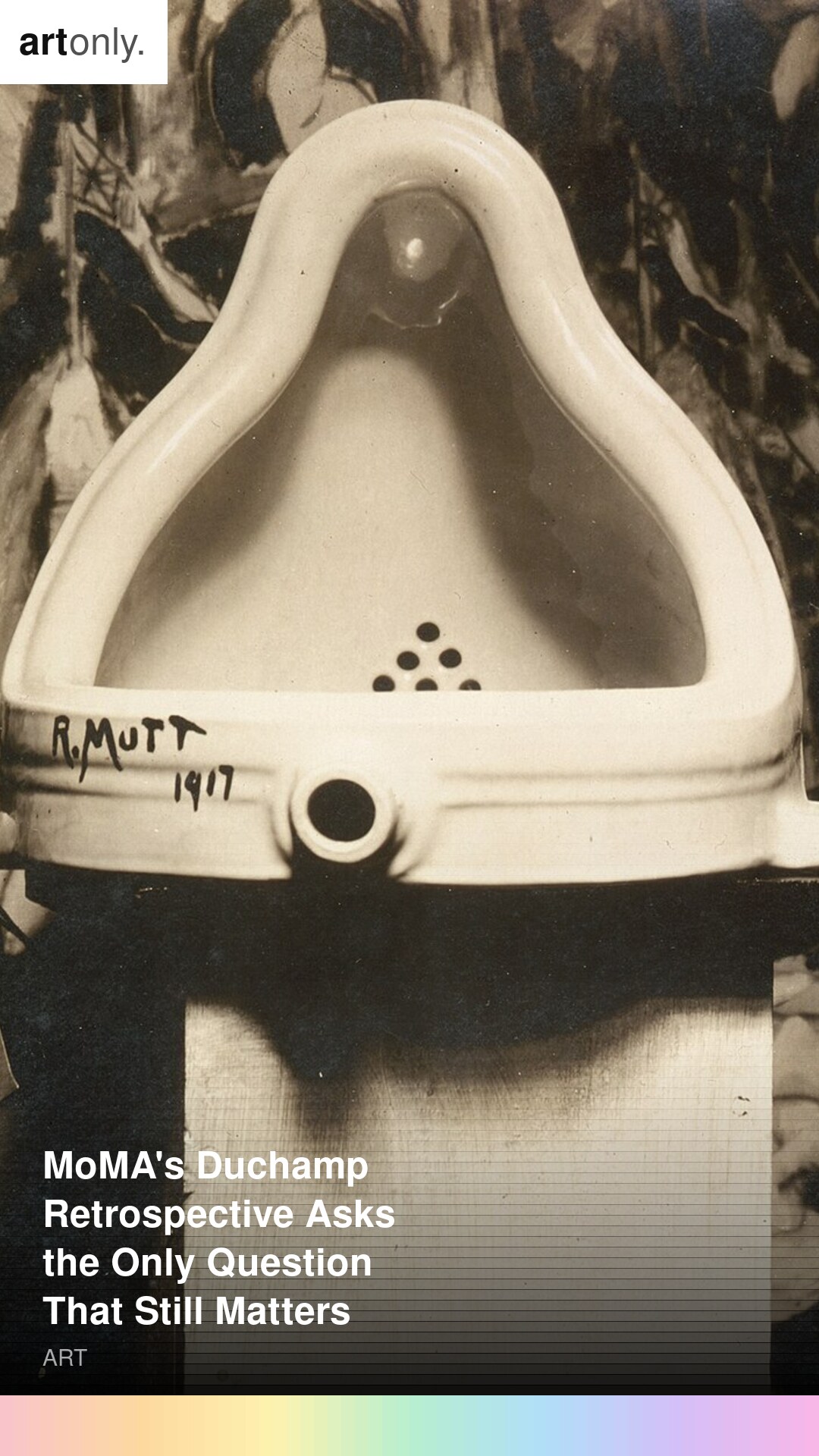
Marcel Duchamp put a urinal in a gallery in 1917 and the art world has been arguing about it ever since. A century later, the Museum of Modern Art has assembled nearly 300 of his works in a retrospective that feels less like a historical survey and more like a provocation aimed directly at the present.
MoMA is not a neutral host for this material. It is the institution that canonized modernism, that turned the avant-garde into curriculum, that made transgression safe enough to hang on a wall with a placard. Showing Duchamp here, in the building that represents everything he spent his career undermining, is itself a curatorial argument. The tension between the work and its institutional frame is part of what makes the retrospective worth attending.
The Readymade in the Age of AI
Duchamp's readymades, ordinary objects elevated to art through the act of selection and context, anticipated the AI debate by a hundred years. When Duchamp signed a urinal and called it Fountain, he argued that the idea was the art, not the object. The hand that made the thing was irrelevant. What mattered was the decision, the framing, the institutional context that transformed a plumbing fixture into a philosophical problem.
When a prompt engineer types words into Midjourney and calls the output their creation, they are making a structurally identical argument. The machine did the rendering. The human made the selection. Duchamp would have recognized this immediately, and he would have been amused by how aggressively both sides of the debate miss the point. The question was never about the hand. It was always about the frame.
The MoMA retrospective places these historical works alongside contemporary responses, creating a dialogue that spans generations. Nude Descending a Staircase hangs in the same building where visitors carry phones capable of generating infinite variations of any image imaginable. The Bride Stripped Bare by Her Bachelors, Even, with its mechanical figures operating in a system of frustrated desire and broken communication, reads differently in 2026 than it did in 1923. The machines have gotten more sophisticated. The frustration has not changed.
Nearly 300 Works
The scale of the show is itself a statement. Duchamp was famously prolific in his refusal to be prolific, spending decades on The Large Glass and The Etant Donnes while publicly claiming to have abandoned art for chess. Seeing nearly 300 works assembled in one space reveals an artist who was always working, always thinking, always undermining his own mythology.
The chess years are particularly instructive here. Duchamp competed at a serious level, studied endgames with genuine obsession, and produced annotated game theory that demonstrated a mind completely invested in formal problem-solving. He did not stop thinking like an artist when he played chess. He moved the arena of inquiry. The retrospective treats this period not as a retreat but as a continuation, and that reframing clarifies the coherence of his project across decades.
The early paintings show an artist who had mastered the conventions he would later demolish. The Cubist and Futurist influences in Nude Descending a Staircase are real and deliberate. You cannot understand the force of the renunciation without first seeing the competence. Duchamp knew exactly what he was walking away from. That knowledge is what gives the readymades their precision. They are not the work of someone who could not paint. They are the work of someone who decided that painting was no longer the most interesting question available.
Language and the Art Object
One underappreciated strand running through the retrospective is Duchamp's sustained attention to language. The titles of his works are not labels. They are components. Fountain is not a description of the object. It is a transformation of it. The gap between the word and the thing, the way naming changes the nature of what is named, occupied Duchamp throughout his career. His notes, manuscripts, and wordplay pieces are given serious wall space here, and they deserve it.
This matters because it connects Duchamp to a longer tradition of thinking about how representation works, one that runs from Magritte's pipe to conceptual art's instruction pieces to the metadata debates now circulating around AI-generated images. The question of what a title does to an object, what a signature does to an unmarked thing, has moved from gallery walls to terms of service agreements. The philosophical content has not changed. The stakes have gotten higher.
The Large Glass and the Etant Donnes
These two works anchor the retrospective and demand separate attention. The Large Glass, formally titled The Bride Stripped Bare by Her Bachelors, Even, took Duchamp sixteen years and was declared definitively unfinished after it shattered during transport and he spent a year reassembling the broken pieces, incorporating the cracks into the final work. The finished accident. The completed incompletion. This is either one of the most sophisticated gestures in twentieth century art or the most elaborate joke ever told, and the correct answer is that the distinction does not hold.
The Etant Donnes, assembled secretly over twenty years and revealed only after Duchamp's death, operates as both a sequel and a refutation. Where The Large Glass is transparent, mechanical, and cerebral, the Etant Donnes is opaque, bodily, and disturbing. Visitors peer through holes in a wooden door to see a tableau that refuses to be processed cleanly. The voyeurism is built in. The discomfort is structural. Together these two works constitute an argument about the relationship between the body and the idea that neither conceptualism nor figuration alone can contain.
Why This Matters Now
Every generation rediscovers Duchamp when it needs permission to question its assumptions. The conceptual artists found him in the 1960s. The appropriation artists found him in the 1980s. Now, in 2026, the AI generation is finding him again. Each rediscovery is partial. Each one takes what it needs and leaves the rest.
What Duchamp actually demonstrated is that the criteria for judgment are not fixed, that they are historically contingent and institutionally produced, and that recognizing this does not dissolve the responsibility to make and defend judgments anyway. The argument does not end because you have exposed the argument's assumptions. It continues on new ground.
The retrospective offers 300 occasions to think through these problems with some of the most rigorously conceived objects ever placed in a museum. The answer to his question has never changed: art is whatever we decide it is. The argument about that answer has never stopped. This retrospective is not a conclusion. It is an invitation to keep arguing.