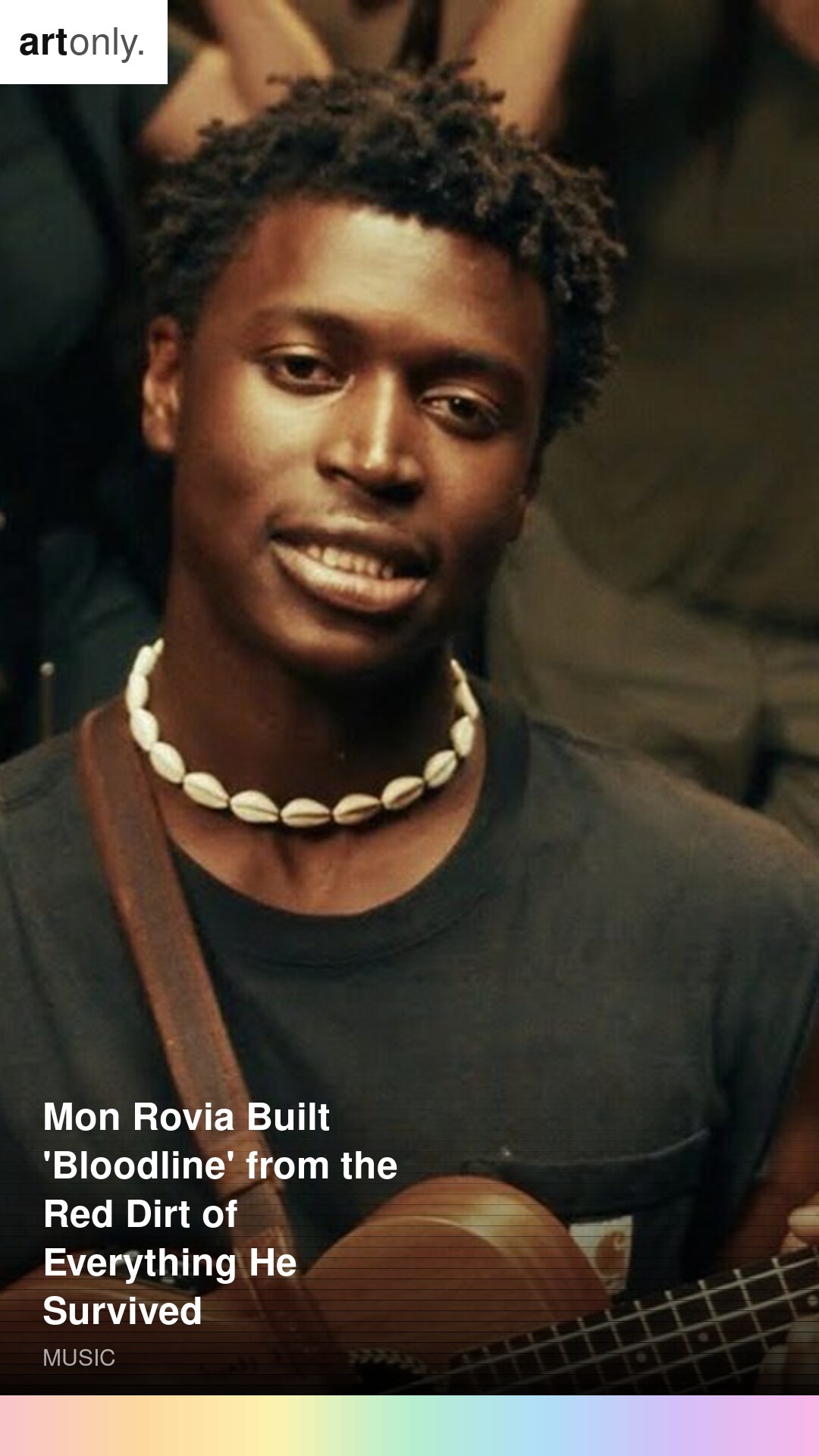
There is a particular stillness that settles over a Mon Rovia song before anything else happens. Not silence, space. The kind that invites you to sit down before it tells you what it needs to say. His debut album, Bloodline, released in January on Nettwerk, is sixteen tracks of that space, filled slowly and deliberately with the weight of a life that refused to stay buried.
The Sound of a Story That Waited Years to Be Told
Born in war-torn Liberia and adopted into an American family in Tennessee, Mon Rovia, born Janjay Lowe, his stage name taken from Monrovia, the country's capital, has spent most of his life negotiating the distance between where he began and where he ended up. That negotiation is the engine of Bloodline. It is not a record about answers. It is a record about the courage required to keep asking questions when you know the answers might not come.
The album opens with "Black Cauldron," a song that positions survival as devotion rather than triumph. "Whittle me 'til I'm little me, back to banyan trees, cassava leaves. War-torn screams, Maria, birthing me in a black cauldron." There is no swagger here. No overcoming narrative packaged for consumption. Just a man looking at the raw material of his own existence and deciding it is worth turning into song. The production on that opener is spare to the point of austerity: acoustic guitar, breath, and a vocal that sounds like it was recorded in a room where time had agreed to wait outside. That restraint announces immediately that Bloodline will not rush, will not perform catharsis on your behalf, will not offer you the emotional shortcut.
Afro-Appalachian Is Not a Genre, It Is a Geography of the Soul
What makes Bloodline impossible to file neatly is the way it moves through folk, soul, gospel, and protest without ever choosing sides. Mon calls his music "Afro-Appalachian," which is less a genre tag and more a declaration of lived reality. The acoustic textures are warm and unhurried. The harmonies feel like they were born in a church but raised in a field. Underneath it all, there is a rhythmic pull that owes as much to West Africa as it does to the Cumberland Gap.
The specific sound of Appalachian folk has always carried African roots that mainstream histories of country and bluegrass routinely understate: the banjo itself is a West African instrument, the call-and-response structures in mountain music trace lines back across the Atlantic. Mon Rovia's self-description as Afro-Appalachian is not a marketing concept. It is a correction. His guitar playing sits comfortably inside the fingerpicking tradition of the Tennessee hills while his vocal phrasing breathes with a rhythmic looseness that belongs to a different continent entirely. When those two things meet in a single phrase, the result is music that sounds both deeply familiar and entirely unlike anything you have heard.
"Heavy Foot" is the album's most overtly political moment, a song about systemic violence that Mon performed on the Kelly Clarkson Show in March, bringing prime-time television face to face with the word "genocide" in a way that felt earned rather than inflammatory. The arrangement on that track is more fully realized than the album's opener, with layered harmonies and a percussive urgency that builds without ever tipping into agitation. It was the kind of performance that reminds you what folk music was always supposed to do: tell the truth loudly enough that comfortable people become uncomfortable.
The Voice as Instrument and Archive
Mon Rovia's voice is the central instrument on Bloodline, and what it does technically is worth examining closely. His falsetto is not deployed for effect. It is used at moments when the lyrical content exceeds what chest voice can hold, when the emotional weight of a line requires a register that sounds less like assertion and more like reaching. The shift from his lower register into that upper range functions almost as a grammatical device, a change in tense or mood rather than a change in volume or drama.
The production, handled largely by Mon himself alongside a small group of collaborators, honors that voice by keeping the arrangements underneath it rather than around it. There are moments on Bloodline where the guitar drops away entirely and the vocal is simply there, unaccompanied, which takes a specific kind of confidence to record and release. Those moments do not feel exposed. They feel correct.
Why This Record Matters Right Now
There is a tendency in music criticism to celebrate debut albums that arrive fully formed. Bloodline does something more interesting. It arrives still forming. You can hear Mon working through his own becoming in real time, and the album is better for it. "Whose Face Am I" is not a rhetorical question. It is a wound dressed as melody. "Ten thousand roads I've walked on my own / Further I go, I'm closer to my ghost." That line alone contains more emotional intelligence than most artists manage across entire careers.
The album has already crossed 31 million streams, and Mon is touring through the summer with stops at major venues including Merriweather Post Pavilion. The numbers matter less than what they represent: an audience forming around an artist who refuses to simplify his story for anyone's comfort. That audience has found Bloodline largely through word of mouth and carefully placed live performances. There is no hit single driving the catalog streams. People are listening to the full album. That is increasingly rare behavior, and it reflects the kind of trust Mon has built with listeners who respond to music that treats their attention as something worth earning.
Refusal as Artistic Strategy
Bloodline is constructed around a series of refusals. It refuses the immigrant triumph narrative that American media typically demands from stories like Mon's. It refuses to resolve grief into gratitude. It refuses to make the adoption story legible as pure blessing. "Holding On," one of the album's quieter midpoints, sits with the complexity of love across cultural distance without flattening it into sentiment. The specificity of the language throughout the record, the cassava leaves, the Monrovia street names, the Liberian dialect phrases scattered through the lyrics, is not local color. It is evidence. Mon Rovia is building a record that will exist as documentation of a specific life, a specific geography, a specific set of losses and survivals that will not be generalized out of existence.
Folk music at its most functional has always done this. It has kept records of lives that official histories do not bother to preserve. Bloodline belongs to that tradition in the most literal sense.
Bloodline is not easy. It is not quick. It is not built for playlists or algorithmic discovery. It is built for the person sitting in the dark at 2 AM who needs to hear someone say: life does not have to end with suffering. There is always more after. Mon Rovia believes that. After sixteen tracks, you might believe it too.