Every few years someone does the thing that should not work, the revival that treats its source material with enough intelligence and enough irreverence in the right proportions, and it works so completely that you feel faintly embarrassed for having doubted it. Nia Archives is doing that with jungle and I keep coming back to her music with the slightly stunned quality of someone who has been proved wrong in the best possible way.
The word revival is probably wrong, actually. A revival suggests a museum piece, a careful restoration, the original thing dusted off and presented under glass. What Archives does is something more disruptive than that. She treats jungle the way a novelist treats genre: not as a set of constraints to honour but as a set of tools to use, to recombine, to work against as much as with. The Amen breaks are there. The bass is there. The tempo is there. But the emotional content is entirely her own, anxious, funny, vulnerable, occasionally furious, always specific.
Specificity as Radical Act
The thing that makes Nia Archives's music feel new even when the architecture is old is specificity. She is singing about being a particular person in a particular city at a particular moment in time, and the specificity is what cuts through. Pop music has a tendency toward universality: the love song that could be about anyone's love, the heartbreak that belongs to the maximum number of listeners. Archives goes the other way. Her records feel like dispatches from an actual life, with all the messiness and particularity that implies.
The jungle context makes this specificity more interesting, not less. Jungle was always music of a specific place and time and community, the raves, the pirate radio stations, the particular demography of 1990s Britain. Archives reconnects with that specificity without pretending to be in the 1990s. She is in 2023. Her concerns are 2023 concerns. But she understands that the music's original specificity is part of its power, and she honours that by bringing her own.
The Production Architecture
Archives produces her own music and the production decisions are where the argument lives. The Amen break that underpins jungle was chopped and time-stretched and pitched to create a particular kind of rhythmic energy: dense, kinetic, almost chaotic but with an internal logic that a trained ear can follow. Archives uses the same basic vocabulary but applies contemporary processing techniques that give the percussion a different texture. The breaks hit harder and decay faster. The sub-bass sits lower in the mix than the original recordings could accommodate on the hardware of the time.
But she is not simply upgrading the production values of a 30-year-old form. She is making structural choices that shift the emotional centre of the music. Her tracks tend to build more gradually than classic jungle and resolve less decisively. The energy accumulates without necessarily releasing on schedule. This creates a tension in the music that feels contemporary, that mirrors the specific quality of anxiety that belongs to her generation.
On Genre as Inheritance
There is a generational question in here that is worth taking seriously. What does it mean to inherit a genre? Not in the sense of being directly descended from its originators, Archives was not making music in 1993, but in the sense of growing up in the cultural aftermath, absorbing it as part of the landscape, finding it formative for reasons that are your own. The artists who make the most vital revivals tend to be those for whom the music was real and personal before it was cultural strategy. Archives clearly loves jungle. You can hear it in the production decisions, in the choices of sample and texture, in the way the music moves. This is not an academic exercise.
The wider context is also relevant: the resurgence of interest in UK rave culture, the retrospective attention being paid to genres that were widely dismissed as too Black, too working-class, too regional to be taken seriously by the mainstream critical apparatus that lavished attention on Britpop and its descendants at the same moment. There is justice in Archives making records that are acclaimed and visible. There would be more justice if the original music had been accorded the same status at the time.
What the Music Does
I have played Nia Archives to people who did not grow up with jungle and watched them immediately understand what it is for, which is to say, watched them start moving. That is the baseline test and she passes it with complete authority.
What I keep returning to is the laughter in the music, not literal laughter, but a quality of joy that is also knowingness, that understands what it is doing and takes pleasure in doing it. Jungle was always partly about pleasure. The sheer physical pleasure of being in a room where the music is right, where the bass is doing exactly what it should and the breaks are landing exactly where they should and everything is working. Archives has not lost that. The records make you want to move. They do what they are supposed to do, and doing what you are supposed to do with this kind of skill and this kind of love for the form is harder than making something strange. Strange is easy. Correct and alive and joyful is the hard version. Nia Archives is making the hard version.
Across the Floor
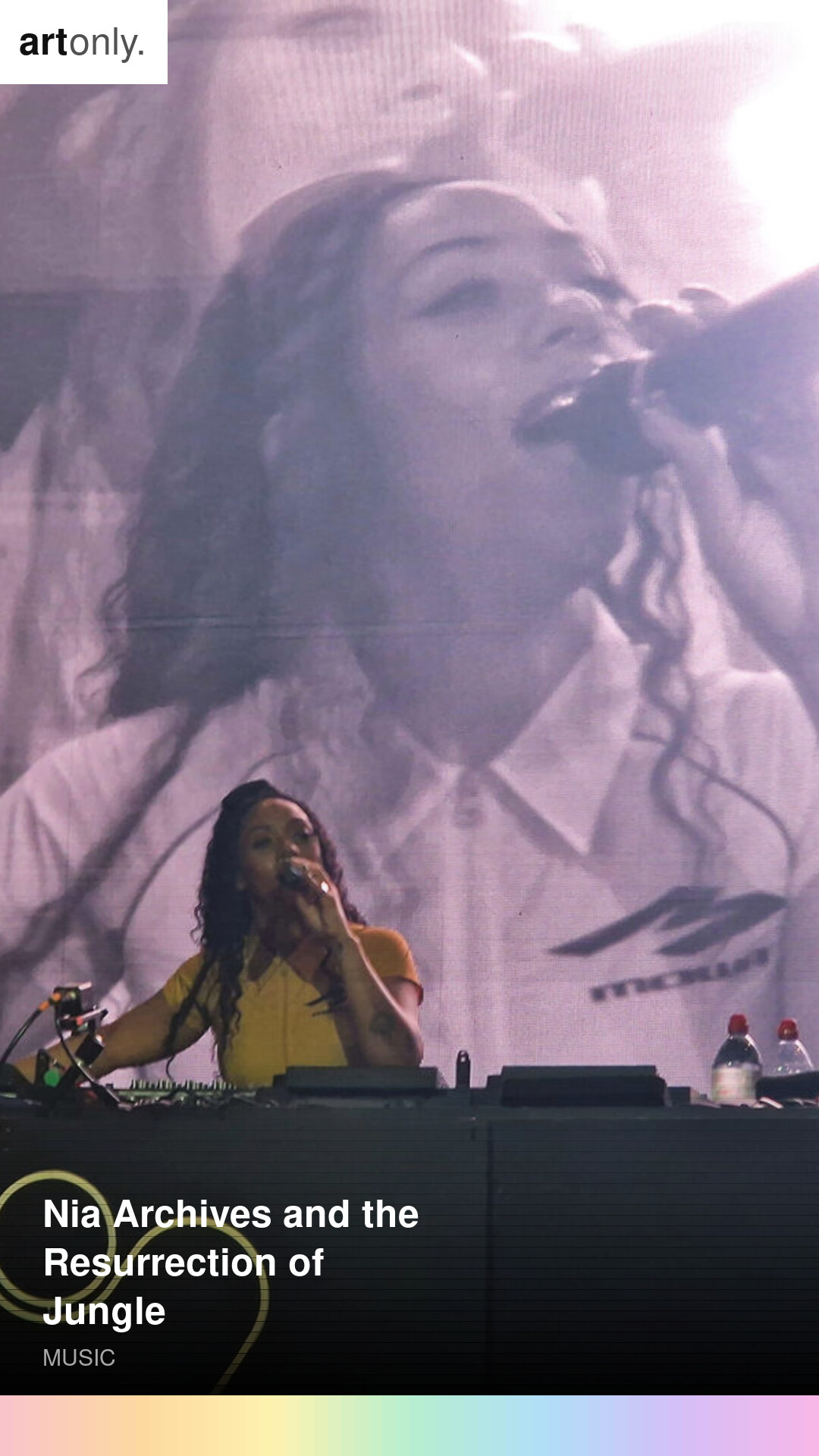
There is one more thing worth naming: the way Archives moves. She performs her music live, and the live context reveals something the records imply but do not fully demonstrate. The relationship between her body and the music, the physical intelligence that informs the production, is visible in ways that make the studio work more legible. The Amen break was always a body instruction as much as a sound. Its tempo and rhythm specified a particular way of moving, a particular energy that the dancer receives and returns. Archives understands this not as history but as present fact. The music is built for bodies, addressed to bodies, and completed by bodies in motion. The records are already good. In the right room, they become something more.
The thing about jungle, the thing that makes it different from most forms of electronic music, is that its emotional content and its dancefloor function are identical rather than separable. The breakbeat does not provide a platform for the emotional content. The breakbeat is the emotional content. Its energy, its intensity, its particular quality of propulsive forward motion, is the feeling, not a vehicle for the feeling. Nia Archives has inherited this understanding and made it entirely her own.