There is a version of "Wild Is the Wind" that most people know: Nina Simone, 1966, alone at a piano with a voice that does not so much interpret a song as dismantle it from the inside. It is one of those performances that makes you feel slightly reckless for even attempting a comparison. Most singers, wisely, stay away from it.
Niki Black did not stay away from it.
The London Archives
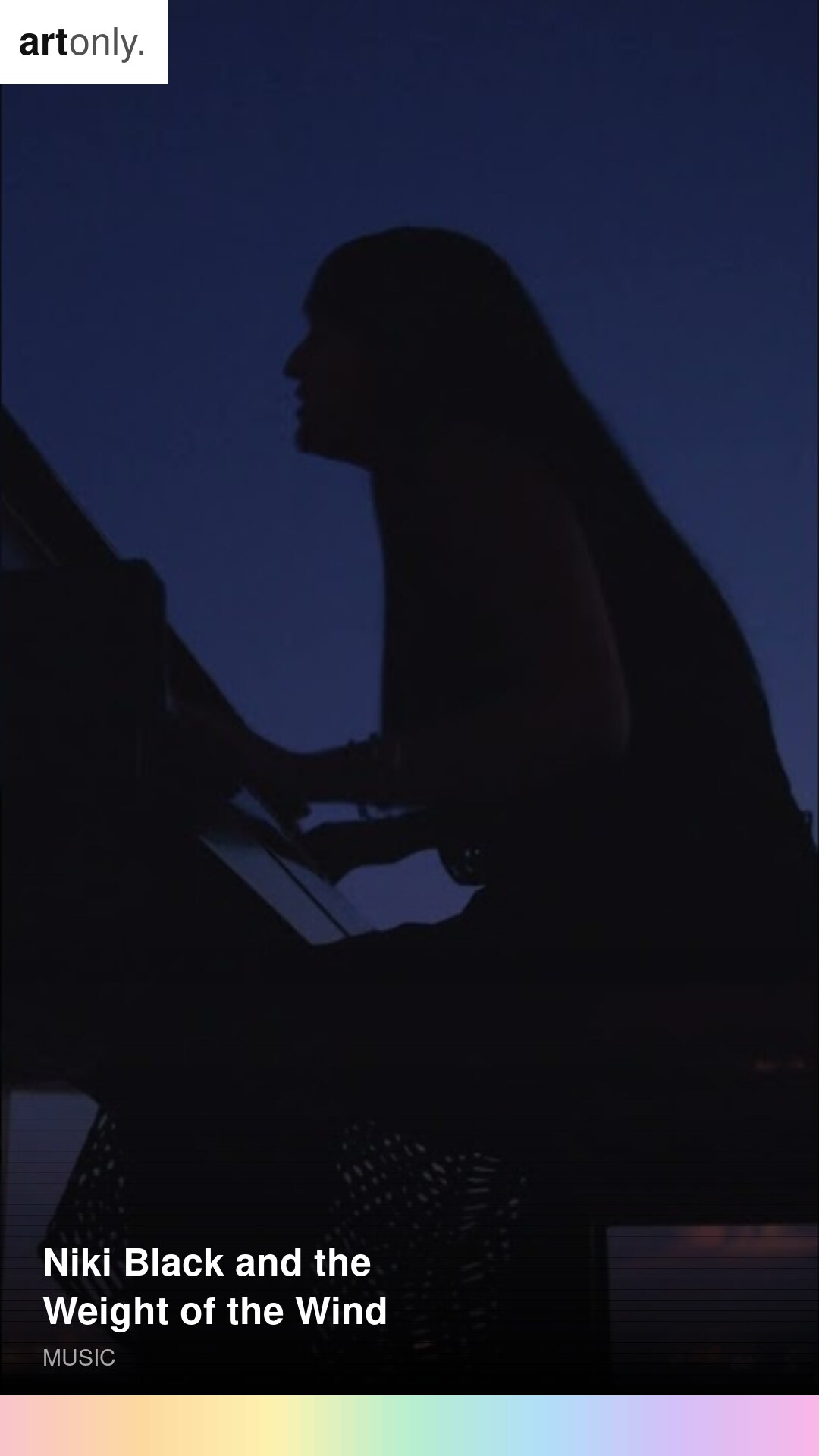
The session is called the London Archives. Filmed by director Amos LeBlanc, the Cannes Young Director Award winner behind some of the most precisely composed music visuals in recent memory, the footage has a quality that most performance videos only pretend to have: it looks like something actually happened there. Not a shoot. A moment.
Niki sits at a piano at what appears to be an elevated space overlooking London at dusk, the sky behind her shifting through blue, violet, deep indigo. She is silhouetted against it, hands on the keys, the city spread out below in bokeh points of light. LeBlanc frames her not as a performer being documented but as a presence inside a feeling. The camera does not move to show you more. It stays. It trusts the stillness.
What Niki does with the song is not an impression of Nina Simone. It is a conversation with her, informed, unhurried, completely without ego. She understands that "Wild Is the Wind" is not a vocal showcase. It is a song about the specific terror of loving something so much it terrifies you, and the way that terror becomes indistinguishable from the love itself. Like the leaf clings to the tree / oh my darling cling to me. The piano carries it. The voice floats just above the keys. Nothing is forced. Nothing is performed.
Who She Is

Niki Black is an Iranian-American singer-songwriter from Los Angeles, born to a Chicago-raised American father who gave her the blues and an Iranian mother who gave her Googoosh. She began playing piano at four. By the time she appeared on The Voice France Season 10 in 2021, performing Amy Winehouse's "Back to Black" at the piano, landing a chair, reaching the demi-finale, she had already spent years quietly building one of the more singular artistic visions in her generation. Two million people watched that audition. More should have kept watching.
Her own music, singles like "The Other Man", "American Spirits", "My Little Dreamer", and her most recent release "Paradies", operates in a space between opera, Chicago blues, and Iranian folk tradition. The theatricality is always earned. The emotion is never decorative. She branded herself "Hollywood Haute Mess" not as an ironic deflection but as an honest description of what it looks like to contain that many contradictions and still make something coherent out of them.
The Bluesman's Daughter and the Persian Singer
The dual inheritance is not a marketing concept. It is the actual condition of the music. Chicago blues is a tradition built on emotional directness and the transformation of pain into form. Iranian classical and folk music, particularly the tradition of tasnif and the great singers of the pre-revolution era like Googoosh and Marzieh, shares that directness while operating from a completely different tonal and melodic vocabulary. What these traditions share is an understanding that the voice is not a vehicle for a song but the song itself, the emotional content and the formal carrier collapsed into a single thing.
Niki Black has absorbed both. The result is a voice that does not fit neatly into any contemporary category, which is probably why she has not yet achieved the commercial recognition her talent warrants. Categories are how the industry processes new artists. She resists categorization at the level of the instrument itself.
The Weight of It
Nina Simone recorded "Wild Is the Wind" because she recognized herself in it. She heard a song originally written for a 1957 Western film, stripped away everything extraneous, and rebuilt it as a private declaration of need. It became one of the defining documents of her artistry, proof that the right voice applied to the right material does not cover a song. It reveals it.
What Amos LeBlanc understood in filming Niki's version, and what Niki understood in performing it, is that the song demands that kind of honesty or it gives you nothing. The London skyline behind her is not set dressing. The silhouette framing is not aesthetic choice alone. It is visual language for exactly what the song is about: something immense and shapeless and beautiful and slightly terrifying, moving through you whether you invited it or not.
Watch it twice. The second time, you hear more.
Follow Niki Black at @heynikiblack and on Spotify.
Why the Cover Matters Now
The history of "Wild Is the Wind" runs from Dimitri Tiomkin's 1957 film score through Johnny Mathis to Nina Simone's 1966 recording, which is the one everyone means when they reference the song, and then through David Bowie's 1976 version on Station to Station. Each interpreter brought a different relationship to the material. Mathis took the romance at face value. Simone transformed it into an assertion of selfhood that transcended the love song frame. Bowie used it as evidence of range, the balladeer capacity that his rock persona normally obscured.
Niki Black's version enters this conversation with something none of those recordings have: the contemporary context of a Black British woman singer finding her way to a song that Nina Simone made irreducibly her own. The comparison is unavoidable. Black does not avoid it. She addresses it directly by not addressing it at all, by approaching the song with the confidence of someone who has earned the right to be in the room with this material. She has. The vocal performance on the cover demonstrates a technical and emotional command that belongs to her alone. The lineage is present but so is the arrival at something new.
The viral numbers confirm that Black has found an audience that was waiting for exactly this kind of voice and exactly this kind of material. The question now is what she does with that attention. Based on the archival work she has been doing and the quality of the covers and originals she has been releasing, the answer will not be generic. This is an artist who is building something specific. The breadcrumbs are already there for anyone paying attention.