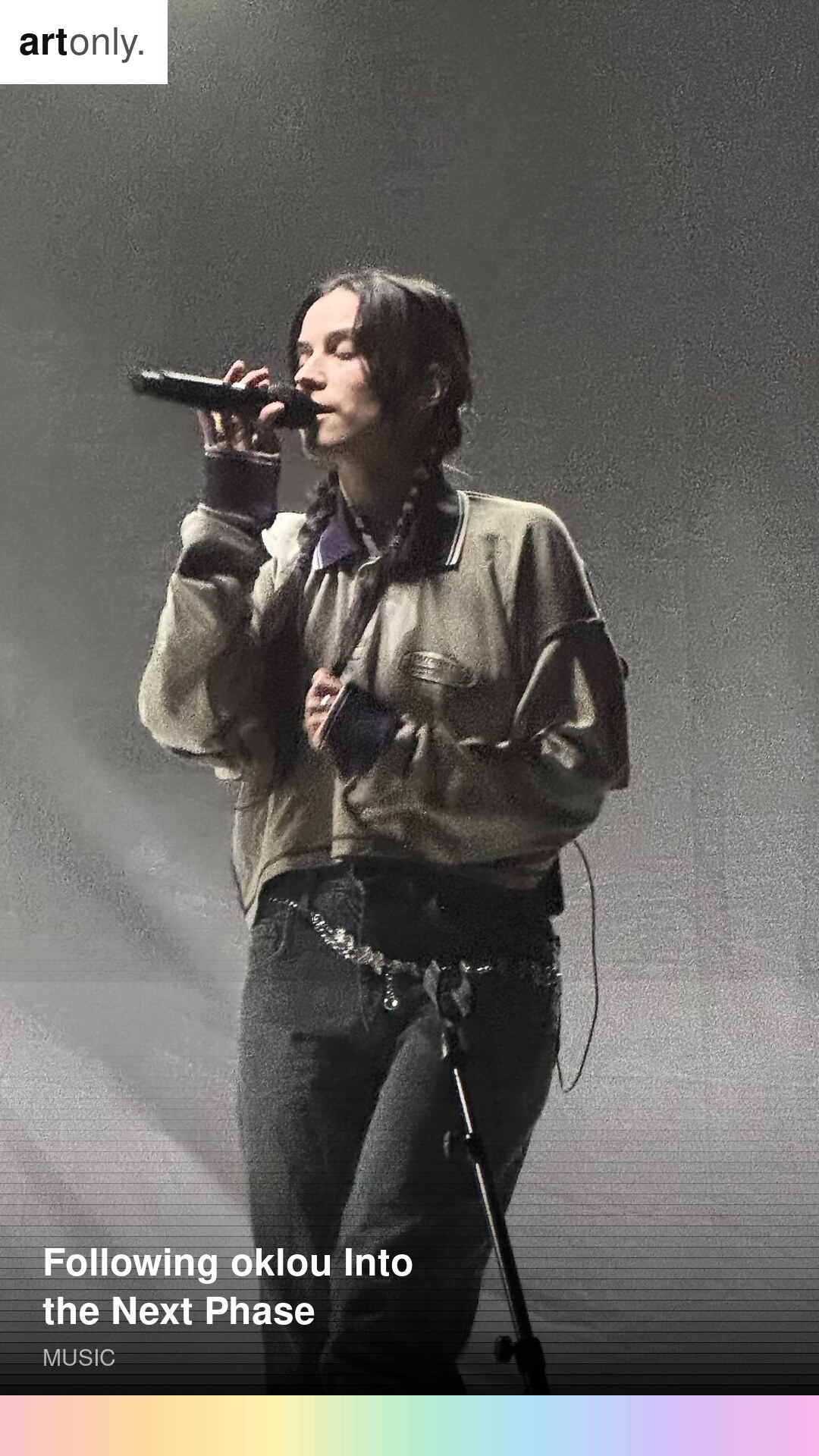
There are moments in a career when an artist stops being someone you discovered and starts being someone you follow, someone whose next move you are already thinking about even while absorbing the current one. Oklou crossed that threshold for me around the time of gdflt, the mixtape that arrived and proceeded to make itself necessary in my listening in a way I had not fully anticipated. I had heard the early work, the singles, the features, and I had thought: this is interesting, this is someone doing something. Then gdflt came out and I thought: this is someone who knows exactly what they are doing.
What Marylou Mayniel does with voice and production has a quality that is difficult to name but worth reaching for: something like granularity, a sense that the music has been worked at the level of the individual grain of sound, that every texture is a decision and every decision adds up to a total that could not have been reached by accident. The pop sensibility is there, there are melodies, there is structure, there is the occasional moment of directness that hits you before you have intellectualised it, but it is surrounded by an electronic environment that is strange enough to keep you off-balance.
The French Electronic Context
Oklou comes from a French electronic lineage that is more various than the international shorthand suggests. Yes, there is the house tradition of the Parisian clubs. But there is also a long history of experimental and musique concrete practice, of electroacoustic work that treats the studio as a compositional instrument, of artists who have pushed electronic music toward something that does not fit the dancefloor or the ambient category. Oklou operates in this tradition while also being entirely contemporary, entirely herself.
The specific French context matters for understanding the production philosophy. The GRM, the Groupe de Recherches Musicales, developed a tradition of treating recorded sound as raw material rather than document, of manipulating and transforming audio in ways that had no acoustic equivalent. That intellectual tradition is present in French electronic music even when it is operating far from the conservatory, even in music that sounds nothing like musique concrete. The understanding that production is composition, that the recorded object is the work rather than a representation of a performance, runs deep in French music culture.
Oklou's voice is the unexpected element. Pop voices placed in experimental electronic contexts often create a jarring disjunction, the legibility of the voice fighting with the illegibility of the surrounding production. Oklou's voice does not jar. It is processed in ways that make it continuous with the electronic elements rather than in contrast to them, so you are never quite sure whether you are listening to a person or a texture derived from a person. The ambiguity is productive. It keeps the question of what you are responding to open, which means the response stays live.
The Debut in Retrospect
With Choke Enough released in 2025 and the critical response confirming what the preceding work suggested, it is possible to look back at gdflt and the single releases that preceded the debut and see the line more clearly. Mayniel was building a vocabulary. The specific treatments of voice and synth and rhythm that appear in gdflt were experiments toward a language, a way of making music that would be fully realised in the debut album.
What is striking about that developmental arc is how consistent it was. Many artists spend the pre-debut period trying different things, pivoting toward whatever the current moment seems to reward, accumulating influences without settling into a position. Oklou's pre-debut work has a coherence that was only partially visible at the time. Looking back from Choke Enough, the continuity is obvious.
On Following
Following an artist through phases is a particular relationship, different from discovering a body of work retrospectively. When you follow in real time, you are invested in the trajectory in a way that retrospective listening does not require. You have something at stake: your reading of where the work is going, your sense of what the artist is capable of, your faith or lack of it in the decisions being made. When the next thing arrives, you bring all of that investment with you.
I followed oklou into the debut with a quality of investment that I have for very few artists currently making music. Choke Enough rewarded that investment completely. The production intelligence had deepened. The emotional range had expanded. The clarity of artistic vision, which was always the most striking quality of the work, had not been diluted by the scale of the moment.
The anticipation that following an artist creates is its own pleasure. Music that generates that quality of forward-leaning attention is rare and worth noting. The production on gdflt was making arguments at every moment: the reverb choices and the compression and the way elements sit in space, all of it doing work that contributed to what the record meant. Following her into each new phase is partly about following that production intelligence as it develops. The development has been extraordinary to watch.
The Structure of Following
Following an artist across a multi-release project like the gdflt series involves a specific kind of listening. You are not encountering each work fresh. You are bringing the context of the earlier installment, the expectations it generated, the questions it raised, the emotional territory it opened up. The follow album answers to all of that accumulated context while also standing on its own. The task is to satisfy and to surprise simultaneously.
The second gdflt installment does this by deepening rather than redirecting. The emotional vocabulary established in the first EP is present and extended. The production approach is consistent but not repetitive: the same sensibility applied to new material generates new outcomes. The continuity is the point. Oklou is building something that requires multiple encounters to fully inhabit, a world rather than a statement, and the follow album adds rooms to that world rather than redesigning the structure.
This approach to extended projects is increasingly rare. The industry incentivizes constant novelty, the pivot that resets audience expectations and generates a new cycle of attention. Oklou has not pivoted. She has gone deeper, and going deeper is the right call for music that was already pointing inward. The reward is a body of work that holds together, that makes sense as a continuous inquiry rather than a series of separate attempts to do different things.
The listener who arrived at Choke Enough from gdflt had been prepared. The preparation was audible in how the debut landed, in the quality of attention the audience brought to it. That kind of patient audience-building is its own achievement. Oklou earned it by trusting the work and the people listening to it.