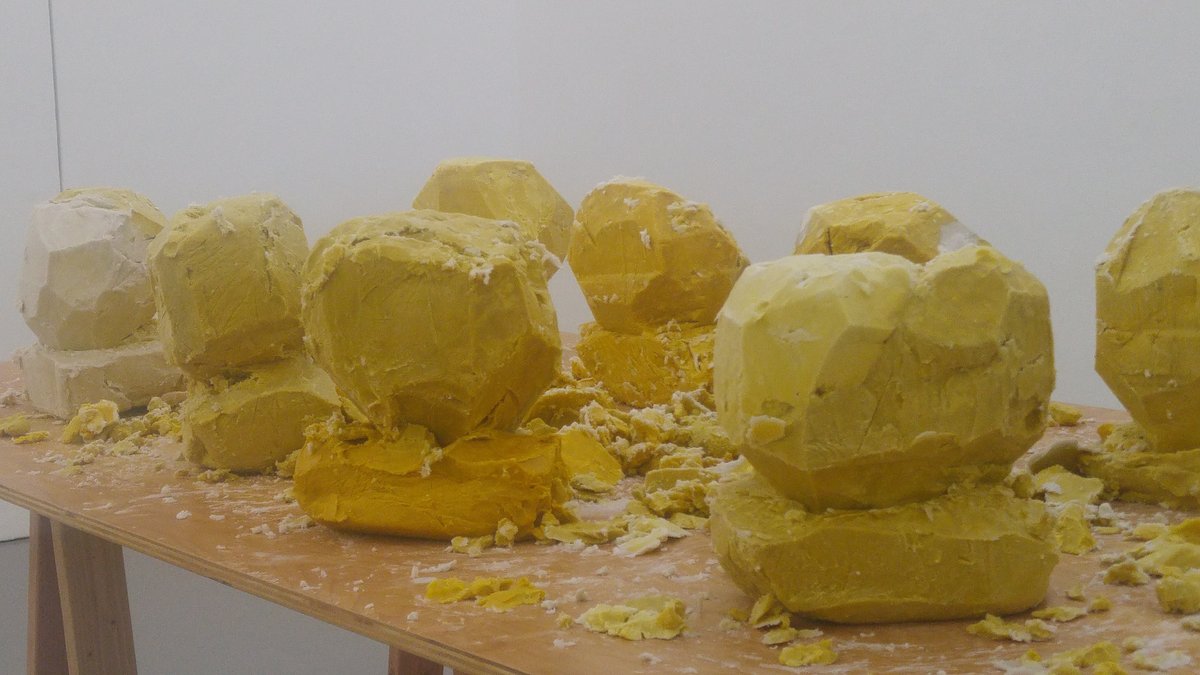
The Specific Weight of Shea Butter
Rashid Johnson's choice of materials is not decorative. Shea butter, black soap, plants, mirrors, books with their spines facing the wall, astronomic charts, wood shelving systems that suggest storage rather than display: these materials carry histories before they carry aesthetics.
Shea butter and black soap are products of Black domestic culture in America and across the African diaspora. They appear in medicine cabinets and kitchens, passed through family lines. Johnson uses them in his wall-based works as surface and pigment, smearing them across mirrored tiles until the reflective surface is partially obscured. The figure in the mirror becomes unclear. The clarity that mirrors promise is interrupted by material that carries a different kind of knowledge.
Anxious Men
The Anxious Men series began appearing in Johnson's work around 2014 and has continued in various forms since. Small figures are carved into surfaces made from shea butter and black soap, arranged on mirrored tiles in gridded formations. The figures are roughly rendered, almost expressionist in their abbreviated bodies and simplified heads. Their arms reach or clutch or cover faces.
The anxiety the series names is not abstract. It locates itself in the specific historical and social conditions of Black men in America: the threat of bodily harm, the management of visibility, the labor of navigating spaces built around your erasure or your threat. The figures are small enough to suggest vulnerability, numerous enough to suggest that this is not an individual condition.
Where an artist less committed to formal rigor might make this subject matter explicit through representation, Johnson makes it present through material. The shea butter does not illustrate anxiety. It carries it. The substance that Black mothers put on children's skin as a form of care becomes, in this context, a surface on which harm and its history are inscribed.
Antoine's Organ
Johnson's installation practice tends toward the accumulative and the living. Antoine's Organ, first shown in 2016 and reconstructed in several versions since, fills gallery space with a shelving structure housing plants, video monitors, books, and speakers playing Sun Ra compositions. The title references both the musician Sun Ra, born Herman Poole Blount (later Sonny Le Son Ra), and a kind of physical organ: the system as a body, the installation as something that breathes.
Sun Ra is important to Johnson's thinking because Sun Ra built an entire cosmology that located Black consciousness outside the bounds of the society that had systematically excluded it. Afrofuturism before the term existed. The claim that he was from Saturn, the adoption of Egyptian mythology, the name change, the relentless recording and touring: all of these were strategies for inhabiting a selfhood that American society refused to recognize.
Johnson's installations do not illustrate these ideas. They create conditions in which the viewer encounters them: through the smell of the plants, through the music in the space, through the physical fact of being inside something that functions as an organism.
The Mirrored Surface
Mirrors appear throughout Johnson's work with a specific function. They implicate the viewer. You cannot look at a Johnson wall piece without seeing yourself in it, or seeing the version of yourself that comes through the obstruction of the applied materials.
This is different from the mirror as vanity or the mirror as window. It is the mirror as site of contested reflection, where the image you receive back is partial, distorted, materially complicated. The history embedded in the shea butter and black soap interferes with the clean self-image the mirror would otherwise provide.
For a Black viewer, this carries one set of implications. For a white viewer, a different set. Johnson's work does not resolve this difference or smooth it over. It makes the divergent experience of looking a structural feature of the work.
The Practice Since 2020
Since 2020 Johnson's work has moved further into film and into large-scale public installations. The Tribeca Film Festival premiered Fly Away in 2022. His gallery shows have expanded the shelving structures into environments that take over entire rooms.
The core concerns have not shifted. Anxiety, Blackness, the inheritance of African and African American cultural traditions, the refusal of simple resolutions, the specific material weight of things that carry histories: these remain the organizing principles.
What changes is the scale at which the work makes its claims. Larger spaces, more presence, more insistence on the physical fact of materials in room. Johnson's work grows because the questions it asks have not become smaller or more answerable with time.