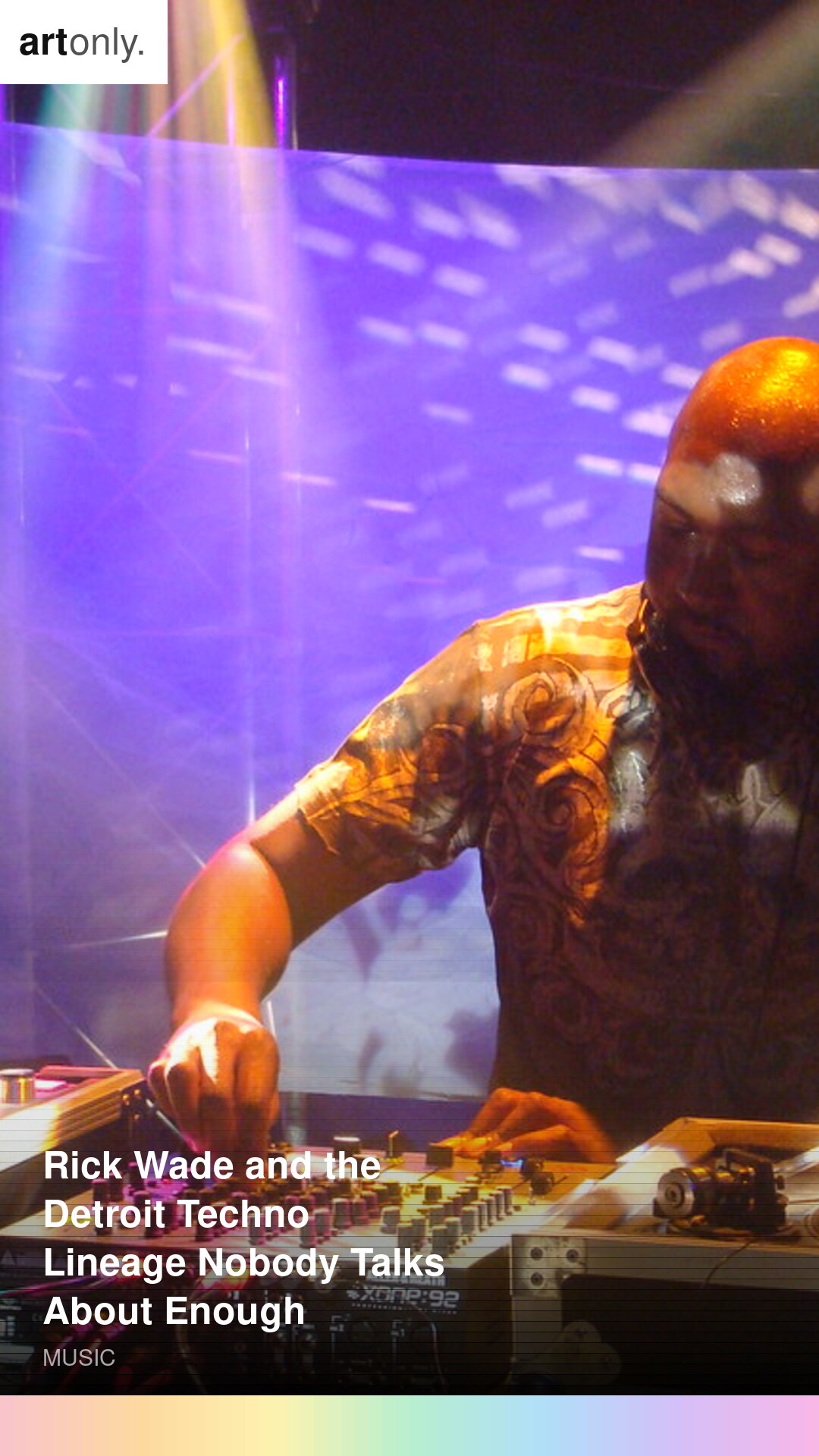
I keep coming back to this. I keep coming back to Rick Wade's records the way you return to a neighbourhood you grew up in, not because it has changed, but because you have, and suddenly you notice things you walked past a hundred times without seeing. Detroit techno has a mythology that is both well-documented and completely misunderstood. People know the names: Derrick May, Juan Atkins, Kevin Saunderson. People know the story of post-industrial collapse and the music that rose from it like something beautiful and severe out of the rubble. What people do not talk about enough, what I have been thinking about constantly, is the second wave, the artists who came after and carried the language forward without needing to announce what they were doing.
Rick Wade is one of those artists. He has been making music since the late 1980s and his output is staggering in the best way, prolific without being careless, consistent without being predictable. His tracks have this quality of arrived-at precision, like someone who is not trying to impress you because they are genuinely absorbed in what they are building. There is a Detroit release from 2021 that I have been listening to obsessively through the first months of 2022, and I find myself unable to explain to anyone exactly why it hits the way it does. It just does.
The Sound of a City That Won't Let You Go
Detroit techno was always about contradiction. It was futuristic music made in a city that was being abandoned by its future. It was music built for the body that was doing something to the mind at the same time, something architectural, something insistent. Wade works in that tradition but he is not nostalgic about it. His basslines feel like they were just discovered, not inherited. The rhythmic construction on his recent work has this almost stubborn patience, things take their time arriving, and when they do, you feel like you have earned it.
What I find hardest to describe is the emotional register. People call this music cold. I have never understood that. Detroit techno is some of the most emotionally direct music I have encountered; it just does not bother with the signposts that tell you how to feel. There is no string section swelling to cue your sadness. There is a kick drum at 130 BPM and a bassline that seems to be coming from somewhere underneath the floor, and something in your chest responds to it in a way that predates language.
Why the Second Wave Gets Written Out
Part of the reason Wade does not get the attention he deserves is the same reason that second-generation practitioners of anything tend to get written out of the founding story. It is tidier to have three names, a creation myth, a specific cultural moment. The messy truth is that musical lineages are alive, they continue, they branch and evolve through people who are doing the work without a publicist and without a retrospective exhibition at a cultural institution.
I think about the clubs that played this music in Detroit and Chicago and London, the sweaty underground rooms where Wade's records functioned exactly as designed, as total sonic environments, as spaces you could disappear into. There is something almost political about music that refuses prettiness, that insists on its own logic. Wade has been insisting on his for three decades and I do not think he is finished.
There is an interview I read where he talked about the experience of watching Detroit change, watching buildings come down and sometimes go back up, and how the city's relationship with its own history is complicated in ways that outsiders tend to flatten. He did not say his music was about that. He did not have to. You can hear it, not as illustration or metaphor, but as evidence. This is what it sounds like when someone has been in a place long enough to let it metabolise into something else entirely.
The Architecture of a Wade Track
The structure of a Rick Wade track rewards close listening in a way that a lot of electronic music does not, because the interest is not in surface variation but in what happens when you hold the same elements in proximity for a long time. The compression choices are specific and deliberate. The way he layers a bassline against a hi-hat pattern against a chord stab creates a kind of grid that the rest of the music can push against, and the pushing is where everything interesting happens.
The mixing aesthetic is worth noting. Wade produces records that sound like they were made in a specific room, with a specific set of tools, by someone with a specific relationship to those tools. That quality, a tactile sense of a human being making decisions at a desk, is increasingly hard to find in electronic music that has been smoothed and polished until it could have been made anywhere by anyone. Wade's tracks have fingerprints on them. You can feel the hand.
The Detroit context matters here too. The city's sonic identity, shaped partly by the physical characteristics of the club spaces where the music was developed, produced music that is built for bass frequencies at volume. Wade's records demand good speakers. They reward being played loud. That is not a casual feature; it is the result of music that was developed in relationship to a specific listening context and has never lost that grounding.
What Three Decades of Work Sounds Like
I keep putting on his records when I am alone late at night and finding that they do exactly what I need them to do, which is to be completely themselves. That is rarer than it sounds. The records do what they were always going to do, regardless of whether anyone pays attention. That independence from validation is part of what makes them trustworthy. Rick Wade has been making music without needing external permission for decades, and the music carries the confidence of that independence. I trust it completely.
The 2021 material sits in a line that goes back decades and forward to whenever he decides to make the next thing. The through line is not sonic consistency in a narrow sense; the music has evolved and the production has developed over thirty years of work. The through line is commitment to what the music is supposed to do. It is supposed to move you. It does. Every time.