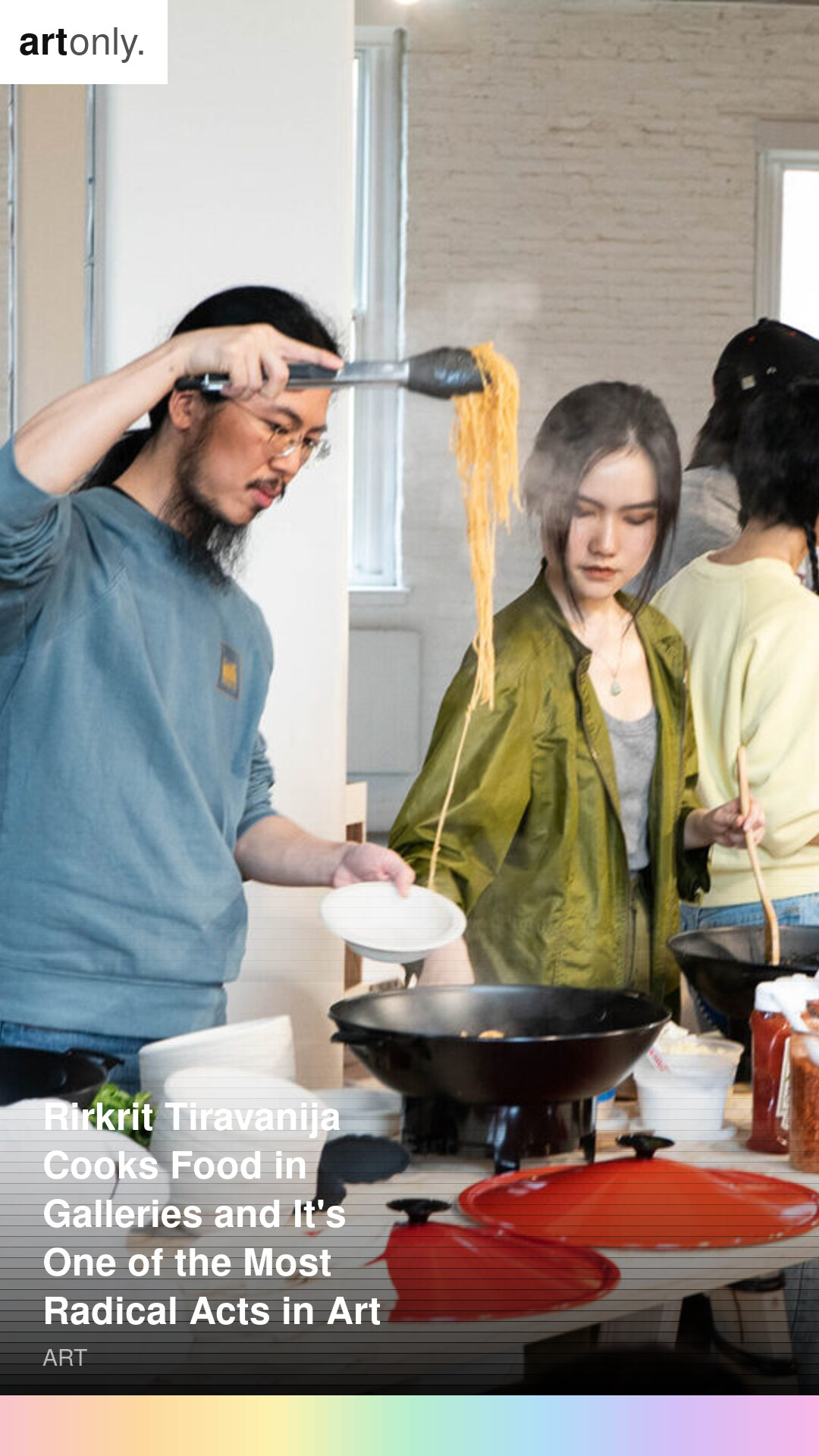
In 1992, Rirkrit Tiravanija cooked Thai curry in a gallery. He set up a camp stove in the back room of 303 Gallery in New York, cooked, and served it to whoever came in. The gallery was the kitchen. The artwork was the cooking. The art object, if there was one, was the pot, the smell, the conversation, the act of being fed.
This sounds simple. It is not simple. It is actually one of the more quietly radical propositions in contemporary art: that the artwork is not a thing but a situation, not an object to be contemplated but an experience to be lived, and that the experience of sharing food, of the hospitality that cooking represents, of the vulnerability and trust that eating together requires, is a legitimate artistic medium.
Tiravanija has been cooking in galleries and art spaces across the world for more than thirty years now. His practice has expanded to include other forms of social engagement, but the cooking remains central and has become one of the most discussed bodies of work in contemporary art, studied in every art school and debated extensively in critical literature. He received a significant retrospective recently that attempted to document what is fundamentally undocumentable, a practice that exists in its doing and resists the museum's impulse to preserve.
The Problem of Documentation
How do you show work that is fundamentally about presence and participation in a context designed for contemplation? The retrospective's answer involved reconstructions, photographs, the original equipment, the pots, the stove, the table, presented as sculptural objects. These objects are interesting, but they are not the work. The work was the feeding.
This paradox goes to the heart of relational aesthetics, the theoretical framework that Nicolas Bourriaud developed in part to describe what Tiravanija and his contemporaries were doing. The claim was that the artwork was the relationship generated by the work, not the object that generated it. This was radical in art world terms and also genuinely difficult for the art market, which depends on objects that can be bought and sold.
Tiravanija's solution has been elegant: he sells the props, the stoves, the furniture, while the events themselves are given freely. The market gets its objects, the public gets the experience, and the distinction between them says something important about what we value. This three-decade experiment with art as hospitality has generated an enormous amount of critical writing but its most significant effect is probably simpler: a lot of people were fed, a lot of conversations happened, a lot of unexpected connections occurred in gallery spaces that are not usually designed for any of those things.
The Social Turn and Its Discontents
The critical conversation around relational aesthetics was not without its skeptics, and the skepticism was worth taking seriously. Claire Bishop's intervention, published in response to Bourriaud and widely debated in the mid-2000s, raised the question of whether hospitality was sufficient as a political act, whether the comfortable social relations produced in a gallery context amounted to anything more than pleasantness, whether art needed to produce antagonism as well as harmony.
Tiravanija's work exists at the center of this debate without resolving it. The curry dinner is not a confrontation. It does not produce the kind of disruption that a more overtly political work might demand. What it produces is a softening of the boundaries that usually structure gallery experience, the hierarchy between artist and viewer, the silence, the reverence, the sense that art is something you receive rather than something you participate in. Whether that softening is transformative or merely pleasant depends on what you think transformation looks like.
The Thai cultural context of the food itself is a dimension that the relational aesthetics frame sometimes obscures. Tiravanija is Thai-born and Argentine-raised, and the food he cooks is specifically Thai, not a generic hospitality gesture but a culturally specific one. Bringing Thai food into the gallery, into 303 Gallery on Greene Street in 1992, was a specific act that carried specific meaning about who belongs in what spaces and whose hospitality is recognized as art.
The Duration of a Practice
What remains after a performance, what the work leaves behind after the event, is one question that all time-based and relational art confronts. For Tiravanija the residue is partly material, the pots, the stove, the documentation, and partly relational, the memory of having eaten in a gallery, the relationships formed at his tables, the conversations that happened over the food.
But there is also a theoretical residue, a changed set of questions about what art is allowed to be, about where the line is between artmaking and cooking, between gallery and kitchen, between the aesthetic and the social. These questions have been asked more urgently and more widely because of his practice.
The thirty-year duration matters here. A single curry dinner in 1992 is an interesting proposition. Three decades of curry dinners, in galleries and museums and art fairs and public spaces across the world, in multiple countries and cultural contexts, constitutes something different: a sustained argument about the purpose of art and the relationship between artist and community that has accumulated enough evidence to be genuinely persuasive.
I keep coming back to the image of the curry on the stove in that New York back room in 1992. The simplicity of it. The radicalism of the simplicity. Thirty years later the conversation it started is still going.
The conversation his work started, about what art is and who it feeds and what the relationship between artist and audience can be, continues in every practice that has taken up the question of art as hospitality, as social practice, as something that requires participation rather than contemplation. That conversation is now part of the infrastructure of contemporary art. It came from a man cooking curry in a gallery in 1992.
The smell probably lingered. The best things do.