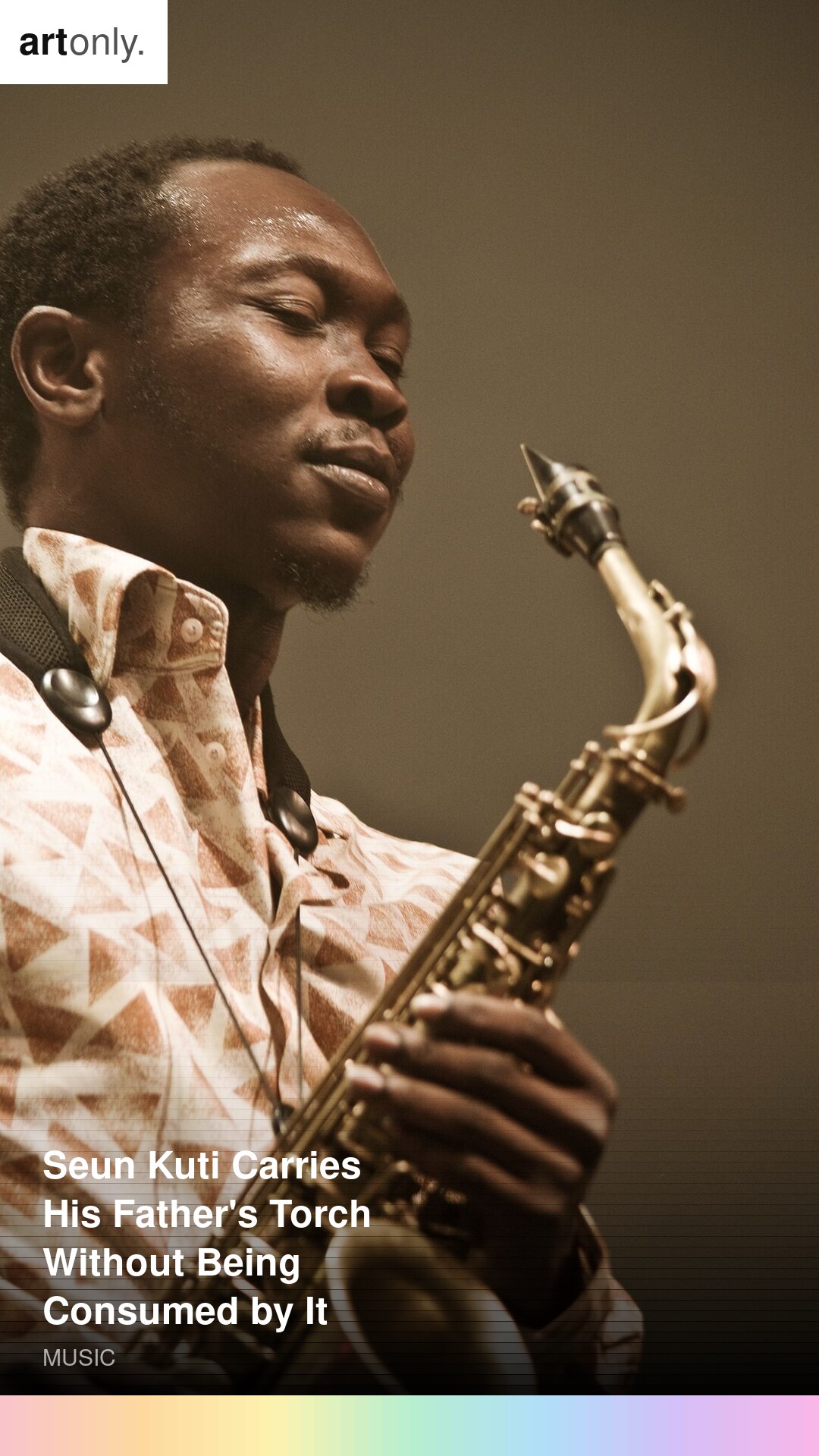
There is a specific kind of pressure that children of great artists carry, and it is different from ordinary pressure because it is public and permanent and attached to a name that does not belong only to them. Fela Kuti is not just a father; he is a cultural monument, a political symbol, a musical innovator whose influence on African music and on the global understanding of what music can do politically is genuinely without parallel. Being Fela's son and making music is a condition that could easily consume a lesser character. Seun Kuti is not a lesser character.
I have been listening to his recent work, the Egypt 80 band he inherited from his father, the new compositions that sit alongside a continued engagement with the Fela repertoire, and finding it increasingly difficult to talk about only in terms of the inheritance. Seun's own voice is clear enough now, his own concerns specific enough, his own musical intelligence sufficiently developed, that the father conversation, while not irrelevant, no longer dominates. He is his own artist who carries a legacy, rather than a legacy carrier who happens to be an artist.
The afrobeat he makes, and yes, Fela created and named the genre, and yes, Seun is in direct succession to it, is politically engaged in the most uncompromising way. This is music that understands that form and content cannot be separated, that the communal nature of the music, the multiple horns, the percussion section, the chorus vocals, is itself a political statement about collective action and collective joy. You cannot listen to this music and think that music is apolitical. It refuses the depoliticisation of form that most contemporary music accepts.
Egypt 80 as Living Organism
The Egypt 80 band is forty musicians, and Fela created them and Seun has led them for most of his adult life, and the experience of that continuous leadership is audible in the music. This is a band that knows each other. The tightness of the rhythm section, the way the horn lines interact, the particular energy of musicians who have been playing together for years and who have developed their own shorthand, these are qualities that cannot be manufactured or accelerated. They accrue through time, through the shared experience of performance, through the specific knowledge that comes from having played the same music in many different rooms for many different audiences.
The music swings in the technical sense, the phrase musicians use for the property of rhythm that makes it feel inevitable and joyful simultaneously, rather than merely metronomically correct, and that swing is partly the band's collective knowledge and partly something that Seun has inherited and developed in his own playing. He was nine years old when he started performing with the band. He has been doing this for his entire conscious life.
The Political Content Is Not Metaphor
Fela's afrobeat was explicitly political in a way that cost him dearly. He was beaten by soldiers acting on government orders. He was imprisoned. His mother was killed in an attack on the Kalakuta Republic. The music was not merely commenting on Nigerian politics; it was a site of resistance that the state treated as a genuine threat.
Seun carries this tradition with clarity about what it means. The political content of his music is not metaphor or artistic positioning. It is a continuation of a practice that understood music as a form of collective organizing, as a way of naming power and identifying its abuses in terms that everyone in the room could feel rather than merely understand abstractly.
The global context of contemporary afrobeat, the genre that has emerged from Lagos and Accra and other West African cities to become one of the dominant popular music forms worldwide, is both connected to and distinct from what Egypt 80 does. The plural afrobeats of contemporary global pop carries Fela's name in its etymology but has moved considerably from his political practice. Seun has been clear about this distinction without being dismissive of what has emerged. He understands the difference between a musical tradition that takes its energy from a political position and a musical tradition that has absorbed some of that energy into forms that serve entertainment rather than critique.
On Carrying and Extending
I find myself thinking about what the next generation of afrobeat looks like, what Seun's relationship to contemporary African music means for where the music goes. He is not naive about this. He has been in dialogue with contemporary artists, been part of conversations about what afrobeat means and who it belongs to and how it can develop without abandoning its political seriousness.
The torch he carries is not becoming heavier. If anything, the more clearly his own voice emerges, the lighter the inheritance seems. He is not crushed by it. He is using it. That is the only good way to deal with a legacy that large, and watching him do it is its own kind of satisfaction.
The music will outlast all the complications of legacy and succession that make writing about it so fraught. In twenty years what will matter is whether the records were good, and the records are good. Seun Kuti made music that deserves to be heard on its own terms. I am hearing it that way.
The Live Dimension
Egypt 80 as a live proposition is different from almost anything else in contemporary music. Forty musicians playing afrobeat at volume in a concert setting produces a physical experience that recorded music can represent but not replicate. The horn section alone, in a room that lets the sound accumulate properly, creates a kind of pressure that you feel before you interpret.
Seun has maintained the live practice as central rather than supplementary. This is not an artist whose primary existence is in the studio. The music was designed for performance, for the specific kind of collective experience that only happens when a large band plays for a large crowd and the boundary between the two becomes permeable. That experience is what Egypt 80 was built to provide and what it continues to provide, under Seun's leadership, with a consistency that is itself a form of political statement. The practice continues. The argument continues. The music does not stop.
The political dimension of afrobeat, which Fela built into the music's DNA, its very structure, the way it requires collective participation and refuses individual stardom even as it produced a star, is something Seun carries forward without rhetoric. He does not talk about it as much as he demonstrates it. The band, the collective experience, the music that can only exist as a shared act, these things are the argument. He makes the argument by making the music.