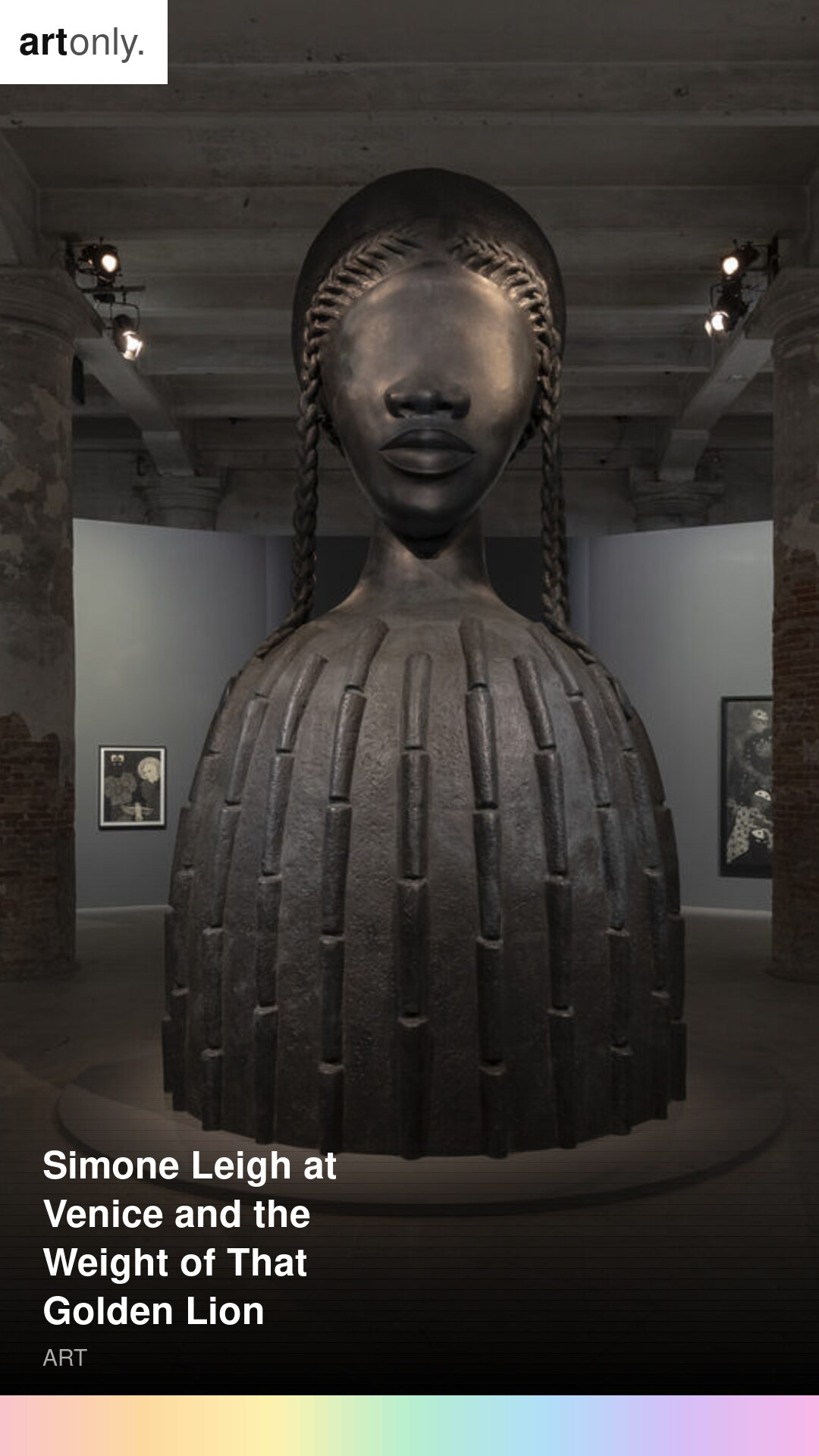
Simone Leigh became the first Black woman to represent the United States at the Venice Biennale in 2022. This fact is significant and the significance of it is uncomfortable. It is a first that should have happened long before, that is both an achievement and a reminder of the depth of the exclusion it partially addresses. The art world tends to celebrate firsts without fully sitting with what they mean. I want to sit with it for a moment.
The Biennale is a strange institution. A biennial exhibition that has existed since 1895, that represents the art world's version of national prestige, that has historically reflected the power structures of the world that hosts it. The American pavilion has been occupied over the decades by names that constitute a certain kind of art history. That Leigh is the first Black woman in that list is information about a hundred and twenty-seven years of decisions, of who was considered, of what the art world thought the United States should show the world.
Leigh's work, large-scale bronze and ceramic sculpture that draws from the history of African and African diaspora artistic traditions, that depicts Black female figures with a monumentality and a dignity that the Western sculptural tradition has rarely granted them, was perfectly, even painfully, suited to this context. Putting her work in the American pavilion was putting the thing the pavilion had historically left out directly at the center.
The Sculptures Themselves
The work Leigh made for Venice is among the most powerful of her career. The architectural and sculptural vocabulary she has developed over years, the thatch roofs that merge architecture and figure, the ceramic forms drawn from African aesthetic traditions, the bronze figures that feel genuinely monumental in a way that does not require scale to achieve, reached a kind of synthesis here.
The title of the exhibition, Sovereignty, is the governing concept. Sovereignty over one's body, over one's representation, over the space one occupies. The figures Leigh makes are not asking for anything. They are simply there, fully present, sovereign in the most literal sense.
I keep thinking about the quality of presence in these sculptures. The way they occupy space, the way they hold their ground, the way standing near them produces an awareness of your own body in relation to theirs. Sculpture at its best does this: makes the space between objects and bodies charged, makes being near something mean something.
The Sources and What They Mean
Leigh's formal sources are specific and chosen with intention. The thatch roof structures draw from vernacular African architecture, from the Baga and Fang traditions, from forms that Western art history has consistently treated as craft rather than art, as anthropological artifact rather than aesthetic achievement. By placing these forms at the center of work shown in the world's most prestigious exhibition venue, Leigh is doing something precise: she is reassigning the value the institution attaches to these traditions by force of the institution's own machinery.
This is not naivety about how institutions work. It is a sophisticated use of the institution against itself. The Biennale has conferred prestige on Western forms for over a century. Leigh uses that conferral mechanism to direct prestige toward forms the Western tradition has excluded. The strategy is visible and intentional, and it works because the work itself is undeniable.
The ceramic forms she places alongside the bronze figures carry a different register, smaller, more intimate, more obviously connected to craft traditions, to the history of women's labor in ceramic production. The combination of monumental bronze and intimate ceramic is not accidental. It holds together two scales of making, two registers of care, two modes of attention that Western aesthetics has typically separated into high and low.
What the Golden Lion Meant
Leigh won the Golden Lion for Best National Participation. The award is given by juries, which means it involves evaluation, debate, judgment by people with their own perspectives and limitations. That she won it does not mean the recognition is simple or unambiguous.
But it meant something. It meant that the institution, that particular institution, at that particular moment, recognized her work as the best of what it was doing. The first Black woman. The best national presentation.
Those two facts sitting together say something about where the art world is and where it has been and the distance between them. We are not done reckoning with that distance.
But the work is extraordinary. That is separate from the reckoning, and it matters separately.
After Venice
The sculptures will travel. They will appear in museums, in collections, in the increasingly diverse landscape of art world visibility that the last decade has been slowly, imperfectly building. They deserve the rooms they will be given and they will transform those rooms in the way that work of this weight always does, by making the space around them feel charged, by making you aware of the fact that you are in the presence of something made with absolute intentionality and complete seriousness.
Leigh's work has been building toward Venice for years. The Loophole of Retreat project, the Free People's Medical Clinic, the consistent emphasis on Black women's intellectual and creative labor as the subject of art rather than its invisible infrastructure: these are not separate concerns from the sculpture. They are the same concern expressed in different forms. The Venice presentation brought the sculpture into full visibility but did not change what the sculpture had always been about.
The first Black woman. It keeps coming back to that. Not because the work is a symbol, it is not, or it is not only that, it is much more than that, but because the fact of the first means something about how long the room was closed. We are still reckoning with what that closed room cost. The room being open now does not cancel the cost of it being closed. It just means the work can be seen. Leigh's work deserves to be seen. That is the clearest thing.