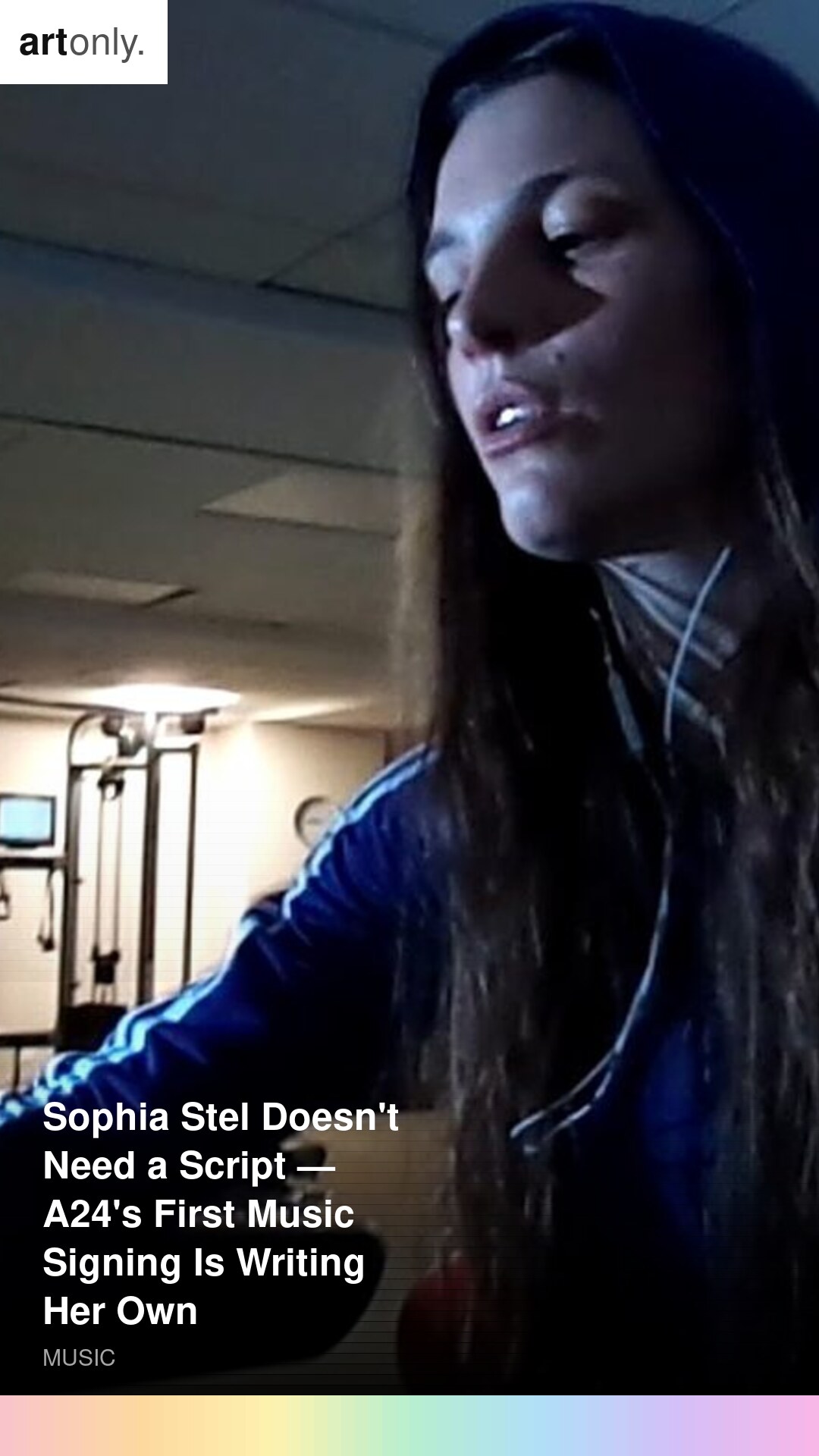
When A24 announced it was moving into music, the question everyone asked was: who? The studio that made grief beautiful in Moonlight, made chaos elegant in Everything Everywhere All at Once, and made Midsommar somehow the feel-good horror film of a generation, who would they trust with the sonic equivalent of that vision? The answer was Sophia Stel. A 24-year-old from Vancouver who records in the basement of a DIY venue. And that choice tells you everything you need to know about where A24 thinks music is going.
Solitaire Rules
The name of her second EP, How to Win at Solitaire, came from a moment that is almost too perfect as metaphor. Stel googled how to play the card game and found nothing useful, vague advice, no guaranteed outcome, just the sense that you have to figure it out yourself. That is her music in a sentence. It does not arrive with instructions. It does not tell you how to feel. It sits next to you and waits.
The original EP was written, produced, and recorded entirely by Stel in the basement of Paradise, a DIY venue in Vancouver where she was essentially living and working. The Deluxe Edition, released earlier this year on Pack Records, adds three reworked tracks that expand the project without betraying it. Mura Masa strips "I'll Take It" into an acoustic-rock space that somehow makes the song feel both bigger and more intimate. Tommy Genesis shows up on "All My Friends Are Models" with a verse that should clash with Stel's restraint but instead locks in perfectly. Cecile Believe, one of SOPHIE's closest collaborators, pushes "Everyone Falls Asleep In Their Own Time" toward an art-pop euphoria that keeps the original's melancholy intact.
What is striking about the Deluxe Edition is how little it tries to fix. The additions are not corrections. They are more like translations, the same text rendered in a different key, which only reinforces how strong the original material was. When a remix or rework lands badly, it usually means the source was thinner than it appeared. When it lands like this, it means the source had more room in it than anyone had fully explored.
The Production
Stel built How to Win at Solitaire in conditions that most A-list studios would describe as limitations. A DIY venue basement. Recording herself. The album sounds like it. That is a compliment. There is a particular quality to music made without the buffer of an engineer in a separate room and a producer watching the clock: decisions get made faster, instincts take over, and the songs end up carrying the actual texture of the moment they were made in.
Her production is minimal but never empty. The space in her arrangements is not absence. It is pressure. Dreamy synths layer over lyrics that offer observation rather than resolution, and the gap between those two things, between what is heard and what is concluded, is where the music actually lives. She is not a producer who fills that gap for you. She is a producer who makes it uncomfortable enough that you have to.
The closest sonic references are Ethel Cain, FKA twigs, and Imogen Heap. All three land without fully capturing what she does. Cain's weight is there, but Stel does not lean into martyrdom. Twigs's precision is there, but without the armor. Heap's orchestral instincts are there, refracted through something much more compressed. Stel is making a synthesis that does not fully resemble any of its inputs, which is the only kind of synthesis that matters.
The A24 of It All
There is a reason this partnership works, and it is not just branding. A24 has always been drawn to artists who make you uncomfortable in productive ways, who leave gaps in the narrative for you to fill. Stel does exactly that with music. Her songs are cinematic, but it is the cinema of small moments. Not the score to the car chase. The sound of the drive home after.
A24's track record in film is built on one consistent instinct: they back artists who are doing something specific rather than something broad. Moonlight was not a general story about identity. Hereditary was not a general horror film. Everything Everywhere All at Once was not a general multiverse blockbuster. Each of those films had a controlling idea that was precise enough to feel personal and expansive enough to reach a wide audience. Stel operates the same way. "All My Friends Are Models" is not a general song about alienation in a superficial social world. It is a specific, slightly absurdist observation that lands somewhere between dry comedy and genuine loneliness. That specificity is what makes it stick.
The partnership also signals something about where A24 is placing its bets on what audiences actually want. Not polish for its own sake. Not accessibility engineered through committee. Something that feels like it came from a real place, made by someone with a genuine point of view, who was not trying to please everyone in the room.
What the Tour Means
Her Europe and North America tour kicks off today, April 10, timed to the release of the Deluxe Edition. The more interesting thing is what the tour represents structurally. Stel has not built this moment through a viral TikTok strategy. There is no feature-stacking for playlist placement. The audience finding her is finding her through the music, which means the audience is self-selecting for people who actually want what she is making.
That is a slower build, and it is a more durable one. Artists who arrive through one viral moment have to immediately answer the question of what comes next. Artists who build through sustained quality have already answered it. Stel is in the second category. The tour is not an introduction. For a lot of people in those rooms, it will be a confirmation of something they already knew.
What Comes Next
Her debut full-length album is due this year. The EP has functioned as proof of concept, and the Deluxe Edition has functioned as proof of range. The album will be the first time she has to sustain an argument across a full-length format, which is a different challenge. EPs allow for intensity without development. Albums require both.
The bet here is that she handles it. The basement ethos, the self-production, the deliberate refusal to optimize for platform performance. These are not limitations she is working around. They are the method. The album will almost certainly sound like it came from the same place the EP came from, which is exactly what it should do.
The question is not whether Sophia Stel will break through. She is already doing it. The question is whether the industry will understand what she is doing before she outgrows its categories entirely. A24 understood early. The rest of us are catching up.