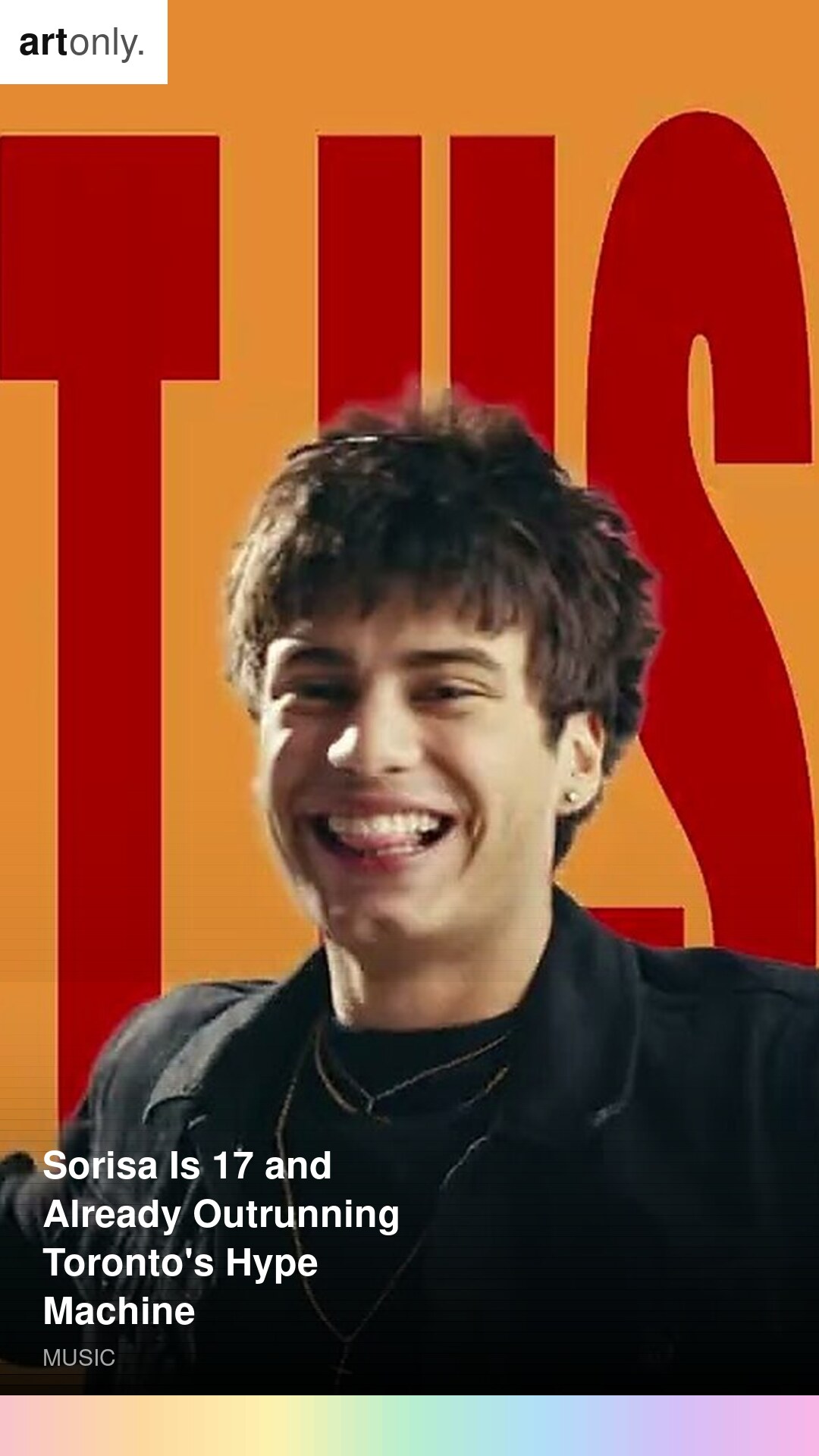
Toronto has a habit of producing artists who feel older than their years. Drake was already narrating his quarter-life crisis at 23. Majid Jordan were crafting R&B for people who had lived three lives by the time they hit 25. But Sorisa, born Sebastian Pena, currently 17 years old, is doing something different. He is not performing maturity. He is performing the chaos of being young right now, in real time, and making it sound like a genre that does not have a name yet.
The Numbers Don't Lie, But They Don't Tell the Story Either
"U Look So Good in Fall" passed 600,000 streams and counting. He sold out Lee's Palace, a venue that has launched careers and ended egos in equal measure. Atlantic Records signed him. Rolling Loud Orlando has him on the May 2026 lineup. For a 17-year-old from Toronto, that is an extraordinary trajectory. But the numbers are the least interesting thing about Sorisa.
What matters is the sound. His music sits at the intersection of hyperpop's synthetic maximalism and Toronto's atmospheric melancholy, a combination that should not work but does, because Pena treats both traditions with genuine affection rather than ironic distance. There is no winking at the audience. No self-aware posturing about genre. He simply makes songs that move between euphoria and sadness with the kind of speed that feels honest to the way teenagers actually experience emotion.
"U Look So Good in Fall" is the clearest proof of this. The song is not trying to be a hit in the way that calculated pop tries to be a hit. It moves like a feeling, not a formula. The production sits in that specific sweet spot between warmth and digital coldness, and Pena's vocal delivery refuses to choose between sincerity and performance. He sounds like he means it. That is rarer than it should be at any age.
Toronto's Next Wave
The city has spent the last decade being defined by a very specific sound: moody, atmospheric R&B with OVO's fingerprints all over it. That sound is not dead, but it has calcified. The next generation, artists like Sorisa, are pulling from different wells entirely. Hyperpop's shattered production. Electropop's sugar rush. The emotional directness of emo rap without the nihilism. It is a sound that feels native to a generation raised on TikTok's 30-second attention economy but still craving something that lasts longer than a scroll.
Toronto gave the world a particular vision of nighttime sadness, slow tempos, and introspection dressed up in luxury. Sorisa is not rejecting that legacy so much as running away from it at full speed. His songs are fast. They are bright. They are unashamed about wanting to feel good even when the lyrics are not necessarily happy. That is a meaningful departure from a city that has rewarded emotional withholding for years.
His EP I Love Colours, released late last year, is the clearest statement so far. Five tracks that move fast and hit hard, each one exploring a different shade of the same restless energy. The production is bright and slightly abrasive in the best way, the musical equivalent of neon at 2 a.m. The EP does not overstay its welcome. It arrives, makes its point, and leaves. That kind of editorial control, knowing when to stop, is something artists spend years learning. Pena arrived with it already installed.
What the EP Gets Right
I Love Colours works because it commits. There is a specific failure mode for young artists chasing multiple sounds at once: the music ends up belonging to no genre and serving no emotional purpose. Sorisa avoids this by treating each track as a complete argument. The production choices are deliberate. The tempo shifts are not accidents. When the energy drops, it drops for a reason, and when it surges, it feels earned rather than imposed.
The title itself is telling. Colours, plural, but also the specific spelling, the British English version that signals something about how Pena sees himself and his audience. It is a small detail, but small details accumulate into a worldview. The EP's worldview is that feeling things intensely is not a flaw to be corrected. It is the whole point.
Why It Matters
There is always a risk with young artists signed to major labels early. The machinery can smooth out the edges that make someone interesting. Atlantic has the resources to push Sorisa into a million playlists, but the question is whether they will let the rough edges stay. Right now, those rough edges are the whole point. The slightly unpolished vocals. The production choices that lean toward messy rather than pristine. The willingness to be loud and bright in a city that has rewarded darkness and restraint for years.
Major label relationships with young artists have a documented pattern. The first release is often the most authentic, because there has not been enough time for A&R feedback loops to sand everything down. By the second or third project, the fingerprints start to show. The vocal is tuned a little more aggressively. The production is a little more committee-approved. The edges that made the early work interesting get filed off in the name of radio readiness. Atlantic signed Sorisa for a reason, and that reason is exactly the thing they are most likely to try to change.
The hope is that Pena is stubborn enough to resist. The early signs are good. Lee's Palace was not a calculated stepping stone. It was a real show for a real audience in a city that does not give standing ovations out of politeness. The crowd showed up because the music moved them, not because an algorithm told them to. That is a different kind of proof than streaming numbers, and it is harder to manufacture.
The Live Dimension
Selling out Lee's Palace matters more than it might look on paper. The venue has a specific gravity in Toronto's music culture. It is not a stadium and it is not a bar. It sits in that middle space where artists either prove they can hold a room or expose the gap between what sounds good on a recording and what actually lands in front of people. Sorisa filled the room. The fact that this happened before his 18th birthday is not a footnote. It is the main story.
Rolling Loud Orlando in May 2026 is a different test. Festival crowds are not loyal. They are there for the spectacle, and they will drift if you do not hold them immediately. But hyperpop's kinetic energy translates well to outdoor stages, and Sorisa's music has the kind of propulsive forward motion that rewards a loud speaker system and a large crowd. The festival circuit will either accelerate his trajectory or expose cracks. Either way, the answer arrives soon.
What Comes Next
Sorisa does not need to be the next Drake or the next anyone. Toronto is big enough for multiple traditions. What he needs is time, the one thing the industry is worst at giving young artists. At 17, with Lee's Palace already behind him and Rolling Loud ahead, the clock is running. But listen to the music and you hear someone who is already running faster.
The specific sound he is developing, that collision of hyperpop maximalism and genuine emotional stakes, has room to grow. The question is not whether the talent is there. The question is whether the infrastructure around him is smart enough to leave it alone long enough to develop on its own terms. If it does, I Love Colours will look like the beginning of something. If it does not, it will still be a very good EP by a very young artist who briefly sounded like the future.