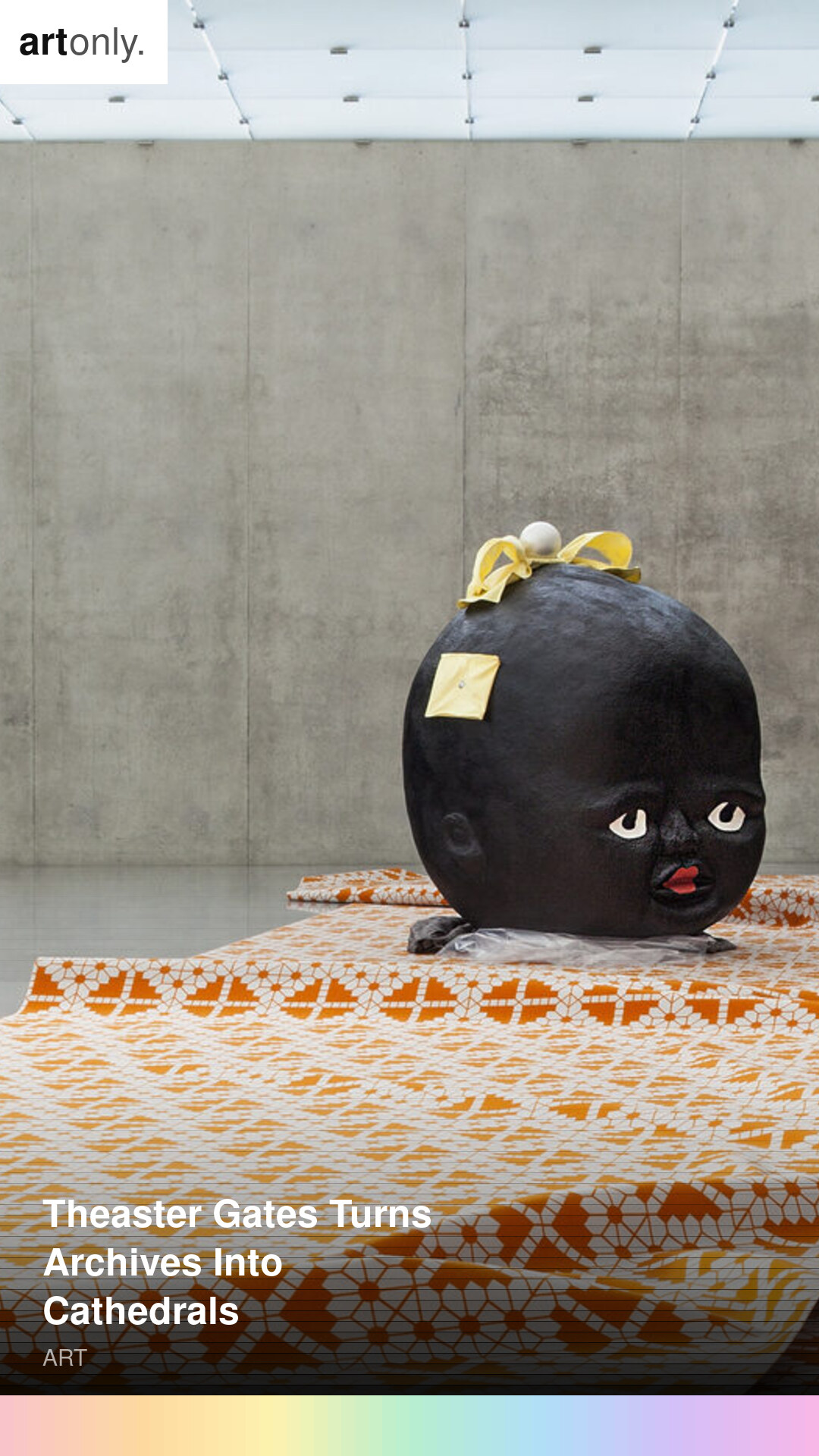
Theaster Gates's practice begins with things that would otherwise be lost, collections of vinyl records, archives of Black magazines and newspapers, the architectural salvage of abandoned buildings in Chicago's South Side, and transforms them into something that has the quality of monument without the coldness of monument. The archive becomes the artwork. The salvage becomes the building. The materials of a culture carry that culture into new forms.
His installation and exhibition work of the past few years has involved the Stony Island Arts Bank, a former bank building on the South Side that Gates purchased and renovated using income from his gallery work, turning it into a library, archive, and cultural centre, and a series of major international exhibitions that bring the materials of that archive into gallery contexts around the world.
What he does with this material in exhibition is not simply display it. He transforms the context. The gallery becomes something between a library and a cathedral, the objects accumulate into something that has an atmosphere, a weight, a sense of charged presence. The vinyl records stacked floor to ceiling in vitrines are not just collections. They are the visual representation of a culture's self-documentation, of the fact that Black musical culture was rich and abundant and is worth preserving.
What a Cathedral Does
I use the word cathedral deliberately and with awareness of its fraught relationship to the history of colonialism that Gates's work engages with. Cathedrals were built by powers that also enslaved. The form is not innocent. But Gates uses it knowingly, the soaring space, the quality of light, the sense of something sacred, in a reclamation that is both formal and political.
The Black archive is sacred. The materials of a culture are worth treating with this quality of attention, this quality of care. The cathedral form, applied to the collected evidence of Black life and creativity, is a statement about what deserves to be preserved and how it deserves to be treated.
This is simultaneously art practice and community development work. The distinction between them matters less in Gates's project than in almost any other contemporary art practice I know. The Stony Island Arts Bank is a real place where real things are stored and real community members have access. The gallery exhibitions generate income that funds the building and the archive. The two things are the same thing.
The Archive as Argument
The specific materials Gates works with carry particular weight. The Johnson Publishing Company archive, which Gates acquired and has worked to preserve, contains decades of Ebony and Jet magazines, publications that documented Black American life at a moment when most mainstream media refused to. These were the primary visual record of Black beauty, Black aspiration, and Black achievement for millions of readers across the mid-twentieth century.
Bringing these materials into gallery space insists that the standards applied to art objects, the conditions of preservation, the quality of institutional attention, be applied equally to the documents of Black culture. The act of preservation is itself a political act. It refuses the logic that says some materials are worth keeping and others are not.
The vinyl collections he works with operate similarly. Every record in those stacks is evidence of someone making music, pressing it, distributing it, building an audience for it. The stacks accumulate into something that no single record could convey: the sheer scale of Black musical production across the twentieth century, the abundance of creativity that commercial history has systematically undervalued.
The International Context
Gates's work has moved through major institutions across Europe, Asia, and North America over the past decade. The Serpentine Gallery in London, the Prada Foundation in Milan, Documenta in Kassel. Each of these institutional engagements brings the materials of the South Side archive into contact with audiences who have no direct relationship to the communities those materials document.
This creates a specific dynamic. The work travels. The community stays. Gates builds this separation into the structure of his practice, using international institutional resources to fund local community infrastructure, making the international context productive rather than merely extractive. The gallery in Milan receives the aesthetic experience. The Stony Island Arts Bank continues to operate in Chicago. That outcome requires sustained and deliberate management.
The Political Economy
There's a sophistication in how Gates has navigated the art market, using gallery sales and institutional commissions to fund community projects in ways that don't compromise either side. He's not selling out by being in galleries. He's using galleries to do something else. He's not romanticizing poverty by working in underserved communities. He's treating them as the cultural centers they are.
This pragmatism is itself unusual in an art world that often treats commercial engagement and political commitment as incompatible. Gates has found a way to make them aspects of the same project, and the elegance of that solution is part of what his practice demonstrates.
The cathedrals he builds from archival material are beautiful. They are also useful. Those two things being the same is, I think, the whole argument.
The cathedral built from archives. The sacred made from the discarded. These transformations are not metaphor. They are actual, physical, the result of real labor applied to real materials. The labor is visible in the work. That visibility is the argument.
The Labor
Gates trained as an urban planner before becoming an artist, and that background is visible in every aspect of his practice. The renovation of buildings, the organization of archives, the establishment of programs that serve community members are not sidelines to the art. They are the art, carried out through different materials and at different scales. The gallery objects and the community infrastructure emerge from the same intelligence and the same set of convictions about what is valuable and who decides.
That training also explains the patience the work requires. Urban planning is long-horizon thinking. You are working on timescales that extend past any individual career. Gates applies that same temporality to the archive: building something that will outlast him, that will be available to people not yet born, that will keep accruing value as the documents it holds grow older and rarer. The Stony Island Arts Bank is not a project with an end date. It is an institution, and Gates has committed to the labor that institutions require.