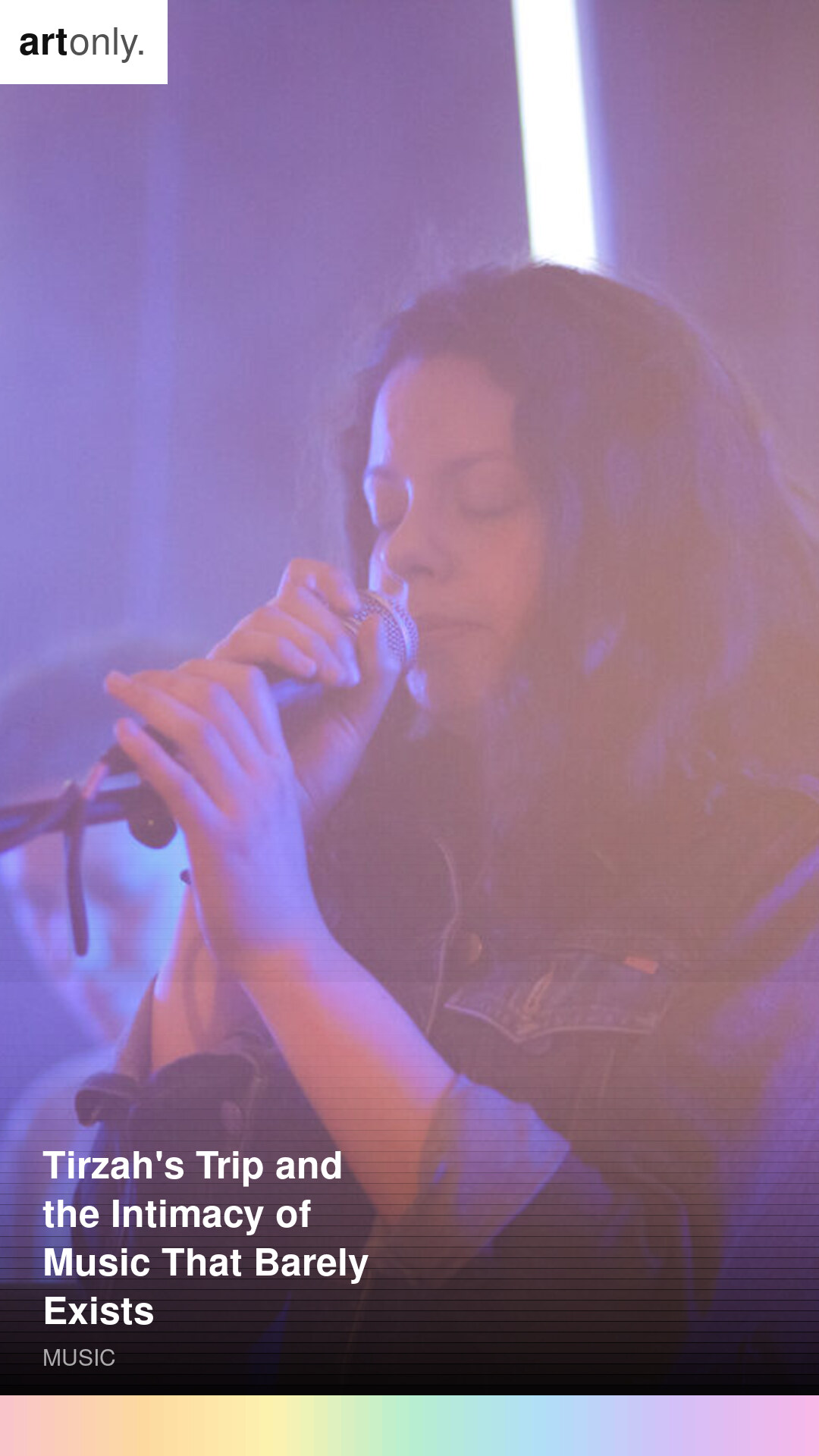
There's something unsettling about how good this is. I put on Trip for the first time in the back of a cab, headphones in, rain on the window, and I felt immediately like I was intruding on something private. Not private in the way of a diary entry that's been published against someone's better judgment, private in the way of a room where two people are having a conversation that has been happening for years, a conversation with its own shorthand, its own silences, its own grammar. Tirzah makes music like that. Music that assumes you already understand.
Coloured In, her debut, arrived in 2018 and made my year feel suddenly insufficient. She and Mica Levi, her longtime collaborator, the composer who did the Under the Skin score, who understands how unease can be beautiful, built something there that I still don't have the vocabulary for. It occupied a space between R&B and electronica and somehow avoided both categories' worst tendencies. By the time Trip came out I'd almost trained myself not to expect too much. I was wrong to have lowered my expectations. She hadn't.
Music That Withholds in the Best Way
What Tirzah does, what she and Levi do together, is withhold in a way that creates extraordinary pressure. There is almost nothing happening on these tracks and yet they are saturated. The production is skeletal: a few textures, a beat that sounds like it was recorded through a wall, a bassline that barely commits to being a bassline. And over all of it, her voice, which is not a conventional R&B voice, which is not trying to demonstrate range, which is simply present in the way that only a few singers ever manage to be simply present.
I've thought a lot about what presence means in a vocal performance. It's not loudness. It's not technical facility. It's something closer to the sense that the person singing is genuinely somewhere else, that you're overhearing rather than being performed at. Tirzah sings like she's talking to herself. There's a track called "Hive Mind" that has been living inside my head for weeks, a fragment of a thing, barely three minutes, and it contains more emotional information than most albums.
What Trip Actually Sounds Like
The record was made during lockdown, and that context is audible without being heavy-handed. Trip has the quality of music made in a contracted world, where the usual external stimulation is absent and the interior life becomes more vivid by necessity. The spatial quality of Levi's production throughout is particular: sounds that seem to come from different rooms, reverbs that suggest spaces larger than they should be, a general sense of recorded distance.
The track "Prayer" is where the record reaches its emotional center. It is not structured in any conventional sense, no verse, no chorus, no development that follows a recognizable arc. It simply holds a feeling in place for its duration. That is an extremely difficult thing to do. Most producers cannot resist the impulse to move a track somewhere, to develop it, to give it a sense of progression. Levi sits still. The track stays where it is. The effect is that of a long exposure photograph of an emotion, every detail held in perfect, still focus.
The Intimacy Problem
There's a problem that music faces when it gets this intimate, which is that it becomes very easy to dismiss as slight. Critics have done this to Tirzah. I've watched it happen in real time, the reviews that praise but hedge, that use words like "minimal" as if minimalism were a limitation rather than a philosophy, that seem faintly embarrassed by their own response to the music. We have a cultural habit of valuing scale. Big productions, wide emotional arcs, music that announces itself. Tirzah's music doesn't announce itself. It sits down next to you and says something quiet.
The scale of an emotional experience is not measured in decibels. I don't know why this needs saying but apparently it does. Trip is a small record that contains multitudes. It's about new parenthood, or it's about love during crisis, or it's about the way your interior life changes when the world outside becomes unbearable. Honestly, I'm not sure, and I'm not sure it matters. What matters is that it sounds like something true. It sounds like something that was made because it had to be made, not because there was a release cycle to fill or a brand to maintain.
I keep thinking about the word trip, the journey, the stumble, the altered state. All three meanings seem to apply. This album takes you somewhere. It doesn't tell you where you're going. I've been grateful for that lack of instruction every time I've put it on.
The intimacy is the achievement. Most music achieves scale and calls it success. Tirzah achieves intimacy and that is harder and rarer and more lasting. I keep going back to Trip not for what it proves but for what it is, which is small, private, true, and quietly, completely extraordinary.
I return to it at different intervals and find it somehow both familiar and renewed. That quality, the music that can be known and still surprise, is the rarest quality in pop music, where the logic of the form pushes toward everything being immediately legible. Tirzah makes pop music that is not immediately legible and that rewards the time you spend learning to read it. I've spent the time. The return is ongoing.
There is a version of this music that becomes background, that recedes into the space of a room and supports other activity. I've used it that way occasionally. But the fullest experience of Trip is the opposite of background. It is foreground in a way that demands the kind of attention you give to a conversation you don't want to miss. Put it on with headphones in a quiet room and give it an hour. What comes back is not ambient pleasantness. It is something closer to the particular relief of being understood.