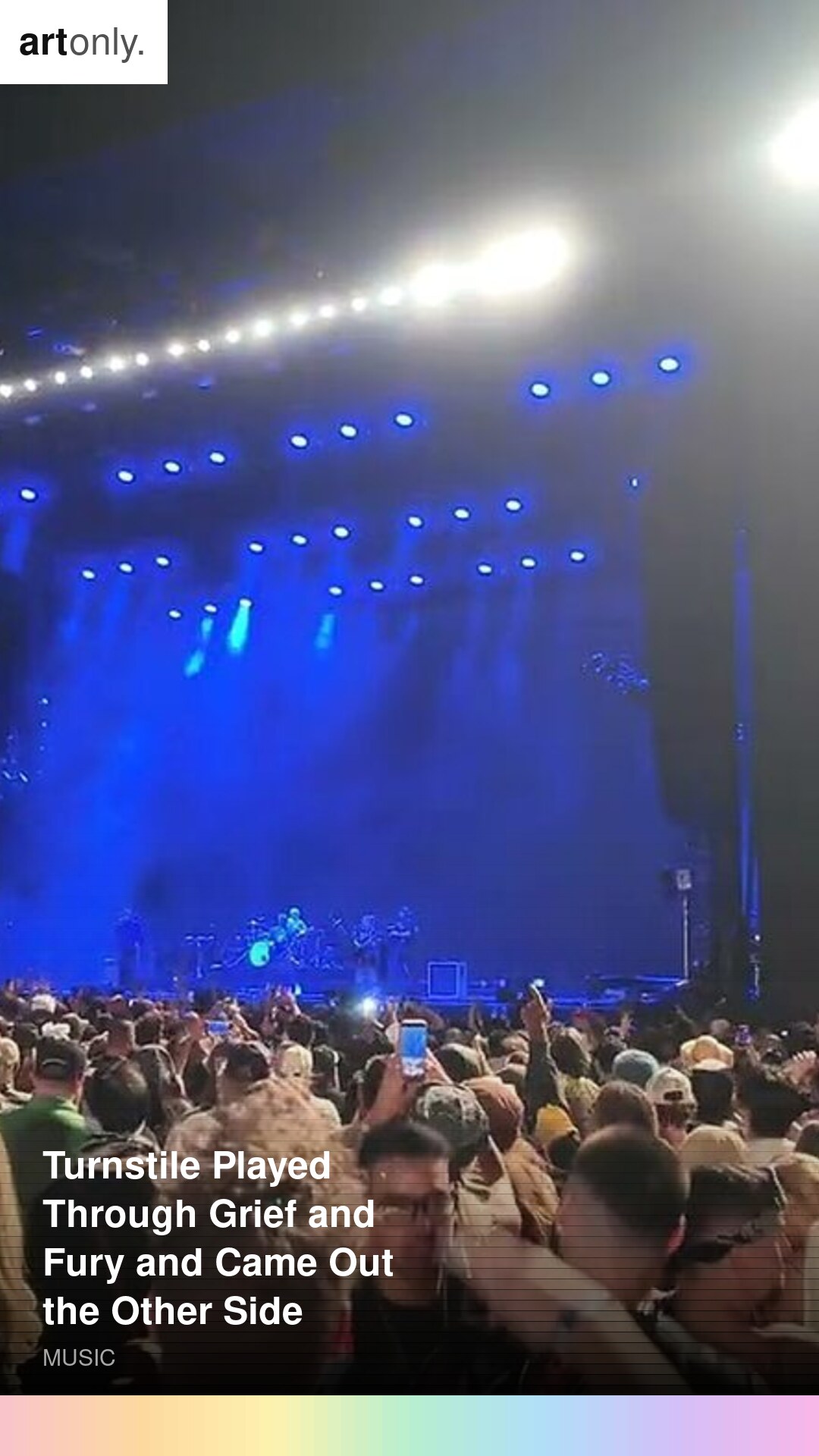
There is no version of Turnstile that holds back. That has been true since the Baltimore hardcore band started playing basements in 2010, and it was violently, beautifully true at the Outdoor Theatre on Friday at 8:05 PM, when they played what might have been the most emotionally loaded set of their career.
Three Mosh Pits Deep
Within the first thirty seconds of the opening track, three separate mosh pits had formed in the Outdoor Theatre crowd. Not the choreographed circle pits of festival hardcore, these were organic, chaotic, joyful expressions of a crowd that had been waiting all day for permission to lose it. Turnstile gave them that permission and then kept pushing.
The Grammy-winning "Birds" arrived early in the set and hit with the force of a band that knows exactly what that song means now. It's the track that took hardcore punk to the Grammy stage, the one that made rock critics and punk lifers argue about whether that was a good thing. Brendan Yates sang it like the argument was irrelevant, like the only thing that mattered was the room and the sound and the people in it.
The set moved between the GLOW ON material and cuts from Never Enough with a logic that was less about chronology than emotional escalation. Turnstile builds sets the way they build albums, with an understanding that the order of things matters, that a crowd's capacity for intensity is not fixed but trained, song by song, until what seemed like the peak twenty minutes ago is revealed as the setup for something more extreme.
The Dev Hynes Moment
Midway through the set, Dev Hynes, Blood Orange himself, walked onstage carrying a cello. "Seein' Stars," already one of the best rock songs released in the last five years, became something else entirely with live strings cutting through the distortion. The collaboration made perfect sense in a way that shouldn't work on paper. Hynes, the genre-fluid art-pop polymath, sitting with a cello amid the wreckage of a hardcore set, and the music breathed differently. The mosh pits paused. People looked at each other. Then the chorus hit and everyone moved again.
The Hynes appearance was the most visible example of something that defines Turnstile's particular position in contemporary music: the genuine cross-genre credibility that allows them to bring in collaborators from completely different worlds without the collaboration feeling like a stunt. Dev Hynes playing cello at a hardcore set is only possible because both parties have earned enough credibility in their own lanes that the crossover is legible as mutual respect rather than novelty.
Playing Through Pain
What most of the crowd didn't know, and what made the set resonate on a deeper frequency, was the context. Earlier that week, former guitarist Brady Ebert had been charged with second-degree attempted murder after allegedly hitting Brendan Yates's father, William Yates, with a car. The band did not address it directly. But after "Seein' Stars," a message appeared briefly on the screens: a tribute to Bill Yates, followed by a red tape heart in memory of Bo Lueders, the Harm's Way guitarist who died recently.
Yates stood still for a moment. The crowd held its breath. Then the band launched into the next song with a ferocity that felt less like performance and more like survival.
There is a specific quality that defines the best live music: the sense that something is actually at stake, that the performance is not a reproduction of a recorded product but a real-time event with real-time weight. Turnstile at Coachella 2026 had that quality in abundance. The grief was real. The fury was real. The physical release of the mosh pits was real. The music was the container for all of it.
What GLOW ON Built
The GLOW ON album, released in 2022, was the record that made Turnstile's Grammy eligibility legible. It demonstrated that their sonic range extended beyond the baseline expectations of hardcore punk without abandoning the genre's energy or values. The album incorporated funk, shoegaze, R&B influences, and acoustic moments alongside the abrasive core material, producing something that felt genuinely new rather than genre-blending for its own sake.
The Grammy nomination brought new listeners to the catalog. The Coachella set converted those listeners into the kind of fans who show up in the pit. What makes Turnstile at Coachella significant beyond the specific event is what the booking represents: an acknowledgment that the boundary between hardcore and mainstream festival culture has shifted. Turnstile did not soften to earn that slot. The festival adapted to accommodate them.
Why Turnstile at Coachella Matters
Hardcore punk at Coachella has always been a negotiation, the genre's intensity versus the festival's curation, the pit versus the sponsored lounge. Turnstile doesn't negotiate. They showed up as exactly what they are: a band that has won Grammys, sold out arenas, and still plays like every show is in a Baltimore basement. The Never Enough album cuts sounded enormous in the open desert air, and the older material, "Mystery," "Holiday," proved that the catalog is deeper than most rock bands achieve in twice the career.
The fact that Turnstile draws the same audience across both festival and basement contexts is the achievement. Most bands lose one constituency when they gain another. Turnstile has somehow retained both, which suggests that the music itself is the constant and the context is secondary.
Friday night belonged to a lot of artists. But at 8:05 PM, in the golden hour before the sun fully set, Turnstile owned the Outdoor Theatre in a way that felt permanent. Shows become permanent when what happens inside them exceeds what the show was supposed to be. What they delivered was a demonstration of what live music is capable of when the people performing it have nothing left to protect.
Follow Turnstile on Instagram: @turnstilehc