The Specific Sensation
There is a physical experience I associate with Heaven to a Tortured Mind, not a metaphor but an actual sensation, something in the chest and solar plexus, a feeling of rapid descent followed by an involuntary catch. Like a dream-fall. Like the moment before you step off a curb you did not see. Yves Tumor makes music that operates on the body before it operates on the mind, and this album is the most extreme version of that so far.
Yves Tumor, an American artist based in Europe whose gender presentation and personal information are deliberately ambiguous and always evolving, has been making music that resists categorization since at least 2016. The journey from the noise-textured early work through Safe in the Hands of Love and then to Heaven to a Tortured Mind describes an arc toward something that sounds almost like rock music but has been through so many other things on the way that it emerges transformed.
Heaven to a Tortured Mind came out in April 2020 on Warp Records to widespread critical acclaim, earning a Metacritic score of 88 and landing on numerous year-end lists as one of the defining records of that year. I was still inside it in 2022, still finding corners I had not fully explored. That is the kind of record it is. It uses the grammar of 1970s glam and soul, the guitar tones, the call-and-response, the kind of dramatic orchestration that sounds like curtains being drawn, but the context is entirely different, the emotional content more complicated, the sonic palette saturated to the point of distortion.
What Excess Reveals
This is an album that understands excess as a tool. The production is too much in exactly the right ways, too compressed, too dramatic, too willing to push guitar tones into feedback and let them stay there. It has been said that this is Yves Tumor's rock record, but that framing undersells how alien it sounds. It is rock the way a memory of rock filtered through forty years of subsequent music sounds.
"Kerosene!" is the track I keep reaching for as evidence. Three and a half minutes of something that should sound dated, the guitar tones, the screaming, the gospel-adjacent choir, and instead it sounds urgent and present and slightly dangerous. The danger is not threat exactly. It is more the danger of something genuinely feeling, genuinely reaching for something, genuinely unprotected by irony or aesthetic distance.
Yves Tumor's voice on this record is extraordinary. It moves between falsetto and chest voice with a fluidity that makes the transitions feel less like technique and more like emotional necessity, as if the voice is finding the register that the feeling requires rather than the other way around. There are moments where it breaks, where you can hear the effort and the strain, and those moments are the most alive things on the album.
The lead single "Gospel for a New Century," released to announce the album in February 2020, set the terms for what would follow. The title is both accurate and ironic. The gospel element is real, a tradition of transcendence and community summoned from below the surface of the noise. The "new century" framing acknowledges that the tradition is being brought forward through a great deal of intervening history. The two things together produce something that is neither pure gospel nor pure glam nor pure noise, but something that borrows the structural force of all three and produces a fourth thing in the synthesis.
The Question of the Body
Much of the writing about Yves Tumor focuses on identity, on queerness, on the way the music moves between genres and gender presentations, on what it means to build an artistic persona that refuses fixed legibility. That is all interesting and relevant. But I find myself most arrested by the physical qualities of this music, by the way it registers in the body before anything else.
This might be what glam was always doing and what the contemporary moment allows us to hear more clearly: the music as body, the music as sensation, the music as something that bypasses signification and goes straight to feeling. Not feeling as sentiment but feeling as physical event.
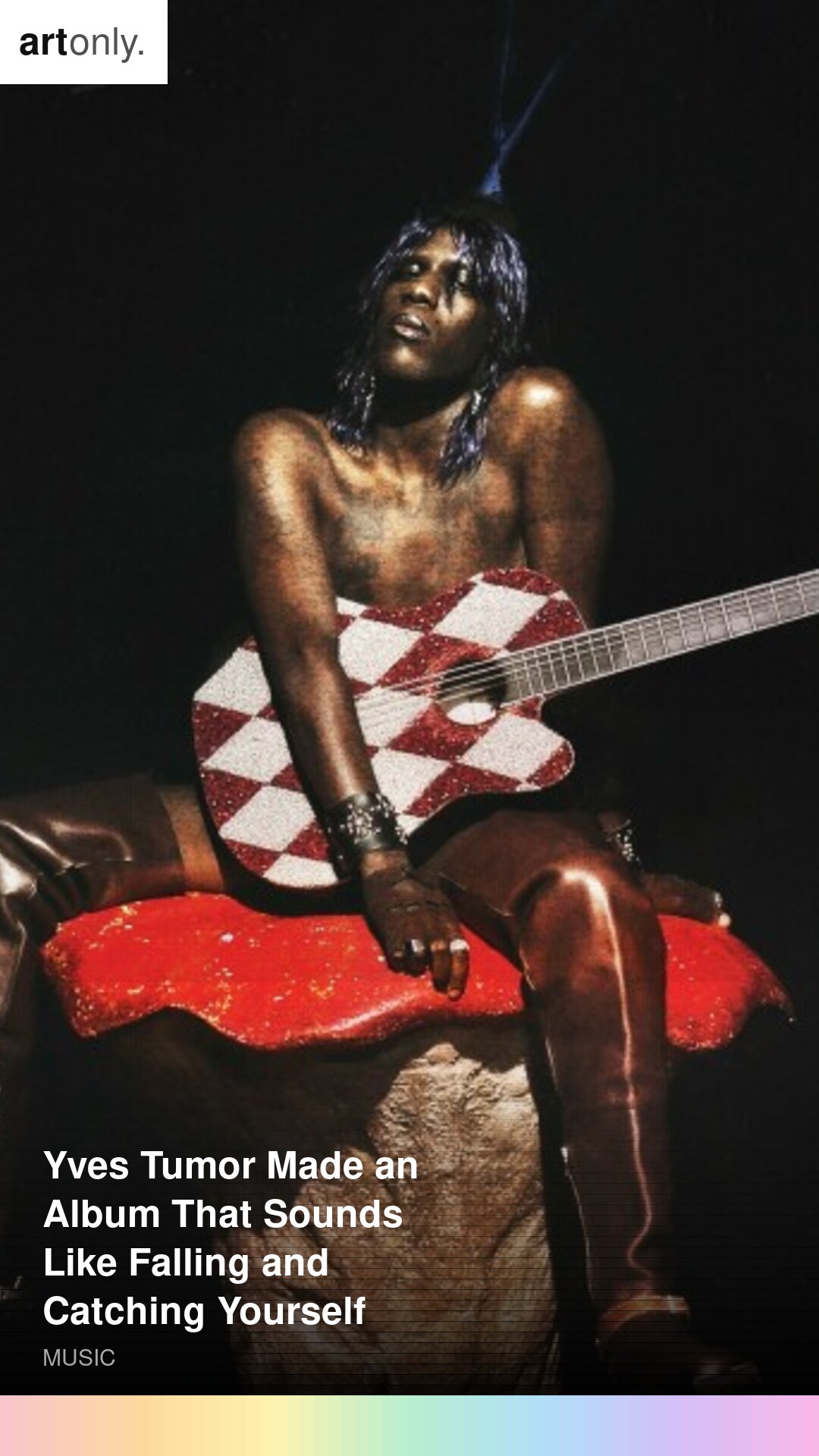
The cover art of Heaven to a Tortured Mind is doing similar work. It is not documentation. It is performance, costume, construction. The record is the sonic version of that construction: something built with great care to produce a specific kind of experience in whoever encounters it. The care is audible. This is not music that arrived by accident or through improvisation. It is the product of someone who understands exactly what they are doing and has the technical capability to execute it at a very high level. The danger and the dissonance are crafted, not stumbled into.
What I Keep Coming Back For
Falling and catching yourself. That sensation. Something about releasing the tension that holds you upright and then the involuntary response, the catch, the recovery, the moment of relief and adrenaline combined. This record gives me that, every time. I come back to it at specific times, not when I need music exactly, but when I need something to happen that the usual music cannot make happen.
The physical response it produces is reliable in a way that feels almost like a bodily function. I have stopped trying to understand why and just accepted that this is one of the things the record does. Some music explains itself to you. Some music just does something. Heaven to a Tortured Mind is in the second category entirely, and I mean that as the highest possible form of praise.
The Warp Records context matters for understanding the album's position in the landscape. Warp has spent thirty years releasing music that refuses easy categorisation while remaining connected to the formal traditions it departs from, and Heaven to a Tortured Mind fits that lineage while also extending it in a specific direction. The emotional directness of this particular record, the willingness to be genuinely vulnerable in a way that the more ironic or formally distant parts of the experimental canon avoid, gives it a quality that stands apart from the rest of that catalog. The dissonance between the distortion and the tenderness is the album's central formal achievement, and it is one that requires both the production vocabulary and the emotional courage to execute without one undermining the other.