Zanele Muholi calls themselves a visual activist rather than a photographer. The distinction matters. A photographer documents; a visual activist intervenes. The act of insisting on the visible presence of Black LGBTQ+ lives in South Africa, in images, in archives, in the history of representation, is an act that carries risk and requires commitment beyond the aesthetic.
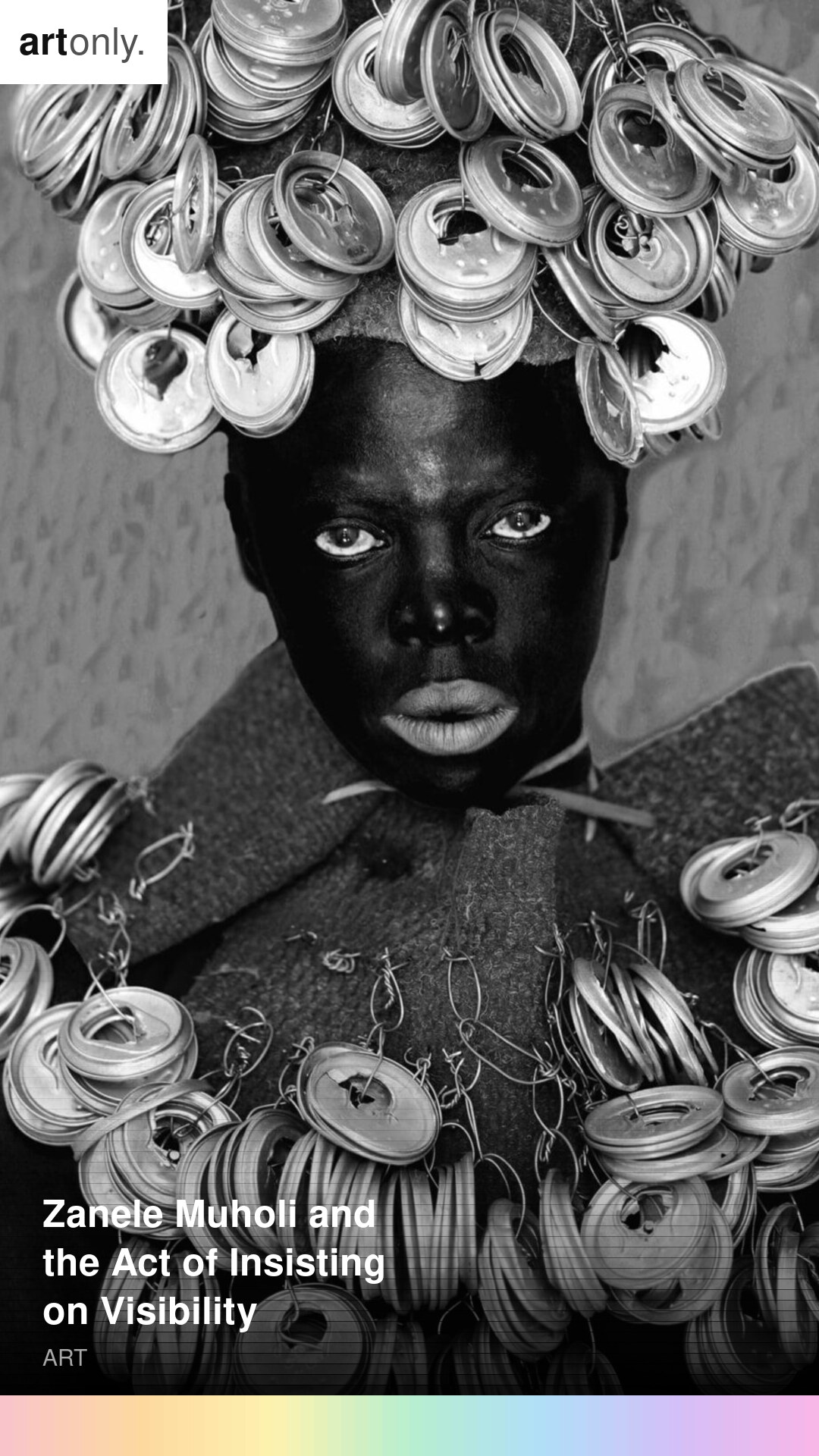
Muholi's Somnyama Ngonyama series, meaning "Hail the Dark Lioness" in Zulu, is where this visual activism takes its most confrontational form. These self-portraits, made in locations around the world over many years, feature Muholi with dramatically darkened skin, a manipulation of exposure and post-processing that intensifies the blackness of the skin to a degree that makes the viewer conscious of seeing Blackness, of the politics of what is seen and how.
This confrontational hypervisibility is itself a response to a history of invisibility, of erasure, of the literal absence of certain kinds of bodies and certain kinds of lives from the archive. To be made very visible, aggressively, undeniably visible, is to counter that erasure. In 2022, the exhibition "Being Muholi: Portraits as Resistance" at the Isabella Stewart Gardner Museum in Boston brought more than 50 works together, pairing the iconic black and white self-portraits with recent paintings and a sculptural bronze, the first museum exhibition to make that specific combination of forms visible in a single presentation.
The Portrait as Act
The individual portraits in Somnyama Ngonyama are among the more powerful things in contemporary photography. They use props and found materials, often sourced from the locations where they are made, to construct images that are simultaneously costume, commentary, and transformation. Muholi is depicted as warrior, as domestic worker, as archetype, as specific self, in images that refuse any single interpretive frame.
The scale at which these images are printed and exhibited matters. At life size or larger, the gaze of the subject meets the viewer's gaze directly, at eye level. You cannot look down at these images. You cannot maintain the power differential that smaller prints sometimes allow. The eyes in these portraits hold. They do not ask for sympathy or understanding. They simply exist, fully, with a presence that is its own argument.
Muholi's statement about the series is precise: "To me, Somnyama Ngonyama is one way of reckoning with this past, to address its politics of race, racism and colonialism, and it is also a way of addressing a past that still informs the present." The past that informs the present is not a metaphor. It is the specific legislative history of South Africa, the specific institutional history of how Black and LGBTQ+ bodies have been treated by systems of power, and the specific ongoing reality of violence against the communities Muholi documents.
Muholi's earlier documentary work, photographing the LGBTQ+ community in South Africa over more than fifteen years, provides the archive of community from which the more formally ambitious self-portrait series grows. The two bodies of work are in dialogue: the community and the self, the documentary and the constructed, the plural and the singular. Neither is complete without the other. The self-portraits gain their weight from what we know about the community. The documentary work gains additional dimension from the self-portrait series's formal ambition.
The World the Work Is Made In
South Africa has some of the highest rates of violent hate crimes against LGBTQ+ people in the world. "Corrective rape" is a documented phenomenon. The legal protections that exist on paper do not translate to safety in daily life for many of the people Muholi has been documenting.
The work is made in this context. It exists in response to this context. The beauty of the images, and they are beautiful, is not an aestheticization of suffering but a refusal to accept that suffering is the only story. The insistence on beauty, on dignity, on full visual presence, in the face of a world that has worked to deny these things, is itself a form of courage.
The materiality of the props is worth attention. Muholi uses electrical cables, latex gloves, cotton wool, combs, sponges, materials that carry associations with labor, with bodily care, with the infrastructure of daily life. Placed on a Black body in high-contrast black and white photography, these objects shift in meaning, become loaded with the histories of who has performed which kinds of labor and under what conditions. The transformation is achieved with objects that cost nothing. The power of the images does not depend on expensive materials or elaborate production. It depends on intelligence and intention, which is itself an argument about what photography is and what it is for.
The Archive as Resistance
The archive of community that Muholi has built is invaluable independent of its artistic quality, though the artistic quality is real and high. To have this documentation, these images of lives that have been systematically threatened and erased, is itself a form of resistance, a refusal of the invisibility that violence seeks to impose.
The photographs will outlast the hostility that made them necessary. They are already outlasting particular moments of that hostility. They are in collections, in institutions, in the permanent record of what was seen and documented and cared for enough to preserve. The visibility is the act. The preservation is the argument.
I am not sure "art" is the right word for work this embedded in necessity. But "art" is the frame that allows it to travel, to be seen, to make its argument in places it might not otherwise reach. Wherever it lands, the argument holds, and the eyes in the portraits hold the viewer in return.
The global reach of the exhibitions, which have traveled through institutions in Europe, North America, and Africa, raises questions about the relationship between the work's origin in a specific South African context and its circulation in gallery spaces whose audiences are primarily outside that context. Muholi has addressed this directly, arguing that visibility in global institutional spaces is itself part of the project, a way of making the argument in rooms where power accumulates and where the presence of these images changes what those rooms contain. The discomfort that the images can produce in certain contexts is not a side effect of their circulation. It is a purpose.