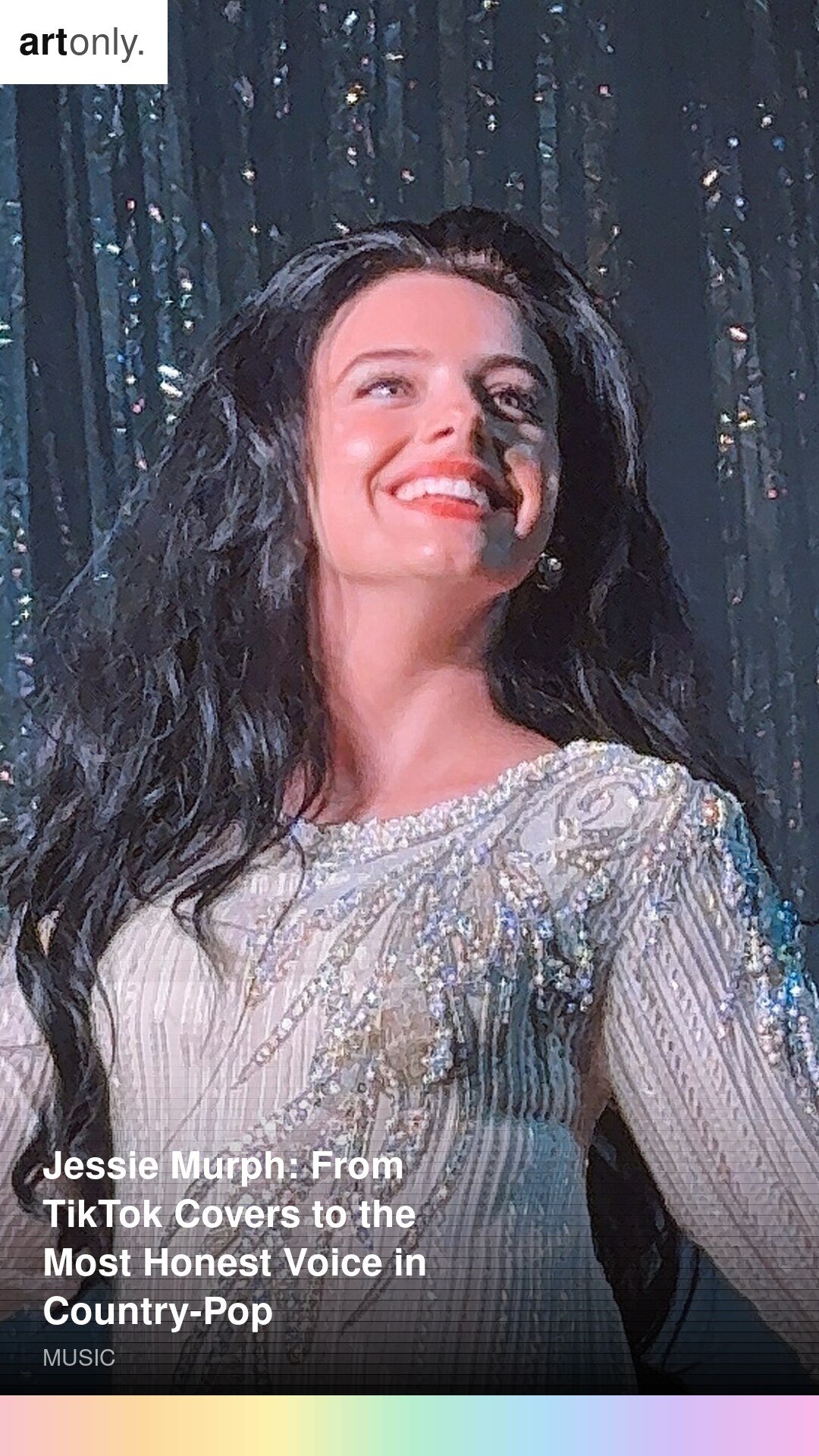
Jessie Murph was posting covers on TikTok when Columbia Records signed her at sixteen. That sentence sounds like a hundred other origin stories in the streaming era, and most of those stories end with a debut single that goes nowhere and a dropped contract. Jessie Murph's story went somewhere else entirely.
Her debut album That Ain't No Man That's the Devil arrived in 2024, a title that told you everything about the emotional register before you pressed play. The music was raw, Southern, and uninterested in the kind of commercial smoothing that major labels typically impose on teenage artists. It sounded like someone who had already lived enough life to write about heartbreak with authority.
Sex Hysteria and Blue Strips
Her second album Sex Hysteria followed in 2025 and produced Blue Strips, her first top-twenty Hot 100 single, peaking at number fifteen. The song's success was not algorithmic luck. It was the result of an artist who had spent years building a fanbase through consistency, live performance, and the willingness to be emotionally exposed in a way that most artists her age avoid.
Billboard named her to their 21 Under 21 list in 2025. Collaborations with Jelly Roll on Wild Ones in 2023 and Maren Morris on Texas later that year positioned her at the intersection of country, pop, and rock, a crossroads that few artists navigate without losing their identity.
Murph navigated it by refusing to choose. Her music is country when it wants to be, pop when it needs to be, and unflinchingly honest at all times. The voice is the constant, a instrument that carries more weight and texture than it has any right to at her age.
The Trajectory
From covers to Columbia to two albums to a top-twenty hit in the span of three years. The speed of Jessie Murph's ascent would be suspicious if the music were not so clearly the product of genuine talent and relentless work. She is not a manufactured moment. She is an artist who happened to be discovered through the same platform that launches thousands of disposable trends, and who has proven that she is anything but disposable.
The TikTok-to-Talent Pipeline and Its Discontents
The music industry's relationship with TikTok as a discovery mechanism has produced no shortage of cautionary tales. Artists who blow up on the platform face pressure to replicate a moment rather than develop a voice. The shelf life of a viral sound is measured in weeks, not careers. Murph's navigation of this minefield reveals something specific about how she understood her own situation from the beginning.
She used TikTok as a megaphone for a voice that already existed, not as a laboratory for manufacturing one. The covers she posted were chosen for their emotional resonance with her actual sensibility, not for their algorithmic friendliness. When Columbia came calling, she arrived with a clear artistic identity rather than the negotiable one that most label-groomed artists bring. That clarity was what protected the music when the commercial machinery got involved.
The Country-Pop Fault Line
Murph's comfort operating across genre borders is worth understanding in historical context. Country music has always been in negotiation with pop, and the results of that negotiation have rarely been simple. The debate over authenticity, what makes something country, who gets to claim the label, where the line between genre evolution and dilution sits, has defined much of the conversation around Nashville for decades.
Murph enters this debate from an interesting angle. She is too young to have a defensively purist relationship with any single genre, and her Georgia upbringing gives her a grounded connection to the Southern emotional vocabulary that country music draws from. When she makes something that sounds country-adjacent, it is because those sonic and lyrical traditions are genuinely part of how she hears the world, not because a label executive identified a demographic opportunity.
This makes her a different proposition from most artists navigating similar territory. Compare her trajectory to the gradual crossover work being done by artists like Chappell Roan, who built a breakthrough on a very different but equally specific artistic identity. Both cases illustrate the same principle: the artists who survive the moment-of-discovery pressure are the ones who arrived with something to say rather than a template to execute.
Why the Voice Matters Most
Everything about Jessie Murph's career operates in service of the voice, and the voice earns the attention. It is technically powerful, the range and control are there, but what distinguishes it is the grain. There is a quality in her delivery that suggests weathering, as if the tone has been earned through experience rather than trained in a studio. Whether this is natural or cultivated is beside the point. The effect is that you believe her, and in country music and country-adjacent pop, belief is everything.
The debut album proved she could sustain it across a project. Sex Hysteria proved she could build on it. The question now is what she does with the mainstream visibility that Blue Strips delivered, whether she uses it to go wider or deeper. Given what she has done so far, the smart money is on deeper.
The Live Proof
No element of Jessie Murph's story is more important than what she does on stage. The voice on record is compelling. Live, with the grain and weight amplified by the directness of performance, it becomes something harder to ignore. This is the difference between an artist whose success makes sense when you encounter it in person, and one whose success makes sense only in the context of algorithms. Murph is emphatically the former, which is why her audience keeps growing between albums rather than waiting for the next single to materialise on their playlists. She has built a concert artist's career through a streaming-era pathway, which is a harder trick than it looks and suggests the longevity is real.