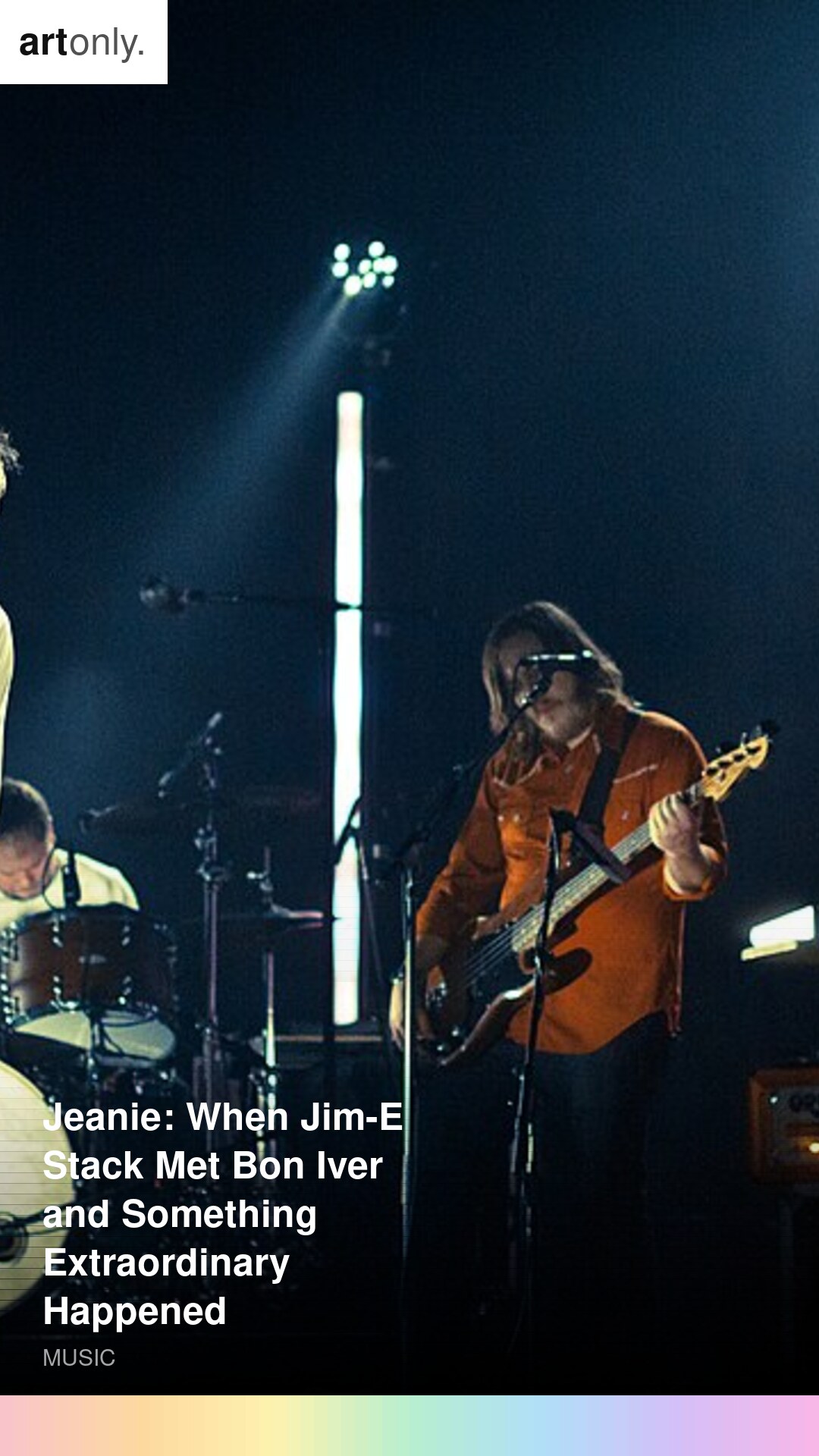
Some collaborations make sense on paper but fail in practice. Others make no sense on paper and produce something transcendent. Jeanie, the collaboration between electronic producer Jim-E Stack and Bon Iver, falls into a rarer third category: a pairing that makes perfect sense to anyone who has been paying attention, and that delivers on every expectation.
Jim-E Stack, the production alias of James Stapleton, has spent years building a reputation for atmospheric, textured electronic production that exists in the space between ambient and pop. Bon Iver, the project of Justin Vernon, needs no introduction but deserves one anyway: he is one of the most influential vocal artists of the past two decades, a musician who has continuously expanded the definition of what a voice can do inside a song.
Jeanie is what happens when these two sensibilities meet.
The Sound
The track, featured on Jim-E Stack's album EPHEMERA, is built on a production that shimmers and pulses without ever becoming aggressive. It breathes. Vernon's voice sits inside the mix rather than on top of it, treated as another texture rather than a lead instrument. This is a deliberate choice, and it works because both artists understand the same principle: space is a sound.
At two minutes and forty-seven seconds, Jeanie does not overstay. It arrives, it moves through you, and it leaves. The brevity is part of the beauty. There is no bridge that outstays its welcome, no final chorus that beats the hook to death. The song trusts its own atmosphere enough to let it be enough.
Why It Matters
EPHEMERA as an album featured several high-profile collaborations, but Jeanie stands apart because the collaboration is genuinely symbiotic. This is not a feature in the conventional sense, where a famous voice is parachuted onto a track to boost its visibility. This is two artists occupying the same space and discovering that the space is larger than either of them could have created alone.
The result is one of those songs that defies playlist categorization. It is not quite electronic. It is not quite folk. It is not quite ambient. It is all of these things at the edge of their definitions, which is precisely where the most interesting music lives.
Justin Vernon's Guest Appearances as a Curatorial Act
Vernon has an unusual relationship with collaboration that makes his appearances on other artists' work worth examining carefully. He is not a serial feature artist in the conventional sense. He does not lend his voice to tracks for commercial benefit, and his guest appearances are few enough to function as genuine endorsements. When Vernon appears on your project, it means something about the project.
His collaborations tell a story: Kanye West on My Beautiful Dark Twisted Fantasy, where Vernon's falsetto provided counterweight to the grandiosity around it. James Blake across multiple projects, where two artists committed to vocal processing found common cause. Taylor Swift on Exile, where his baritone created a specific kind of duet tension. In each case, the Vernon appearance elevated the track's ambition by signalling that the project was serious.
His appearance on Jeanie functions the same way. It tells you this is not ambient wallpaper or playlist bait. It is music that operates with the kind of intentionality that Vernon recognises and responds to.
The Atmospheric Tradition
Jim-E Stack's work on EPHEMERA sits within a lineage of producers who have treated the album as an environment rather than a collection of songs. This approach has precedent in Eno's ambient albums, in the work of Harold Budd, in the more recent output of producers like Four Tet and Jon Hopkins. What distinguishes EPHEMERA within this tradition is its willingness to introduce human voices, not as foreground elements, but as additional textures within the sonic environment.
This approach echoes some of what Fred Again.. does with voice memo samples, the idea that human speech and song are materials to be arranged rather than messages to be transmitted. The difference is that where Fred Again.. foregrounds the emotional content of those voices, EPHEMERA treats them as compositional elements first and emotional content second. Both are valid approaches. They produce very different kinds of listening experiences.
The Short Song Problem
Jeanie's two-minute-forty-seven runtime is worth addressing directly because the tendency in contemporary electronic music is toward length, toward extended builds and extended releases and extended sets. Brevity reads as a statement. It says the artist trusted the idea enough not to inflate it.
The best brief tracks in electronic music share this quality: they arrive complete, with no sense that something has been withheld. Jeanie is complete. Like the quieter moments in André 3000's solo work, it demonstrates that restraint is not limitation. It is a compositional decision with its own kind of authority.
Listen on SpotifyThe Album as Environment
EPHEMERA functions most effectively as a complete listening experience rather than a collection of individual tracks, and Jeanie earns its place within that structure rather than simply standing apart from it. The album builds an atmosphere across its runtime that Jeanie momentarily concentrates and clarifies. Returning to the track after listening to the full album, you hear it differently, charged with the context that surrounds it.
This is the argument for the album as a format in an era when the format is under significant commercial pressure. A collection of tracks that function better together than separately is making a claim about the value of sustained listening that streaming's skip-rate metrics actively work against. EPHEMERA makes that claim quietly and persuasively, and Jeanie is the moment where the claim is most audible. For comparable atmospheric construction using the album as environment, Toro y Moi's Hole Erth makes a similar argument from a different genre position.