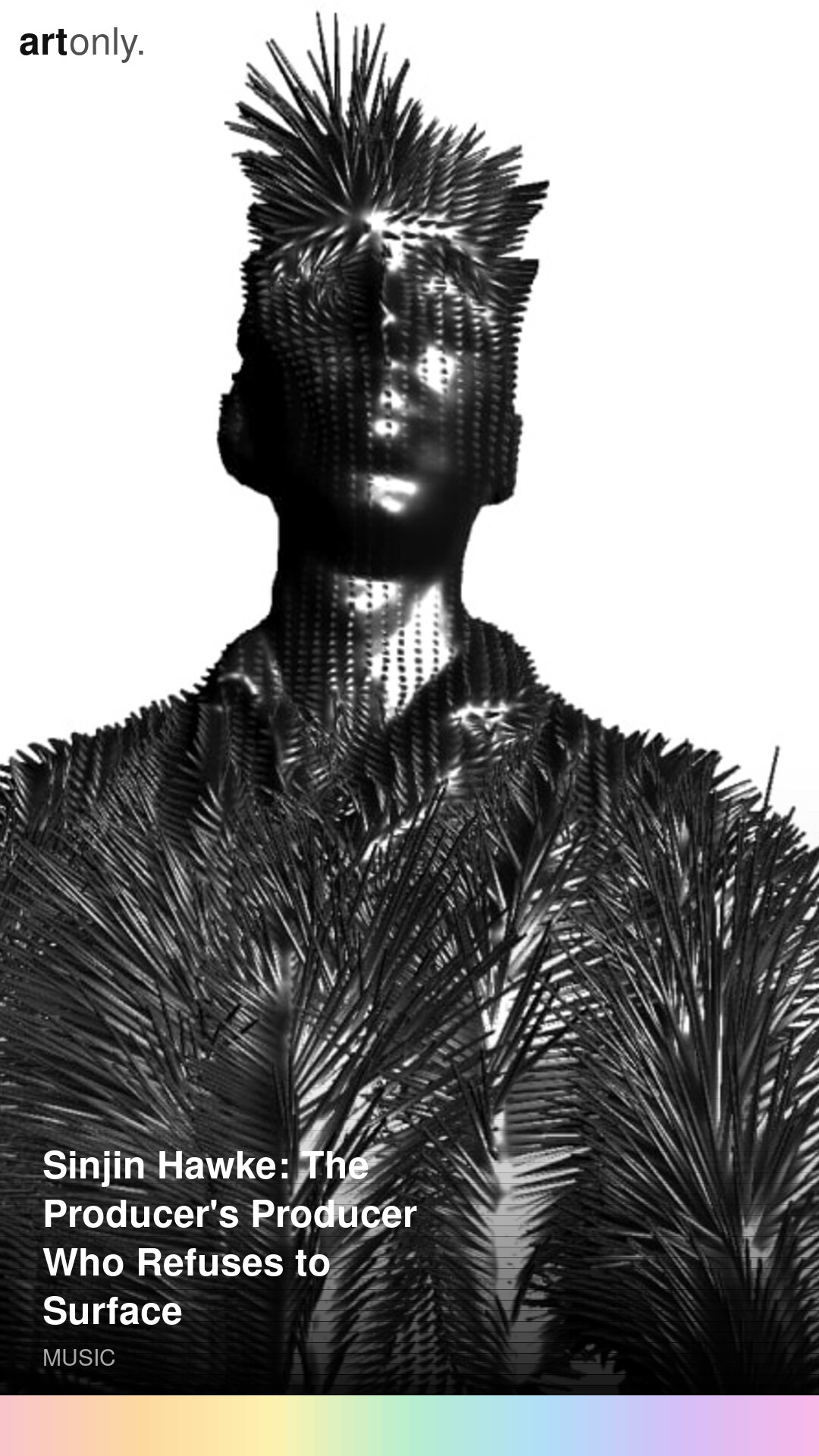
There is a tier of electronic music production that exists below the surface of mainstream visibility but above the underground in terms of influence. Sinjin Hawke lives there, and he seems entirely comfortable staying.
The Canadian-born, Barcelona-based producer has built a career on sonic architecture that other producers study and absorb. His work with Zora Jones, particularly the Vicious Circles EP in 2018, established a production language that blends club music's physicality with a compositional ambition that borders on classical. The sounds are massive. The structures are intricate. The result is music that fills a room differently than anything else.
The Influence Gap
Sinjin Hawke's influence outpaces his visibility by a significant margin. The production techniques he has developed, the way he layers bass frequencies, the spatial design of his mixes, the integration of vocal processing with rhythmic elements, can be heard across contemporary electronic and hip-hop production. But his name recognition among general audiences remains minimal.
This is partly by design. Hawke has not pursued the kind of commercial output that would raise his profile. His releases are infrequent and deliberate. His live appearances, including events like body2body in Toronto in 2025, are selective. He produces on his own timeline.
2025 Activity
Recent tracks including Kill Da DJ with Bobby Skillz have shown that the production quality remains as formidable as ever. The bass is heavier. The textures are more refined. The ambition has not decreased with time.
But a major solo album has not materialized since the early work that established his reputation. Whether this is restraint, perfectionism, or a deliberate rejection of the album format is unclear. What is clear is that when Sinjin Hawke releases music, the production community pays attention in a way that few other artists command.
The Position
Sinjin Hawke is the kind of artist who makes other artists better. His contribution to electronic music is measured not in streams or chart positions but in the sonic possibilities he has opened for everyone working in the space around him. That is a different kind of legacy, and for some artists, it is the only kind that matters.
Barcelona and the Diaspora of Influence
Hawke's relocation from Canada to Barcelona is worth noting as more than biographical detail. The city has become, over the past decade, one of the more interesting incubators of experimental club music in Europe, partly because of its position as a crossroads of Northern European techno influence, Southern European rhythmic traditions, and a substantial international artist community that brings production approaches from across the world into proximity. Sonar, the annual festival that has made Barcelona a pilgrimage destination for electronic music professionals, functions as a meeting point where production conversations happen that do not happen anywhere else.
Hawke exists comfortably in this environment because his production philosophy has always been more interested in spatial and compositional questions than in genre classification. The Vicious Circles EP worked in 2018 not because it belonged to an identifiable genre but because it occupied physical and emotional space with unusual authority. That authority travels across contexts, it sounds as correct in a Barcelona warehouse as it would in a Toronto club or a Berlin basement.
The Zora Jones Collaboration as Model
The Hawke/Jones working relationship, which produced Vicious Circles and has continued intermittently since, is a model for a kind of production collaboration that the electronic music world rarely discusses adequately. Both artists have distinct production voices that are simultaneously complementary and in productive tension. The music they make together is not a compromise between two styles. It is a third thing that neither could make alone.
This is a rare achievement. Most production collaborations produce work that sounds like one artist's template with contributions from another. The Hawke/Jones material sounds genuinely co-authored in a way that can be heard rather than merely asserted. The spatial design is Hawke's. The melodic and harmonic sensibility is more Jones-inflected. But the combination creates a logic that belongs to neither and both simultaneously.
The comparison point is the Jim-E Stack and Bon Iver collaboration on Jeanie, where two artists occupy the same space and discover that the collaboration produces a territory larger than either brought to it. Both cases demonstrate that the most productive collaborations are the ones where neither participant is subordinated to the other's vision.
What a Sinjin Hawke Album Would Sound Like
The absence of a major solo album from Hawke is one of electronic music's more tantalizing incompletions. The evidence available, the Vicious Circles material, the collaborative tracks, the live performances, suggests a producer whose compositional thinking operates on a scale that does not fit easily into the EP format. The question of whether Hawke is building toward something or has made a deliberate decision to work in shorter forms rather than album-length statements remains genuinely unanswered.
What is certain is that the production language he has developed would support an album-length argument. The spatial design and frequency control that define his work create listening environments that reward extended engagement. A full-length Sinjin Hawke solo album would not be a collection of club tracks. It would be a listening experience with its own internal logic and, probably, its own architectural demands.
The electronic music world is richer for having producers who operate outside the album-release cycle that mainstream commercial expectations impose. André 3000's decision to release a flute album with no commercial logic was celebrated precisely because it demonstrated that great artists can make defining work on their own terms, indifferent to commercial structure. Hawke's refusal to operate on any timeline other than his own belongs to the same tradition. The question is not when the album will come. The question is what form his next statement will take, and whether it will finally make his name recognizable to audiences who have been absorbing his influence without knowing the source.